Get Full Government Meeting Transcripts, Videos, & Alerts Forever!
Get email alerts on the Town And Gown Cup Response topic
No spam. Unsubscribe anytime.
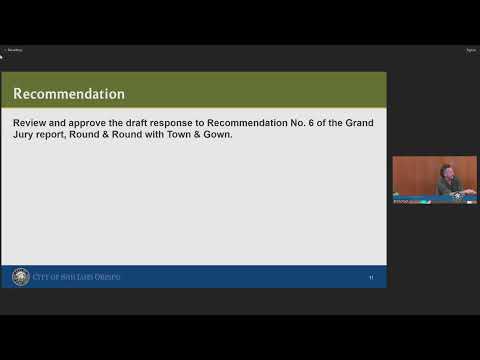
Planning commission approves staff response to grand jury recommendation on 'town and gown' CUP consistency
Summary
The commission voted to approve a draft response to Recommendation 6 of the 2024–25 grand jury report 'Round and Round with Town and Gown,' saying the city has implemented updates to conditional use permit practices to the extent practical and will continue coordination with Cal Poly and enforcement partners.
The San Luis Obispo Planning Commission voted to approve a draft response to Recommendation 6 of the grand jury report titled "Round and Round with Town and Gown," which urged the city to adopt more uniform conditions for conditional use permits (CUPs) related to fraternities and sororities and consider increased enforcement resources.
Staff told commissioners the draft response, which the commission approved, states the recommendation has been implemented to the extent practical and appropriate. The city’s reply will be forwarded as required; a full response to the grand jury is due Sept. 19, 2025, staff said.
Timmy Tway, director of community development, and Tyler Corey, deputy community development director, presented the item. They said the city completed a comprehensive zoning update in 2018 that included the land-use chapter addressing fraternities and sororities and has used that code update in recent re-reviews of several CUPs over the last year. Corey summarized the city’s position that CUP enforcement is complaint-based and that current staff levels do not allow for routine proactive enforcement in most cases.
John Mizzapessa, code enforcement supervisor, described limitations the city faces in linking on-site events to fraternity operations. He said Cal Poly provides an annual report under state law that lists locations the university recognizes as fraternity or sorority sites, but the university no longer lists event addresses in its party-registration reporting. That change, Mizzapessa said, makes it harder for city staff to verify whether a reported event was a sanctioned fraternity or sorority event and to pursue land-use violations tied to fraternity activity.
Commissioners asked whether additional staff would resolve enforcement gaps. Corey and Mizzapessa said staffing alone may not be sufficient because enforcement requires verifiable information tying an event to fraternity operations; they described outreach efforts with Cal Poly and landlords and said staff will continue to seek better information-sharing with the university. Staff estimated fraternity/sorority-related complaints represent roughly 6.5% of complaints requiring follow-up; the complaint program is otherwise complaint-driven.
During discussion commissioners noted the matter’s complexity and the need for multi-party collaboration, including Cal Poly, landlords, student organizations and city departments. Commissioners also mentioned interest in longer-term solutions such as designated Greek-row housing or other land-use strategies but did not adopt specific new policy at the meeting.
A motion to approve the draft response to Recommendation 6 was seconded and passed on a roll call vote with Commissioners Jorgensen, Munoz Morris, Flores and Vice Chair Eric Tolley recorded as voting yes. Staff said City Council will consider other recommendations from the grand jury on Sept. 16, and the recommended Planning Commission response will be forwarded as part of the city’s required replies.