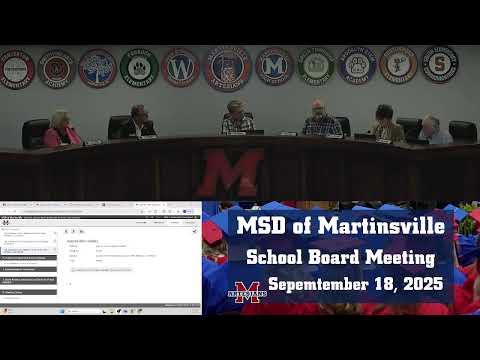
MSD Martinsville treasurer outlines $58.8M proposed 2026 budget, board schedules adoption Oct. 9
Loading...
Summary
District treasurer Whitney Kuzma presented a proposed 2026 budget totaling about $58.8 million, with the education fund accounting for roughly 57% and the operations and debt-service funds the remainder. The board will vote to adopt the budget Oct. 9; the Department of Local Government Finance will review and issue the statutory notice by Dec. 31.
Whitney Kuzma, district treasurer for the Metropolitan School District of Martinsville, presented the district’s proposed 2026 budget during a required budget hearing and told the school board the district will seek formal adoption on Oct. 9.
Kuzma said the district’s total proposed budget is approximately $58,800,000, with roughly $33,600,000 (about 57%) in the education fund, $16,300,000 (about 28%) in the operations fund and $8,800,000 (about 15%) in the debt-service fund. She said the district advertises a higher tax rate than it expects to use to allow flexibility during the state review process.
The proposal reflects the district’s budgeting approach of estimating expenses conservatively and revenues modestly: “The budget cycle is 18 months in all,” Kuzma said, noting the district reviews the previous six months and projects the next 12 months when preparing figures.
Why it matters: The education fund pays instructional costs and teacher compensation and is driven primarily by ADM, the district’s enrollment figure. The operations fund is funded largely by property taxes and any transfers from the education fund; those transfers have historically ranged from about 12% to 14% (statutorily capped at 15%). Debt-service funding is supported primarily by property taxes. Kuzma said the district will advertise a higher levy to avoid underestimating revenue, then reduce it during the state’s review.
Key details and next steps - Proposed total: $58,800,000. - Education fund: ~$33,600,000 (approx. 57%) — primarily instructional costs and teacher pay tied to ADM. - Operations fund: ~$16,300,000 (approx. 28%) — facilities, utilities, contracted services and some operational salaries; transfers from education typically 12–14% (statutory cap 15%). - Debt service: ~$8,800,000 (approx. 15%) — repayment of bonds and lease rental funded by property taxes. - Board adoption scheduled for Oct. 9; the state Department of Local Government Finance (DLGF) will review and is expected to issue the statutory 1782 notice by Dec. 31, per Kuzma’s presentation.
Kuzma explained revenue drivers and risks: average daily membership (ADM) — enrollment measured in February and October — is the largest single revenue source for the education fund; net assessed value (NAV) and circuit-breaker losses affect operations and debt-service capacity; and other revenues such as excise and vehicle taxes, interest, facility rental and local income tax are variable.
Kuzma warned of uncertainties that affect planning: inflation, insurance and salary increases, utility cost volatility, state mandate changes, enrollment shifts and potential litigation. She said the district projects expenses conservatively and revenues on the low side to manage those risks.
Board members raised no objections during the hearing. The board is scheduled to vote to adopt the budget at its Oct. 9 meeting; Kuzma said the district expects DLGF review and issuance of the required notice by Dec. 31.
The treasurer’s presentation and the board’s adoption vote are steps in the statutorily required budget process; Kuzma said the district will continue adjusting the budget during the state review period.