Get Full Government Meeting Transcripts, Videos, & Alerts Forever!
Get email alerts on the Homeless Needs Assessment 2025 topic
No spam. Unsubscribe anytime.
Controller’s draft needs assessment: inflow outpaces exits, single adults show high behavioral-health needs
Summary
The draft 2025 Homeless Needs Assessment presented to the committee finds that inflow into homelessness is outpacing exits, with single adults accounting for the largest share of people experiencing homelessness and higher rates of behavioral-health needs; families and TAY counts rose, in part because of methodology changes.
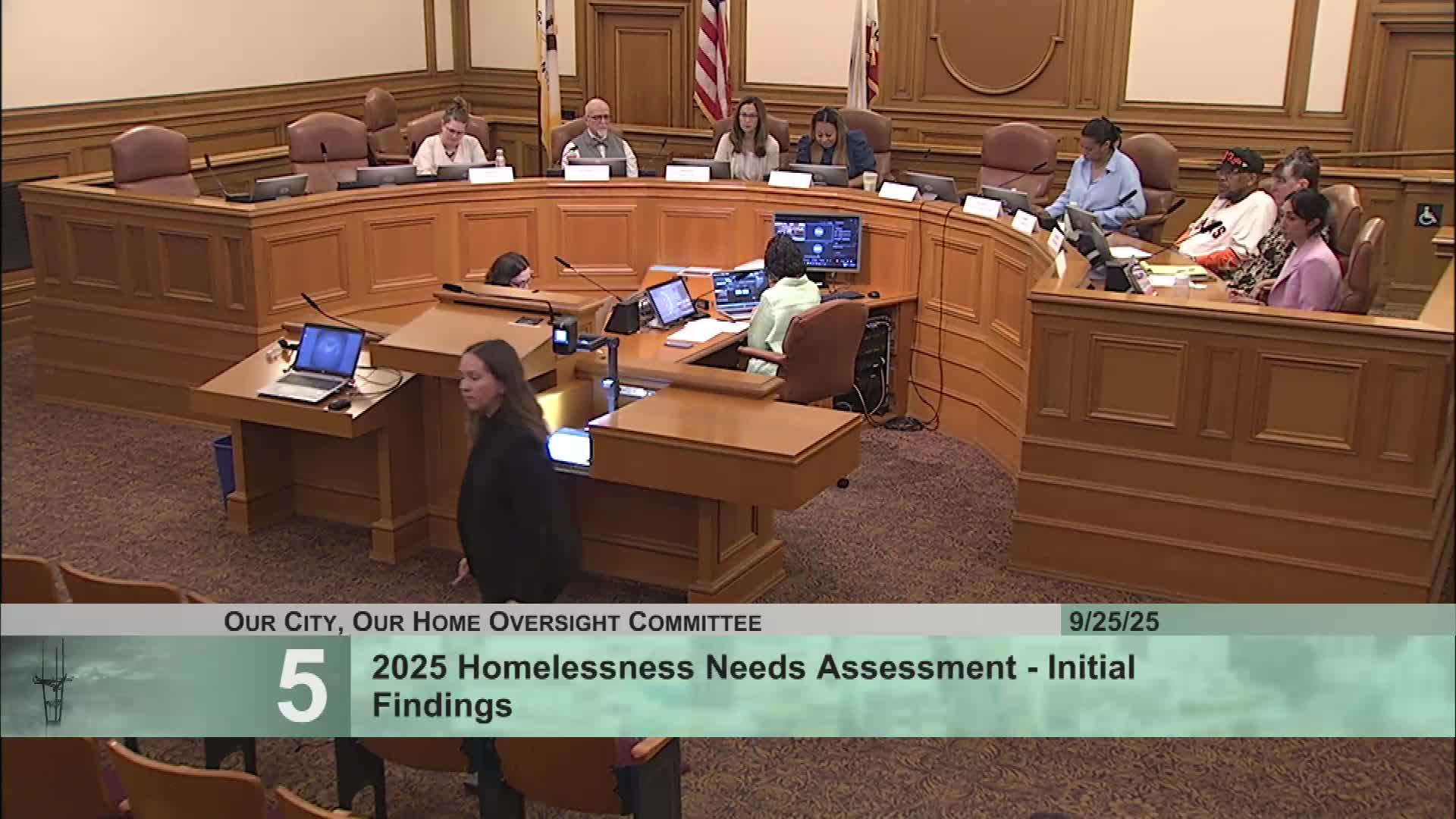
The controller’s office presented initial findings from the draft 2025 Homeless Needs Assessment to the Our City, Our Home Oversight Committee on Sept. 25, emphasizing that inflow into homelessness appears to outpace exits and that program inventory and service types may need adjustment.
“This assessment found that higher shares of single adults face health barriers in comparison to families,” the presentation said, summarizing a range of linked administrative data, the 2024 point-in-time (PIT) count and qualitative sources. The assessment reported about 7,000 households counted during the 2024 PIT; when annualized to reflect inflow and service use throughout the year, the report estimated roughly 20,000 households experienced homelessness in 2024.
Key findings the controller’s staff flagged: the PIT showed a roughly 7% increase in homelessness since 2022 driven largely by an increase in sheltered homelessness; family homelessness increased substantially (about 82%), a change the authors said was partly attributable to a methodology change that identified more families; and the inventory of emergency shelter and transitional housing on the night of the PIT covered about half of people in need (roughly 4,000 beds available and 4,000 people in shelter/transitional housing that night). The assessment also drew on DPH data estimating that more than 16,000 unhoused individuals had a serious mental health and/or substance use diagnosis in 2024.
The draft assessment identified that single adults — who represent the majority of people counted — have higher shares of acute-care needs (serious mental illness, substance use disorder, developmental disability and chronic homelessness) and higher shares of physical health and disability needs. Families, while smaller in count, were more likely to be younger and to report fleeing domestic violence and to need confidential and family-sized housing options; the assessment also noted that families face specific barriers such as lack of documentation, larger unit size needs and income disqualification for some subsidies.
The assessment concluded that despite increased shelter and housing capacity, unsheltered homelessness was largely unchanged and that the system is seeing a high rate of inflow. It recommended aligning inventory with the changing needs of populations: more prevention and housing-stabilization services for people at risk; interim housing with supports or permanent supportive housing for single adults with acute needs; and targeted short-term financial and rapid-rehousing supports for families.
Committee members asked for more detailed data and follow-up. The controller’s office said the assessment is a draft; the full draft and data appendices will be posted and the committee would receive materials in advance of a planned October deep dive and a November action to finalize a committee cover letter or comments for publication. Members requested additional breakdowns — for example, household versus individual counts, cross-tabs on length of homelessness and behavioral-health indicators, school-district student homelessness data, and geographic inflow analysis that identifies where people were housed previously. The committee also suggested the coordinated-entry operators present on intake questions and prioritization rules at a future meeting to better understand inflow, prioritization and whether length-of-time and place-of-origin information is being captured at intake.