Get Full Government Meeting Transcripts, Videos, & Alerts Forever!
Get email alerts on the Behavioral Health Investments topic
No spam. Unsubscribe anytime.
DPH details $42 million in behavioral health spending, warns of a future operating 'cliff'
Summary
The Department of Public Health outlined nearly $42 million in new behavioral health program funding over two years, multiple capital acquisitions and a projected $40 million operating shortfall in FY 2027–28 if one-time funds are not replaced.
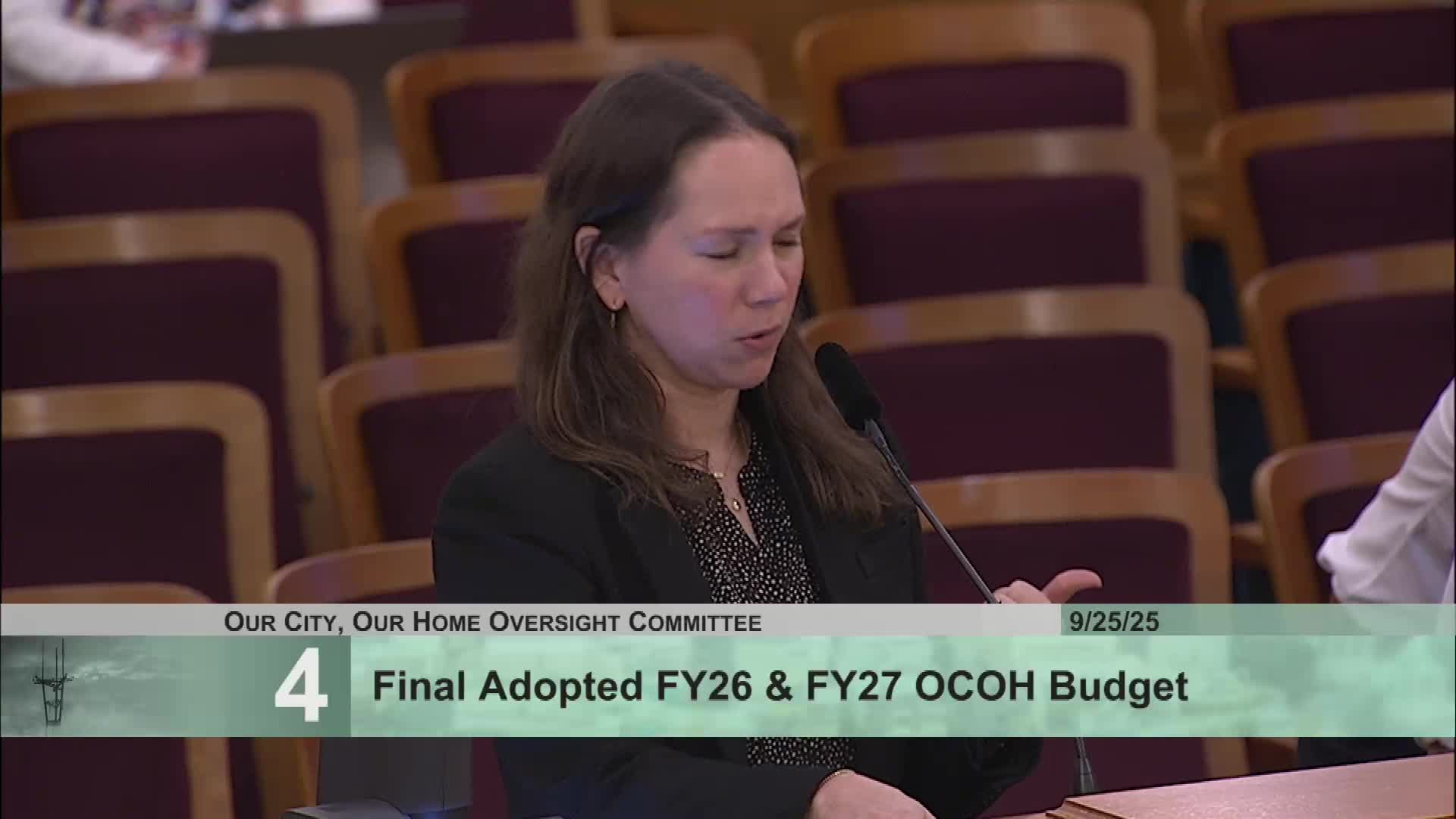
Department of Public Health (DPH) staff told the oversight committee on Sept. 25 that the adopted two-year budget includes about $42 million in new behavioral health programming and operating support, and that the department faces a potential $40 million operating shortfall in fiscal year 2027–28 without new revenue or underspend reconciliations.
“Our adopted budget for the next 2 years, continues our mental health spending as previously budgeted in prior years and added to it additional programming. We added $42,000,000 over the 2 year budget, about $20,000,000 a year, for new programs that were kind of shovel ready and are actually operating now,” DPH presenter Radhika said during her summary.
DPH described several capital and operating investments funded in part with local Proposition C dollars and state grants: funding to open roughly 180 new residential care and treatment beds (including the Eleanor Fagan Center, also called the Keane Hotel, and Wells Place — the Marina Inn operated by the Salvation Army), operating funding included for 44 residential care facility beds at a purchased site at 601 Laguna Street, and ongoing work on the Treasure Island Behavioral Health Building (a new ground-up facility expected to open in 2028). DPH also reported purchasing 1660 Mission for a Health Recovery and Connection Center that will co-locate outpatient behavioral health, buprenorphine treatment access, City Clinic services and drop-in supports; the 1660 Mission item was pending a full board vote at the time of the committee meeting.
Radhika said DPH has drawn down significant state capital awards and other one-time funding since 2022. “We were awarded almost $30,000,000 in Prop 1 Bond B CHIP funding...and we have been awarded over $88,000,000 in state capital funding for behavioral health projects since 2022,” she said.
DPH staff cautioned the committee that the two-year plan relies on one-time fund balance and acquisitions; the department projected a “$40,000,000 one-time cliff in fiscal year 'twenty seven-'twenty 8” for operating funding if new revenue projections or reconciled underspend are not realized.
Committee members asked for data on implementation timelines and outcomes. Member Walton asked the department to return with outcome data tied to street response and other front-line programs; committee members said that outcome and stability metrics would help prioritize investments if revenues tighten. DPH staff said they would provide more detailed implementation timing and noted the department is actively pursuing state and other capital grants to support projects in the pipeline.
DPH described new program openings already in service and ramping up: the Gary Stabilization Unit (opened April 2025), Wells Place recovery housing (62 beds), residential care facilities at purchased properties (601 and 624 Laguna), and longer-term projects tied to the Treasure Island facility and 1660 Mission.