
Orem council candidates debate State Street growth, neighborhood protections and city finances
Get AI-powered insights, summaries, and transcripts
Sign Up Free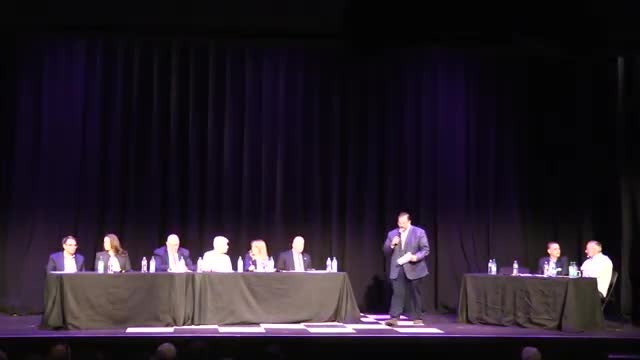
Summary
At a candidate forum hosted by the Utah Valley Chamber at the CIRA Center for the Arts, Orem City Council candidates focused on growth on State Street, protecting neighborhoods and the city’s sales-tax–driven budget, while offering competing proposals for enforcement and community engagement.
At a candidate forum at the CIRA Center for the Arts in Orem, candidates for Orem City Council debated growth management, State Street zoning, neighborhood protections and city finances in front of a Chamber-hosted audience.
The forum, moderated by Curtis Blair of the Utah Valley Chamber of Commerce, opened with one-minute statements from each candidate and moved to audience-sourced questions. Incumbent Councilwoman Lynnae Millet and incumbent Councilman David Spencer defended the council’s recent interventions on State Street and presented low-tax stewardship as a priority. Challenger Quinn Mecham, and other challengers, emphasized citizen engagement and neighborhood quality-of-life issues.
“State Street right now, we have a thing in our State Street Mass Fund that we need to beautify State Street,” Councilman David Spencer said, saying the council previously placed a moratorium that removed a plan he said would have allowed “10,000 high density apartments” along State Street. He argued the city’s sales-tax revenue depends on keeping commercial frontage on the corridor. “The mall in 13 South… is 42% of our sales tax,” Spencer said when describing the city’s revenue anchors.
Incumbent Lynnae Millet said the council removed an earlier State Street master plan that she said pushed for mixed-use redevelopment and higher buildings close to the road. “We returned that to commercial infrastructure. That’s our economic engine,” Millet said, adding the council has sought beautification and resisted high-rise conversions that she said would harm neighborhoods.
Candidates offered differing proposals for State Street. Quinn Mecham called for more pedestrian-friendly spaces and a citizens’ advisory commission drawn by random selection to provide regular resident input. “I would love to see a citizen advisory commission that is randomly selected every year… to come and weigh in,” Mecham said. Multiple candidates agreed on the need to balance growth with neighborhood character, though they described different tools to get there.
Quality-of-life enforcement—noise ordinances, light pollution and property upkeep—was a recurring concern. Mecham and several others urged stronger enforcement of existing regulations and better buffers between commercial development and residences. “We have places with light pollution… and so we don’t have sufficient buffers for some of that traffic noise,” Mecham said. Candidate Crystal Muellstein urged residents to use the city’s online reporting tool, Citizen Connect, to flag violations for the neighborhood improvement team.
When asked about city finances, candidates pointed to sales tax and anchor businesses as central to Orem’s budget. Spencer highlighted recent capital projects he described as debt-free: a $37,000,000 city center and a 10,000,000-gallon water tank. Several candidates praised the city’s grant-seeking and budget management; challenger Angela Moulton said she saw “no property tax increase in years” and praised city staff for creative funding approaches.
First-responder staffing and pay also featured in the discussion. Doyle Mortimer said Orem “worked very hard to bring the pay level of our first responders back up to a competitive level,” but added he sees continuing understaffing and suggested more citizen involvement in public-safety partnerships.
Candidates addressed small-business support and the role of State Street as a collection of locally owned businesses. Multiple speakers said the city should protect and support the small-business ecosystem on State Street while encouraging targeted beautification that does not force displacement.
The forum repeatedly returned to themes of community connection and civic tone. Several candidates described divisiveness and recent localized tragedies as reasons to prioritize belonging and civic listening. “We need to make sure that residents know that they are valued and that their opinion matters,” challenger Crystal Muellstein said.
No formal actions or votes were taken at the forum. The event concluded with 90-second closing statements and an invitation for post-forum mingling.
Votes at a glance: none — the event was a candidate forum and included no legislative motions or council votes.