Get Full Government Meeting Transcripts, Videos, & Alerts Forever!
Get email alerts on the County Meeting Highlights topic
No spam. Unsubscribe anytime.
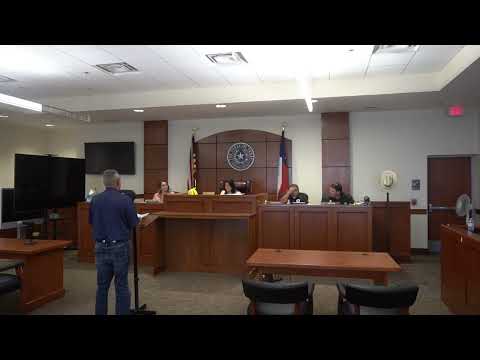
Dimmit County court approves $250,000 meal‑delivery grant; tables battery project and hears proposal for large AI data center
Summary
At its Sept. 22 meeting, the Dimmit County Commissioners Court certified a $250,000 county grant needed for a Texas Department of Agriculture home‑delivered meals application, accepted a state game warden's update on pond enforcement, tabled a proposed 1‑megawatt battery energy storage permit pending site visits, and heard a long presentation from
Dimmit County Commissioners Court met Sept. 22 and took formal steps to certify a county grant that will allow a local provider to apply for Texas Department of Agriculture home‑delivered meals funds, considered enforcement and conservation options for a popular county pond, tabled action on a proposed battery energy storage (BESS) project while scheduling site inspections, and heard an initial pitch for a major private proposal to build an AI data center on a 5,200‑acre ranch.
Why it matters: The decisions and discussions affect services for homebound elderly residents, local public‑safety and natural‑resource enforcement at a county lake, the siting and community review of energy projects that bring questions about safety and grid impacts, and a proposed development with long‑term implications for jobs, water use and county tax revenues.
County certifies grant application for home‑delivered meals
The court unanimously approved a resolution certifying a county grant of $250,000 to permit Community Service Agencies of South Texas (named in the resolution) to apply to the Texas Department of Agriculture’s Home Delivered Meal Grant Program for program year 2026. The resolution states the county certifies that the organization provides home‑delivered meals to homebound persons who are elderly or have a disability and that the county has approved the organization’s accounting system or fiscal agent per the Texas Comptroller’s grant management rules. County Judge Arthur Lucia Fonce introduced the resolution; a motion to adopt carried without recorded opposition.
Game warden clarifies state jurisdiction, court weighs fish‑management options
Texas Parks and Wildlife game warden Macy told the court her office considers the county pond a listed state water body and that wardens have authority there. She said, “I am 100% able to go write tickets there or enforce the law,” and offered to increase patrols and provide fisheries data to the court. Commissioners discussed whether to adopt a local ordinance (for example, stricter size limits or catch‑and‑release rules) or to rely on enforcement of state size limits and targeted patrols. The court decided to “hold off” on adopting a catch‑and‑release ordinance immediately and to monitor enforcement results and fisheries survey data first; no formal regulatory change was adopted.
Battery storage company asks to proceed with 1‑megawatt site; court tables permit pending visits
Representatives of NW Group (Clay Gilmore, account manager; Kevin Gomar; and Jocelyn Morales) requested approval to obtain an electrical permit for a 1‑megawatt battery energy storage project located outside Carrizo Springs on private land near U.S. 186 and county roads (they described the site as off the 186/23607 intersection). They described their technology and safety systems — a battery management system with 24/7 monitoring, emergency operation plans, annual drills and onboard fire suppression — and said their single‑container design (40' x 10') would be tied to the distribution network.
Commissioners asked about safety, firefighting, environmental risks and whether such sites alert local dispatchers. NW Group said the system would provide 24/7 monitoring and an emergency contact list for nearby fire departments, and the company offered to provide first‑responder training and to coordinate annual drills. The company described nearby projects in Texas and Europe and said a comparable 10‑megawatt installation had been operating in West Texas since July 2023.
Several commissioners expressed concern about long‑term environmental and public‑safety effects, electromagnetic fields, and explosive/lithium‑battery fire containment. The court voted to table the permit request and asked NW Group to coordinate a site visit to an operating facility (the company offered to arrange visits to in‑service sites) and to provide documentation the court requested. The court also asked county staff to coordinate the logistics of the site visit and follow up with the company; no permit was issued at the meeting.
Visitors propose purchase of ranch and a large AI data‑center project; county agrees to staff review and MOU discussions
Investors representing ISS 91 LLC (Thomas Blake and Charles Clemens among others) presented a preliminary proposal to buy a 5,200‑acre ranch (referred to in the meeting as Rancho Encantado / Chaparral area, near Artesia Wells/Chaparral) and develop roughly 25% (about 1,200–1,400 acres) as a data center and related power generation and transmission facilities to host artificial‑intelligence workloads. Presenters said the full buildout would cost roughly $1.2 billion, create about 100 permanent local jobs and up to several hundred construction jobs, and require fiber, site power and water. They described a closed‑loop cooling approach to limit water use and said existing on‑site wells could supply the project’s early needs (they cited one well capacity figure discussed in the meeting, and estimated operational water use in the low hundreds of thousands of gallons per day depending on final design).
The investors asked the court to (1) direct county staff to negotiate a memorandum of understanding (MOU) covering coordination on permits, water, fiber and community benefits, (2) provide a county resolution of support for grant applications, and (3) consider a future tax‑abatement package. Commissioners asked for more detail on water use, environmental protections, on‑site generation and whether the project would export power to the grid. Presenters said the design would include solar, combined‑heat‑and‑power generation and substantial on‑site backup so the facility could be an exporter to ERCOT during some conditions; they said the project team would coordinate with ERCOT, the Public Utility Commission of Texas, TCEQ and other regulators as required.
The court did not approve any tax or fiscal incentives at the meeting. The judge and commissioners agreed to have county staff (auditor and legal counsel) meet with the investors and return with an MOU and more detailed proposals; the presenters said they were under a short option timeline on the property and requested an expedited review. The court asked the investor team to work with the county’s grants administrator and the county judge’s office to schedule follow‑up and to provide more detailed technical material for staff review; no formal agreement or incentive was adopted at the meeting.
Insurance renewal: commissioners approve county property and casualty policy after executive session and call for accountability on claims
The court reviewed a proposed renewal of the county’s property and casualty insurance for the 2025–26 policy year. Insurance representatives and county staff reported a rise in claim activity and higher replacement and construction costs; the insurer and broker reported a premium increase compared with last year. Specific figures provided at the meeting: a proposed premium of $754,195.24, plus an optional terrorism coverage of $10,377, for a total package cost of $764,572.24; staff said the premium had increased by about $127,079.11 from the prior year and claimed‑paid amounts affecting underwriting were roughly $580,000 over recent periods.
Commissioners discussed the increase at length and voted to approve the policy renewal. The court also recorded a unanimous intent to pursue accountability steps — asking HR, auditors and departments to help identify causes of vehicle and other claims and to consider targeted training and policy changes to reduce claims in future years. The insurance vote passed after an executive session; the court asked the auditor and insurance broker for a breakdown of claim origin and to recommend loss‑control measures for the court’s next meeting.
Other approvals and procedural items
- The court approved a purchase of an ePole Books DS‑300 scanner and reporting station for $49,132 (vendor: EFS) for the county clerk’s office. The vote passed. - The court approved routine monthly reports, several interdepartmental transfers and budget adjustments, and a set of vendor payments and claims as presented.
Votes at a glance (selected items)
- Resolution certifying county grant ($250,000) for Texas Department of Agriculture Home Delivered Meal Grant (program year 2026): approved (motion carried). - NW Group BESS (electrical permit / 1 MW): tabled pending site visits and further documentation (motion carried to table). - ISS 91 LLC initial request (MOU/resolution/tax discussion): no approval of incentives; court directed staff/attorney to meet with proponents and return with draft MOU and additional information (consensus to engage, no incentive adopted). - Property & casualty insurance renewal (2025–26): approved; court directed loss‑control followup and accountability review (motion carried after executive session). - Purchase of ePole Books DS‑300 scanner and reporting station ($49,132): approved (motion carried).
What the court asked staff and the public to expect next
- NW Group and county staff were asked to schedule and coordinate a field visit to an operating battery storage site and to return with additional safety and permitting documents before the court will consider an electrical permit. - ISS 91 LLC was asked to work directly with county staff (auditor, grants administrator and the county attorney) on a draft MOU and to provide more detailed technical materials (water use, power design, environmental protections and workforce plans). The court asked staff to come back with recommendations before any incentives or tax abatements are considered. - Insurance staff and the auditor will provide a claim‑origin breakdown and recommend loss‑control and driver‑safety measures for the court’s future agenda.
Meeting context and engagement level
The meeting included extensive presentations from private developers (energy and data center), an in‑person state game warden, insurance brokers and numerous county department reports. Item discussion time and follow‑up requests indicate medium‑to‑high implementation risk for the energy and data‑center proposals: both depend on multiple external approvals (ERCOT, PUCT, TCEQ, state and federal grants, and volunteer coordination for fiber) and will require additional staff resources and formal agreements before the court can take final action.
Ending note
Where commissioners asked for more information they emphasized public‑safety, environmental safeguards, local workforce commitments and careful legal and fiscal review before any long‑term commitments or incentive packages are approved. The court scheduled follow‑up staff meetings and site inspections to gather the additional documentation requested.