Get Full Government Meeting Transcripts, Videos, & Alerts Forever!
Get email alerts on the Tax Reform topic
No spam. Unsubscribe anytime.
House Finance Committee hears bill to extend 4% tax rate to residents’ interest, dividends and long-term capital gains
Summary
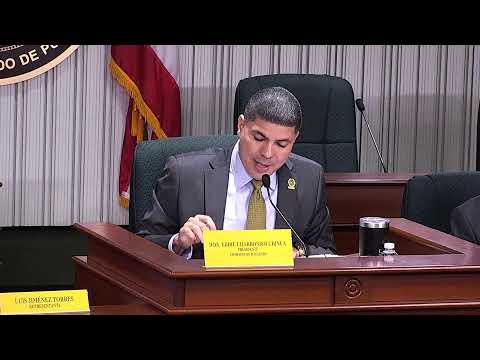
The House of Representatives Committee on Finance on Sept. 24 held a public hearing on Proyecto de la Cámara 501 (P. de la C. 501), a bill to add section 10.23.26 to Law 1 of 2011 (the Puerto Rico Internal Revenue Code) to allow a special contribution rate for interest, dividends and long-term capital gains and to extend to Puerto Rico residents a tax treatment similar to that available to resident investors under Law 22 (2012)/Law 60 (2019).
The House of Representatives Committee on Finance on Sept. 24 held a public hearing on Proyecto de la Cámara 501 (P. de la C. 501), a bill to add section 10.23.26 to Law 1 of 2011 (the Puerto Rico Internal Revenue Code) to allow a special contribution rate for interest, dividends and long-term capital gains and to extend to Puerto Rico residents a tax treatment similar to that available to resident investors under Law 22 (2012)/Law 60 (2019).
Committee members heard presentations from the Department of Economic Development and Commerce (DDEC), the Office of Incentives for Business in Puerto Rico, the Department of Hacienda (Treasury), and the Puerto Rico Fiscal Agency and Financial Advisory Authority (AFAF). DDEC said the measure aims to “proveer al residente de Puerto Rico igualdad de beneficios contributivos en cuanto a la tributación de intereses, dividendos y ganancias de capital” (to provide Puerto Rico residents equality of tax benefits for interest, dividends and capital gains), a change the agency framed as promoting local investment and entrepreneurship (Luis Méndez del Nido, legal counsel, Department of Economic Development and Commerce).
Why it matters: Committee members and agency witnesses focused on the bill’s fiscal impact, enforcement capacity and how quickly the Treasury’s electronic filing systems could be adjusted. Treasury officials and the legislative budget office offered differing revenue estimates; the discrepancy and the measure’s possible interaction with a companion bill (P. de la C. 505) that would raise the rate for future resident-investor decree holders were central points of debate.
Hacienda’s fiscal estimate and implementation concerns
An official identified in the hearing as the secretary of the Department of Hacienda (referred to in the record by the given name “Cristian”) told the committee the department estimated an approximate direct fiscal impact of $100 million if P. de la C. 501 were enacted as drafted. The secretary framed that estimate as a static calculation that does not account for possible macroeconomic feedback: “El principio de neutralidad se encuentra contenido en el plan fiscal” and any change must be considered against the fiscal plan, he said, adding that the potential economic activity generated by lower rates could mitigate revenue loss.
The secretary told members that modifying tax rates tied to interest, dividends and capital gains requires programming changes to SURI (the Treasury’s electronic filing system) and related forms and instructions. He recommended that, if approved, the effective date be set for the 2026 tax year to allow Treasury time to update forms, instructions and systems. “Mi recomendación sería evaluar si la efectividad ... pudiera ser a partir del año contributivo 2026,” he said.
Differing revenue estimates and modeling assumptions
Witnesses noted multiple revenue projections. Treasury estimated about $100 million in direct revenue loss. The Department of Economic Development cited a technical study suggesting a measure similar to P. de la C. 501 could yield net revenues of $312 million under an assumption that 2,000 local investors repatriate capital and 1,500 additional resident investors relocate to Puerto Rico. The committee’s Office of Legislative Budget Analysis (OPAL) provided a separate static estimate cited in the hearing—committee members referenced figures near $132 million for fiscal 2026 and $134 million for fiscal 2027—and OPAL noted its analysis does not incorporate behavioral responses or economic feedback that could attenuate the fiscal effect.
Scope of beneficiaries and existing decrees
Officials debated how many taxpayers would use the proposed provision. Hacienda and other witnesses gave multiple population estimates depending on the base considered: department materials estimated roughly 2,000 local investors could be directly affected if measured against the current base of investors; when counting taxpayers who now report income from interest, dividends and long-term capital gains under ordinary rules, officials said the affected population could be on the order of tens of thousands (Hacienda referenced a broader universe of roughly 30,000–40,000 taxpayers as a possible upper bound). The Department of Economic Development and the Office of Incentives also provided counts for incentives activity: historically about 5,800 decrees had been approved under Law 22/Law 60, with approximately 2,660 estimated active at one point; the agency said 282 investor decrees had been approved in 2025 and 297 new investor applications were pending that year.
Enforcement, audits and revocations
Office of Incentives officials described steps the agency has taken to reduce administrative backlogs and improve compliance tracking. The office reported an initial backlog of 14,183 portal transactions (including new-decree requests, amendments and other filings) that had been reduced to 2,611 pending items after prioritization and processing. The office said fiscalization efforts now include docket review, conditional approvals tied to evidence of compliance, and targeted audit campaigns across incentive programs; approved amendments may include conditions requiring proof of compliance or referral to an audit committee and a $10,000 sanction for noncompliance.
On revocations, the Office of Incentives said between two and five decrees had been revoked that year and that the office had processed roughly 800 voluntary surrenders; the office also said it maintains internal digital records and background checks so that a revoked decree is noted in a file and, under current administration policy, a revoked recipient would not be approved for a new decree.
Committee requests and next steps
Committee members pressed agencies for source data and asked the Treasury and OPAL to reconcile or publish their underlying analyses. The committee chair and members requested that the Office of Legislative Budget Analysis and the Department of Hacienda provide the fiscal-impact studies and reconciliations (committee requests were set with short turnaround times in the hearing record: a 5-business-day and a 10-business-day timeline were discussed for different deliverables). Members also asked the Office of Incentives for a five-business-day list of all decrees revoked in the prior five years and the reasons for those revocations.
No formal vote was taken at the Sept. 24 hearing. Committee members and witnesses agreed the measure should be considered alongside related proposals in the administration’s tax-reform package, notably P. de la C. 505, which would alter the rate for future resident-investor decree holders and therefore materially affects any neutrality analysis.
The hearing record shows unresolved fiscal-model differences and implementation questions. Agencies told the committee they are available to supply additional documents and that final policy choices—timing, effective year, and compliance language—remain for the Legislature to decide. The committee set follow-up deliverables and will consider the bill in later proceedings.
Ending
Committee members closed the hearing after scheduling follow-up information. Officials urged a combined review of the measure with companion bills in the broader reform package so the Legislature and the fiscal oversight board can evaluate neutrality, projected revenues and operational feasibility before any vote.