Get Full Government Meeting Transcripts, Videos, & Alerts Forever!
Get email alerts on the Opioid Settlement Grant Design topic
No spam. Unsubscribe anytime.
Bangor subcommittee refines draft grant application for opioid-settlement funds, recommends tiers and reporting
Summary
A Bangor City subcommittee reviewed a Moss Center grant template and scoring rubric and recommended a tiered award structure, clearer metrics tied to the settlement Exhibit E, financial-document requirements and quarterly reporting; staff will revise the draft, research indirect-cost language and bring recommendations to the full committee.
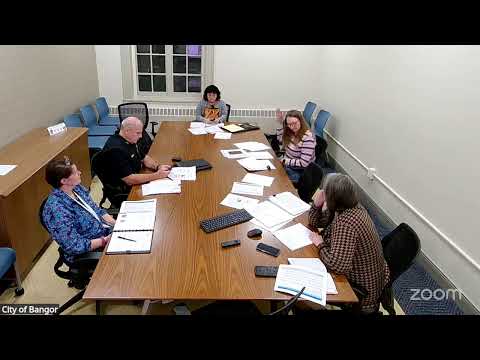
At a meeting of a Bangor City opioid-settlement subcommittee, members and city staff reviewed a draft grant application and scoring rubric for distributing local opioid-settlement funds and recommended adopting a tiered award approach, clearer applicant reporting and tighter financial documentation.
The subcommittee discussed staff estimates that the city will receive approximately $3,450,000 under the settlement schedule and that roughly $1.3 million was already in the city account; staff estimated about $650,000 could be available for grant distribution by the end of the calendar year after prior allocations, including needle-disposal spending. Subcommittee members and staff emphasized that the application must tie awards to the settlement’s authorized uses (the MOU, exhibit E) and the Moss Center scoring rubric used as a starting point.
Why it matters: the group is designing how Bangor will allocate locally controlled opioid-settlement money to service providers. The application’s structure will determine which programs — from treatment and recovery services to housing supports and prevention — are competitive for limited funds and how the city judges impact and fiscal stewardship.
Key recommendations and points of discussion
- Tiered awards: Subcommittee members advised recommending a tier concept to the full committee (for example, larger awards and smaller, more numerous awards) rather than fixing exact award sizes at the subcommittee level. Participants suggested illustrative tiers during discussion (examples discussed included $50,000, $25,000, $10,000 and $5,000 award levels) and proposed the application make clear that including a higher tier does not obligate the city to fund proposals at that level.
- Budget and multi-year risk: Staff and members warned about committing multi-year funding now because settlement payments are scheduled over many years and future availability and priorities may change. The group discussed the risk of multiyear awards and recommended caution about guaranteeing funding beyond the year of award.
- Financial due diligence: The subcommittee discussed requiring applicants to provide annual financial statements, profit-and-loss statements and, where practicable, a chart of accounts to show segregation of funds and responsible bookkeeping. The group asked city staff to identify what financial documents and indicators will best show whether an applicant can deliver the proposed program within the grant period.
- Indirect-costs policy: Members debated whether to cap indirect or administrative costs and how to present that to smaller organizations unfamiliar with federal indirect-rate terminology. Staff agreed to research appropriate language and recommended caps and return with suggested wording for the application and guidance for smaller nonprofit applicants.
- Reporting cadence and technical assistance: The group favored more frequent reporting (quarterly) to allow early detection of problems and to provide technical assistance if needed. City staff noted that the city will be responsible for subrecipient monitoring under the settlement terms.
- Eligibility, geography and service population: The draft application should require applicants to state what percentage of their service population lives in the city of Bangor and allow applicants who serve a broader region to specify the Bangor proportion. The subcommittee discussed whether some proposals would be more appropriately funded at the county level and suggested adding a checkbox or question so applicants can indicate regional impact.
- Scoring and metrics: The subcommittee used the Moss Center scoring rubric as a baseline and sought clearer alignment between the scoring questions and the specific information the application asks applicants to provide. Members recommended moving or clarifying any required performance metrics and making Exhibit E (the settlement MOU exhibit that lists authorized uses) a clear reference point rather than restating all exhibit language in the application.
- Program priorities: The draft preserves the settlement’s authorized categories (prevention, treatment, recovery supports, harm reduction and related wraparound services). Members discussed emphasizing housing-related supports for the target population and asked the application to include a narrative question about how a proposal fills a gap in the local provider network and aligns with best practices.
- Multiple applications and scalability: The subcommittee discussed permitting applicants to submit more than one application if each is for a distinct program. The group also asked for a scalability question so applicants can explain what they would deliver if awarded a smaller amount.
- Review capacity and conflicts: Members noted the full committee had intended to include subject-matter reviewers but many potential reviewers were conflicted out by their organizations. The subcommittee recommended discussing whether to engage external reviewers with no local conflict for subject-specific expertise (for example, prevention or treatment experts) or to add advisory reviewers who would not score but would provide technical input.
Next steps
City staff will produce a revised draft application incorporating the subcommittee’s concept recommendation for tiers, the Moss Center rubric alignment, clearer metric and exhibit-E references, a scalability/alternative-funding question, and proposed language on indirect costs and reporting cadence. Staff will circulate the revised draft to subcommittee members for review and place the application on the next full committee agenda (the subcommittee noted the full committee meeting scheduled in October). The subcommittee did not take a formal, binding vote at the meeting; it agreed by consensus to pass the recommended concepts to the full committee and to return a refined draft for further discussion.
Context and constraints
Subcommittee members repeatedly cautioned against overcommitting funds on multiyear promises because the settlement pays over many years and later payments and priorities may change. The subcommittee also raised equity concerns about balancing a few large awards that could be transformative against smaller awards that help many smaller providers and direct services.
Ending
Staff will research indirect-cost language, suggest a narrative and page-limit approach for applicant responses, and propose a reviewer model (internal panel, external subject experts or hybrid). The subcommittee will review the revised application before the full committee considers final rules for the grant round.