Get Full Government Meeting Transcripts, Videos, & Alerts Forever!
Get email alerts on the Downtown Revitalization topic
No spam. Unsubscribe anytime.
Littleton officials outline Project Downtown concept plan, estimate $36.5 million for Main Street phase and flag funding choices
Summary
Adrienne Burton, director of Venture Projects and project manager for Project Downtown, presented a preferred concept plan for downtown Littleton that prioritizes a curbless, event‑ready Main Street and estimated a conceptual cost of about $36.5 million for a Main Street phase.
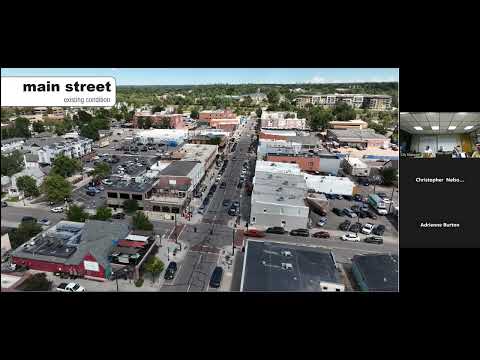
Adrienne Burton, director of Venture Projects and project manager for Project Downtown, told the Next Generation Advisory Board that city planners and consultants adopted a community-preferred “village” concept in a plan City Council approved in November 2024 and that Main Street was selected as the priority for a phase‑1 implementation.
Burton said the plan aims to “preserve Littleton’s cultural heritage, support small business, future‑proof infrastructure, promote health and wellness, address decades of underinvestment, and create a downtown that will serve the community for the next generation.” She described a preferred Main Street design that emphasizes wider sidewalks, a curbless flexible street for events, upgraded lighting, new tree canopy and stormwater improvements, and increased event power and wayfinding infrastructure.
The plan grew from multiple prior efforts including the Transportation Master Plan and the Littleton Downtown Development Authority (LDDA) Plan of Development; Burton also said Denver Water’s need to replace an aging main in downtown helped catalyze the project. Public engagement for the planning process included about 1,700 direct community touchpoints and a final open house with roughly 130 participants, she said.
Burton presented a conceptual cost model developed at planning level and said the model produced a point‑in‑time conceptual estimate of about $36.5 million to implement the Main Street phase. She added that the city has identified roughly $27.5 million it could apply to an initial phase. “If we touch one element, say the pavement, we inevitably affect sidewalks, lighting, utilities,” Burton said, stressing that coordinated sequencing reduces repeated disruptions and can lower long‑term cost and waste.
Burton listed major infrastructure weaknesses in downtown identified by Public Works — deteriorating sidewalks and paving, limited event power outlets (she said six functional outlets exist today), worn crossings, overhead traffic signal systems, and ADA deficiencies — and recommended design choices meant to increase pedestrian comfort and resiliency, such as diversifying tree species and creating more resilient planting footprints.
She said the city is pursuing multiple funding pathways and will present options to council, including certificates of participation (COPs) — financing that does not require voter approval — and a general obligation bond (a ballot measure). Burton showed two schedule options that carry different risks and timing: COPs could accelerate start of work but the council would shoulder debt service via the city’s funds; a GO bond would push a decision to a future ballot and shift levy burden to taxpayers if approved. Burton told the board staff would bring more detail to a City Council study session scheduled for the next Tuesday.
Board members asked questions about parking management, pedestrian and bike connections (Prince Street was described as a future high‑comfort bike corridor), and the Littles Creek trail and pedestrian bridge, which Burton described as requiring additional engineering and study. She said the project team is preparing an economic impact study to model catalytic private investment scenarios and expected to deliver results toward the end of the year.
City staff plan additional design‑phase public engagement if the council endorses moving forward. Burton noted the conceptual renderings are not final designs and stressed that available funding will determine what can be accomplished in a phase‑1 package.
The presentation led board members to discuss opportunities to provide advisory feedback to council and to coordinate outreach with downtown stakeholders, the LDDA and the Chamber of Commerce. Several members said they plan to attend or listen to the upcoming City Council study session on financing for Project Downtown.
Ending: The board did not take a vote on funding or design; staff will present financial options to City Council at the scheduled study session and the board signaled interest in offering feedback after that council discussion.