Get Full Government Meeting Transcripts, Videos, & Alerts Forever!
Get email alerts on the School Construction topic
No spam. Unsubscribe anytime.
Chariho committee reviews three elementary-school options and hears community concerns about site, cost and timing
Summary
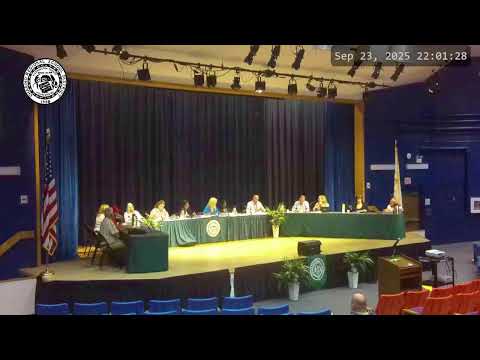
Architects and the district’s owner’s project manager presented three conceptual elementary‑school options to the Chariho Regional School Committee on Sept. 23, outlining construction-cost ranges, reimbursement mechanics and a community engagement timeline as the district prepares a Stage 2 application to the Rhode Island Department of Education.
Architects and the district’s owner’s project manager presented three conceptual elementary‑school options to the Chariho Regional School Committee on Sept. 23, outlining construction-cost ranges, reimbursement mechanics and a community engagement timeline as the district prepares a Stage 2 application to the Rhode Island Department of Education.
The options presented by SLAM Collaborative and Colliers were: (1) a single regional elementary school on a new site (estimated site need roughly 27–33 acres) with construction cost range presented at about $87–90 million (construction dollars only, per the presenters’ model); (2) “renovate-to-new” at each existing school with additions (estimated $89–98 million); and (3) three new elementary schools (highest estimated construction cost). The presenters emphasized that the numbers shown were construction-cost comparisons only and that total project cost would include site acquisition, abatement, swing space and other “soft” costs not included in those headline ranges.
Why it matters: the district must decide which approach to advance in its Stage 2 packet to RIDE; the chosen approach will shape which properties are considered, what bonuses or reimbursement the district can pursue and the schedule for community meetings and a future bond question.
"This is conceptual work to understand opportunities," said Mark Rhodes, design principal for SLAM Collaborative. "We're showing parity across options so the community can compare apples to apples on construction dollars and programmatic outcomes." Kathy Ellethorpe of SLAM and Holly Demerson, Colliers' owner’s project manager, joined Rhodes in explaining site constraints, ADA and mechanical implications, and how RIDE’s reimbursement formula drives school size and allowable square footage.
Superintendent Gina Picard told the committee the presentation was not a decision but a chance to refine messaging before community meetings scheduled for Richmond (Sept. 29), Charlestown (Oct. 1) and Ashaway (Oct. 6). "You're not building the school of five years from now — you're building for the next 50 years," Picard said, urging residents to weigh educational program goals alongside cost and location questions.
Presenters walked the committee through programmatic elements the district requested: classrooms sized to current RIDE expectations, upgraded specialty spaces (DaVinci/STEAM-type labs), full kitchens and larger cafeterias and gyms to achieve parity across schools. SLAM said a unified regional school allows operational efficiencies — one kitchen, one large gym — and the potential for shared specialized programs; it also requires significant land acquisition and adds transportation considerations. The renovate‑to‑new option would retain and upgrade existing buildings where feasible but could require substantial selective demolition, elevated remediation and costly mechanical upgrades; SLAM warned that RIDE can be strict when determining whether a project qualifies as "renovate to new." Three new schools carries the highest construction-price tag because it duplicates major building systems across three sites.
Committee members and residents asked detailed questions about reimbursement and escalation. Colliers’ Holly Demerson explained RIDE’s formula: construction reimbursement is driven by the per‑square‑foot allowance tied to the student population the district submits; Colliers said the currently published construction benchmark is $564 per eligible square foot for elementary work and that RIDE sometimes updates that figure (the team estimated a plausible $15/ft2 increase to account for escalation when the application is reviewed). The presenters repeatedly stressed that RIDE funds construction and many eligible soft costs but does not reimburse every discretionary feature; items that the district wants above RIDE standards would require local funding.
Residents pressed the committee about location and equity across the three towns. Simon Manlove (Hopkinton) asked the presentation to more clearly flag that the worksheet costs were construction dollars only and did not reflect total project cost. Tracy Sylvia (Richmond) asked when bonuses for energy or security could be considered; presenters said bonuses are evaluated as part of Stage 2 and must meet specific programmatic thresholds (for example, a security bonus requires a high percentage of project cost devoted to security work). Multiple speakers asked whether land-acquisition costs would be eligible for RIDE reimbursement; the presenters and Colliers said land, when approved and appraised as part of a project, can be eligible for reimbursement under the same reimbursement rate.
Transportation and swing‑space questions were frequent. SLAM and Colliers said a unified school typically requires 27–33 acres and a letter of intent for a site during Stage 2; they cautioned that land negotiations must protect the district (for example, land offers should include terms that allow the district to withdraw if a bond fails). Committee members noted Chariho spans three towns (Richmond, Charlestown, Hopkinton) and asked whether voters in towns farther from a consolidated site would approve a single regional school; committee members flagged long-standing political concerns about tax distribution and local identity.
Picard and the architects said the design team will refine the slides and add clarifying language (page numbers and explicit labels for "renovation" vs. "new construction" slides were among requests from the committee). SLAM also said Stage 2 will include site feasibility steps (topography, ledge, wetlands, septic, environmental testing) that will be done if the committee chooses a path forward.
What's next: the committee will accept community feedback at the three neighborhood meetings and is expected to decide at its October meeting which plan to advance in the Stage 2 application. Picard reminded the public that Stage 2 is required by law for RIDE reimbursement and that the district will continue to refine cost estimates and identify possible bonuses and incentives with Colliers.
"This is a public conversation," Picard said. "We need to hear what people are worried about and what they want to protect so we can design a plan that fits our community."