Get Full Government Meeting Transcripts, Videos, & Alerts Forever!
Get email alerts on the Water Quality topic
No spam. Unsubscribe anytime.
Oxnard committee forwards Channel Islands Harbor water-quality update to City Council
Summary
The City of Oxnard Public Works and Transportation Committee on Sept. 23 received a volunteer-produced update on Channel Islands Harbor water quality, discussed causes and mitigation options, and voted 3-0 to forward the report to the full City Council as a receive-and-file item.
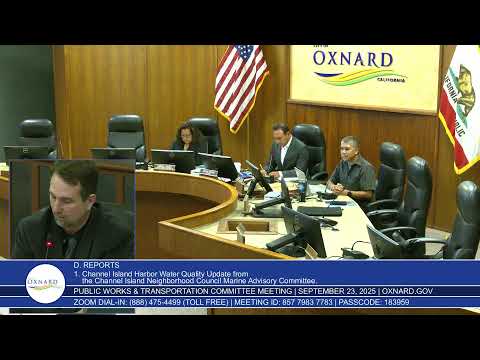
The City of Oxnard Public Works and Transportation Committee on Sept. 23 received an update on degrading water quality in Channel Islands Harbor and voted 3-0 to forward the report to the full City Council as a receive-and-file item.
The presentation, prepared by volunteers from the Channel Islands Neighborhood Council Marine Advisory Committee and delivered by Chuck Carter, summarized monitoring results, identified likely pollutant sources and potential best-management-practice (BMP) responses, and outlined next steps including an implementation plan the city’s public works department is scheduled to review this fall. Carter told the committee, "We need to restore our harbor water quality."
The update matters because the harbor is a local economic and recreation resource and because monitoring by volunteers and consultants indicates repeated exceedances of state water-quality targets for bacteria, low dissolved oxygen events and concentrations of pesticides in drainage channels that feed the harbor. The presenters and staff said those conditions followed the 2018 shutdown of a once-through cooling power plant that had previously created strong circulation in the harbor.
During the presentation, Carter and other volunteers recounted monitoring and modeling work spanning 2018–2025. Key findings cited included dissolved oxygen dipping below 5 milligrams per liter on multiple summer days; Westport readings below 5 mg/L during more than 60% of sampled days in May and June 2025; agricultural and stormwater runoff with elevated Enterococcus counts (one Oxnard West drainage sample measured more than 9,000 most-probable-number units in December 2021); and pesticide detections (bifenthrin and permethrin) recorded at multiples of state water-quality objectives in Edison Canal. Carter said volunteers and consultants have uploaded data to the California Environmental Data Exchange Network for review by the water board.
Public-works staff described the city’s role and next steps. A staff member said, "The request is actually to forward it to council for receiving file." Committee members asked technical questions about how quickly bacteria levels fall after storm events, which pollutants are driving low-oxygen events, and what infrastructure and nonstructural BMPs can reduce pollutant loads. Options discussed included trash-capture and filtration devices in storm drains, dry-weather diversion to sewer when appropriate, on-site low-impact development (bioswales and retention), and agricultural source controls such as denitrifying bioreactors funded through external grants.
Speakers noted funding and monitoring gaps. Volunteers and staff said funding for continuous dissolved-oxygen sensors and for routine laboratory testing lapsed in 2023–2024, limiting up-to-date laboratory data; they reported volunteers collected monthly samples through February 2024. The committee heard that Grama Water Engineering prepared a feasibility study and implementation plan (draft mitigation strategies presented January 2025), with a final mitigation strategy analysis due in September 2025 and an implementation plan scheduled for November 2025; the city’s public works department will review those documents and recommend options to the council.
Committee members and staff emphasized a mix of responsibilities: resident behavior (pet waste, litter, overwatering), municipal infrastructure (catch-basin filters, trash capture), countywide stormwater programs (MS4/NPDES requirements), and agricultural runoff. Committee members thanked the Marine Advisory Committee and volunteers for outreach and data collection but acknowledged that long-term fixes would require interagency coordination and additional external funding. Carter and volunteers noted more than $3 million in state and federal funds have been secured to date, but said larger funds will be needed for full mitigation.
The committee took no ordinance-level action; it approved the minutes for the Sept. 9 meeting by voice vote and then voted to forward the harbor update to the City Council for receiving and filing. Both votes carried 3-0.
The committee labeled the harbor update a receive-and-file item and will report the forwarded materials to the full City Council for further consideration and possible future actions tied to the implementation plan and funding strategies.