Get Full Government Meeting Transcripts, Videos, & Alerts Forever!
Get email alerts on the Land Use topic
No spam. Unsubscribe anytime.
Pocatello and Bannock County debate wording, process for area-of-impact agreement
Summary
City of Pocatello officials presented amendments to an area-of-impact agreement with Bannock County, prompting commissioners to seek clearer language, an MOU or county standard to avoid shifting decision authority and to limit urban-sprawl risks.
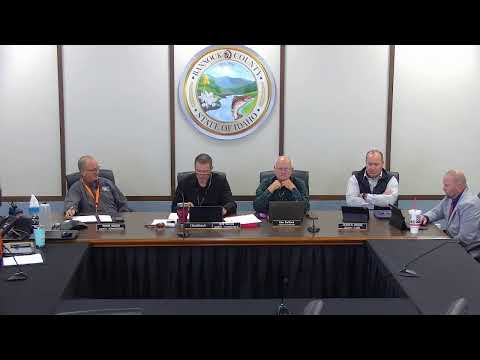
Pocatello city officials and Bannock County commissioners discussed proposed amendments to an area-of-impact agreement on Sept. 23, with the city asking for language to reduce future development conflicts and the county stressing its jurisdiction and need to set county standards.
Brent, a City of Pocatello representative, told the commissioners the city had reviewed the county's draft and added proposed changes intended “to help mitigate some of those conflicts between these properties that might get developed in the county, to different standards than what they would have gotten developed to in this in the city.” Brent said the city’s intent was to “work together” because areas inside the city’s area of impact are likely to be annexed within roughly a five-year timeframe.
Why it matters: development built to county standards can later create costly upgrades for a city after annexation — items such as water mains, sewer connections, road geometry and fire access. Commissioners repeatedly voiced concern about municipal command over county jurisdiction and the risk that mandatory city standards in the agreement could conflict with a state court interpretation that the area of impact is county jurisdiction.
Commissioner Moser said the proposed amendments “go against what the Supreme Court said because their area of impact is the county. Absolutely.” He and other commissioners emphasized that the county must retain final authority: “it needs to be a county standard,” one commissioner said, arguing that an MOU could inappropriately transfer decision power. Several commissioners and staff acknowledged a desire to align standards and processes, however, to avoid “jigsaw puzzle” development that complicates later connection of infrastructure.
County staff and Pocatello officials sketched possible next steps. Brent invited the county to formalize a process for coordinated review: “we would come to the county with the developer to talk about what those things are,” he said, adding that the city wants written procedures so the approach survives personnel changes. County staff noted legal timelines for review and signatures: “it is, a minimum of 4 weeks before we can get a signature on anything because our legal department requires 3 full weeks to review a document,” a county staff member said.
Commissioners raised two recurring concerns: (1) any language that reads like a command that county developments “ensure” city standards could create duplicative approvals and added work for developers and county staff; and (2) overly prescriptive language could drive developers to build outside the area of impact to avoid stricter standards, potentially accelerating sprawl. One commissioner said the county has been modifying its design standards to ease later connections, but asked that any cooperative language be framed so the county implements standards, not the city.
Next steps: Pocatello will revise the proposed amendment language based on feedback and return it to its city council for review before bringing revised language back to the commissioners for discussion. County staff and commissioners asked to continue working with Hal and Tristan (county staff referenced in the meeting) to draft either an MOU, clarified process, or county design standard that aligns expectations without transferring decision authority.
The board agreed to proceed with the scheduled public hearing on the area-of-impact map and noted the map and agreement are living documents that may be reshaped by public input; the county will weigh whether to delay the public hearing but decided to move forward, with officials noting the state-level legislative deadline and the county’s internal legal review timeline.
Ending: Both sides said they want to avoid future infrastructure gaps and high retrofit costs, and to create a predictable process for developers and residents. City staff and county staff will continue drafting language for a cooperative mechanism while retaining county final decision authority on implementation.