Get Full Government Meeting Transcripts, Videos, & Alerts Forever!
Get email alerts on the Governance Reform topic
No spam. Unsubscribe anytime.
Citizens' committee proposes recall rules, fewer town meeting seats and other changes to Danvers governance
Summary
A citizens committee appointed by the town moderator presented redlined draft changes to Danvers' Town Meeting and Town Manager Acts on Sept. 23, proposing a recall procedure for townwide elected officials, a cut in the number of town meeting members per precinct and other process changes intended to boost participation.
A citizens committee appointed by the town moderator presented a written report and recommended redlined changes to the Danvers Town Meeting Act and the Town Manager Act at the Select Board meeting on Sept. 23.
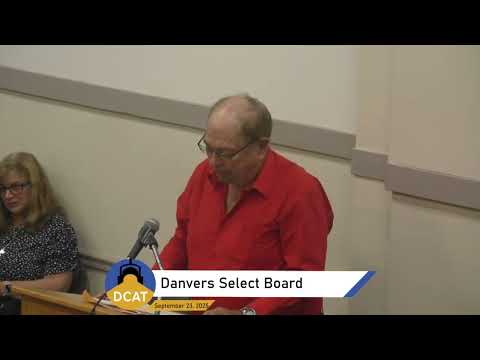
The Town Meeting–Town Manager Acts Review Committee, chaired by Sally Calhoun, recommended multiple changes intended to encourage citizen participation and modernize town governance. "We became most concerned about finding ways to encourage more active participation by the citizens of the town of Danvers," Calhoun told the board, describing the committee's effort to "revitalize and reemphasize" the representative role of town meeting members.
The report, delivered to the board in May and discussed at the meeting, recommends: reducing the number of town meeting members per precinct from 18 to 15; requiring all town meeting candidates, including incumbents, to pull nomination papers and gather 10 signatures; formalizing an informational session for town meeting members by the moderator; and requiring a review of the acts at least every 20 years unless town meeting votes otherwise.
On the Town Manager Act, the committee recommended adding a recall-election mechanism that would apply to townwide elected officials with more than six months remaining in their terms. Under the proposed new section, an initial affidavit from "350 or more registered voters" would trigger a printed petition form from the town clerk; petitioners then would need to gather signatures equal to 20% of registered voters within 20 business days for the petition to proceed to certification and, if the officer does not resign within five days, to a recall election. The committee added language specifying that a vote taken by an elected official on a matter before their body would not by itself constitute valid grounds for recall.
On the same act, the committee proposed that the town accountant be appointed by the town manager rather than by the Select Board and suggested removing the residency requirement for the town manager.
Mike Trainor, who had filed the original citizens petition proposing the recall provision, participated in the committee's work and spoke at the meeting. "While it is expected that the recall process set forth herein would only be used to address serious malfeasance or misconduct, the voters themselves shall individually determine whether the grounds listed for recall are sufficient," Trainor said, summarizing the committee's chosen language.
Town counsel and board members asked questions during deliberations. Kate Connolly, town counsel, told the board the town would not expose itself to liability simply by widening the candidate pool for town manager or by adopting no residency requirement, and that practical hiring criteria would still govern final selections.
Board members expressed mixed reactions in the meeting. Some members said they supported the recall language but wanted safeguards to ensure it would not be used over policy disagreements; others raised concerns about reducing representation by cutting the number of town meeting members per precinct.
The committee also suggested process changes intended to increase precinct-level engagement, including a townwide precinct forum at Danvers High School in early February to allow town meeting members, precinct residents and committees to meet in the same place.
The Select Board received the report and was told it would begin deliberations on Oct. 7. The town manager said the Select Board may hold public hearings and that members may submit additional proposals in writing for review by the town manager's office and the clerk by Sept. 29 to allow town counsel time to review.
Ending: The Select Board and the committee agreed to continue work through October and November with a tentative public hearing on proposed warrant language scheduled for Dec. 16. The report and redlines will be subject to further board deliberation and possible warrant articles at a future town meeting.