Get Full Government Meeting Transcripts, Videos, & Alerts Forever!
Get email alerts on the Recycling Waste Management topic
No spam. Unsubscribe anytime.
Hooksett transfer station faces rising disposal costs for lithium batteries and other recyclables
Summary
Committee members reviewed recycling market updates showing rising disposal costs, discussed whether to pass lithium battery disposal fees to users and noted existing rates for common materials.
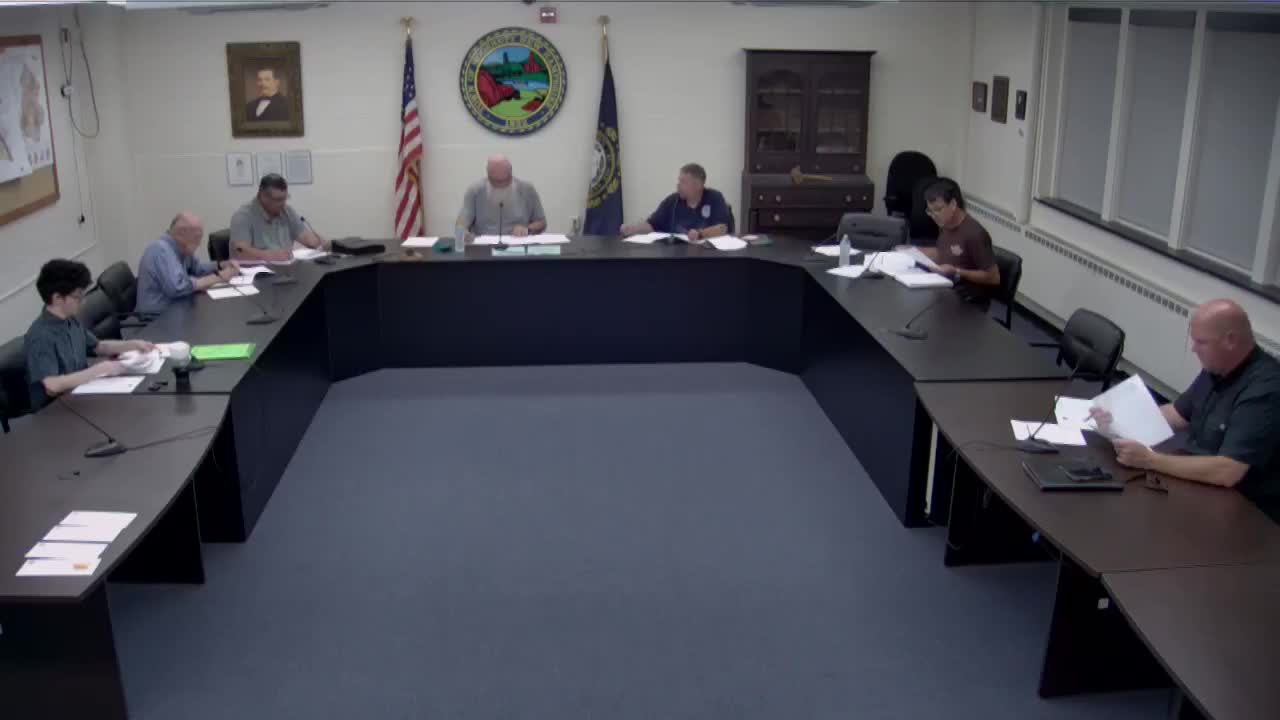
Members of the Hooksett Department of Public Works transfer station committee reviewed updated recycling and disposal rates and discussed whether the facility should begin charging customers for items that now cost the town to dispose of.
The committee heard that disposal of lithium-ion batteries currently costs the town about $1.50 per pound. Staff said the town is not charging residents for lithium batteries at present, meaning the town covers the fee. Other listed rates included: trash $93.45 per ton, furniture $194 per ton, demolition debris $1.19 per ton, glass $50 per ton, cardboard $40 per ton, nickel‑cadmium batteries $0.78 per pound, and plastic at about $0.02 per pound (approximately $40 per ton). An electronics vendor was reported to charge $8 per unit for certain batteries and $80 per unit for Freon-bearing appliances.
Committee members flagged lithium batteries as a growing expense because of new handling and processing rules and mixed battery chemistries in incoming loads. They noted particular concern about small-format batteries (drill batteries, hoverboard and scooter batteries, 48‑volt packs) and said those items add weight and cost quickly.
Members discussed whether there is an economic case to separate higher‑value streams (for example, collecting only natural milk jugs) from lower‑value plastics; staff said higher rates for certain separated streams (milk jugs were cited as fetching roughly $1.10 per pound in some markets) could make separation worthwhile, but space and contamination problems make that difficult at present.
The committee also reviewed recent receipts and market fluctuations: metal prices were cited historically between $1.31 and $1.74 (units not specified in the printout), with a recent disbursement substantially lower (a check for $97 was referenced). Staff said plastics remain low but still yield modest revenue versus simply sending material to landfill.
Members asked staff to return with clearer cost comparisons showing, by material stream, the town’s revenue (what the town receives) versus expenses (what the town pays to transfer or process material) across a defined period. That accounting would inform whether to propose user fees for particular items or adjust existing fees.
Ending
The committee deferred any formal change to fees, directing staff to compile a month‑to‑month cost/revenue comparison and to explore potential options for separating higher‑value recyclables if space and contamination controls can be arranged.