Lifetime Citizen Portal Access — AI Briefings, Alerts & Unlimited Follows
Committee reviews Frederick P. Moussalli’s reappointment as Alcoholic Beverage and Cannabis Administration director
Loading...
Summary
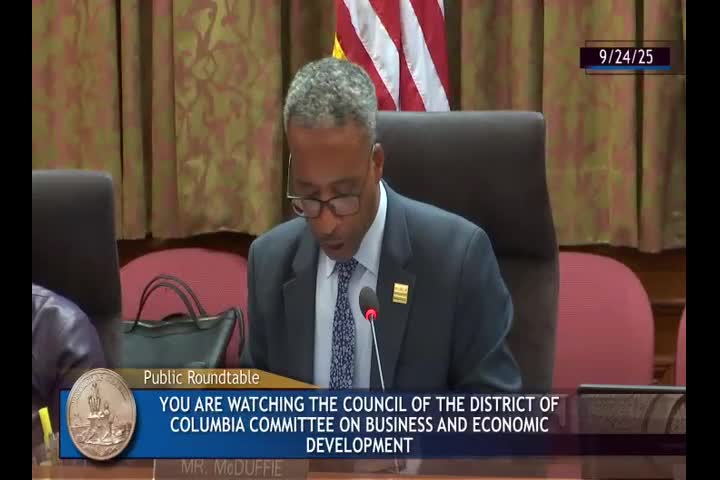
Frederick P. Moussalli appeared before the Committee on Business and Economic Development on Sept. 24 for consideration of Proposed Resolution PR26-230, the Director of the Alcoholic Beverage and Cannabis Administration Frederick P. Moussalli Confirmation Resolution of 2025.
Frederick P. Moussalli appeared before the Committee on Business and Economic Development on Sept. 24 for consideration of Proposed Resolution PR26-230, the Director of the Alcoholic Beverage and Cannabis Administration (ABCA) Frederick P. Moussalli Confirmation Resolution of 2025. The resolution would reappoint Moussalli for a four-year term ending July 14, 2029.
Moussalli, who has served as the agency’s director since July 2009 after earlier service as general counsel, outlined accomplishments he attributed to the agency during his tenure and four priorities should he be reappointed. He said the agency successfully implemented the statutory transition of unlicensed cannabis businesses to the legal medical market by the March 31, 2025 deadline, and that licensed medical cannabis retail sales exceeded $5,400,000 per month for each month from April through August 2025. “By way of comparison, prior to March 2025, medical cannabis retail sales had not been above $3,000,000 in a single month since December 2023,” he told the committee.
Moussalli reported that as of July 2025 there were 64 licensed medical cannabis retailers making sales to registered patients (up from six in March 2024) and that the District’s first medical cannabis testing laboratory was licensed and opened on Aug. 16, 2024. He said APCA/ABCA implemented delivery, education/tasting, safe-use treatment facility, and summer-garden endorsements created by the Medical Cannabis Amendment Act of 2022 and that the agency had expanded patient registration at no cost to District residents to promote access in all eight wards.
On enforcement, Moussalli said the agency had summarily closed and padlocked 75 unlicensed cannabis businesses as of the hearing and had conducted thousands of regulatory inspections: he told the committee APCA’s Alcohol Enforcement Division had conducted 13,966 regulatory inspections and investigations through July 31, 2025. He cited the agency’s role in the Nightlife Task Force addressing quality-of-life issues and said enforcement emphasized after-hours violations that were referred to the Alcoholic Beverage and Cannabis Board.
Moussalli also described a recently enacted change to extended hours licensing. He said the On-Premises and On-Site Extended Hours Program Amendment Act of 2025 (introduced by Councilmember Kenyon McDuffie and taking effect June 10, 2025) allows the Board to extend hours for sporting, cultural and tourism events without additional Council approval; the agency has used the authority for events including Arnold Night, the World Games 2025 and the 2025 FIFA Club World Cup.
If reappointed, Moussalli described priorities including modernizing the District’s alcohol and medical cannabis laws in coordination with the Board and the executive, implementing the game-of-skill and commercial-bingo subtitles of the Fiscal Year 2026 Budget Support Act of 2025 (scheduled to take effect Oct. 1, 2025), unveiling a new online licensing and patient-registration system in FY 2026, and strengthening the agency’s Cannabis Enforcement Division (he said APCA/ABCA had closed 75 unlicensed businesses and planned to fill two enforcement vacancies in FY 2026).
Committee members questioned Moussalli about the distribution of licensed retailers and cultivation centers across wards, the status of conditional licenses, testing-lab capacity, and competition from neighboring Maryland’s adult-use market. Moussalli said retailers were denser in Wards 1, 2 and 6 and fewer in Wards 7 and 8; cultivation and manufacturing activity was concentrated in industrial/manufacturing zones (he cited Ward 5 and Ward 7 locations). He said testing capacity at the single open lab was adequate and operating below capacity but that two other conditional testing-lab licenses existed. On cross-border competition he said Maryland’s adult-use market had reduced District sales when it opened and remained a competitive factor; he said the District’s policy tools while limited to medical sales must focus on product variety, craft-preparation and beverage rules, and easier patient registration to retain market share.
Moussalli and the committee discussed ongoing litigation and enforcement matters, including lawsuits brought by unlicensed operators challenging enforcement actions; Moussalli said the agency had prevailed in initial temporary restraining-order proceedings and continued to litigate some cases. He also identified agency staff members assigned as the community resource officer who handles protests and community complaints.
The roundtable was a hearing to collect testimony; no confirmation vote was taken at the Sept. 24 session. The committee accepted written testimony into the public record through Oct. 3, 2025.