Get Full Government Meeting Transcripts, Videos, & Alerts Forever!
Get email alerts on the Financial Audit And Compliance topic
No spam. Unsubscribe anytime.
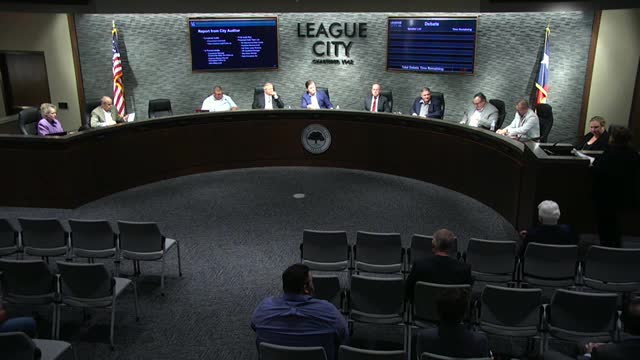
League City auditor outlines FY26 audit candidates; council picks franchise and CIP reviews, adds hotel-tax audit
Summary
The League City auditor presented possible FY26 audit topics Sept. 23 and council directed staff to prioritize a franchise-fee revenue audit and a CIP liquidated-damages review and to add a hotel-occupancy-tax audit to the workplan.
City Auditor (name not provided in the meeting transcript) presented a proposed list of potential audit topics for fiscal year 2026 at the Sept. 23 League City Council meeting, and council selected initial priorities.
The auditor’s list included: 5G telecommunications node revenue (questions about whether the city is collecting and accounting for expected node fees), franchise-fee revenue (cable, gas, electric, solid-waste and recycling franchise agreements), cell-tower lease revenue (different departments handle leases for tower mounts and water-tower mounts), CIP liquidated damages and change orders, and smaller items such as take-home vehicle usage and hotel (occupancy) tax collections.
During discussion councilmembers suggested combining related telecommunications topics into a single review and emphasized the CIP liquidated-damages item as a priority because it could identify uncollected recovery or inconsistent waivers. The auditor estimated the telecommunications work could require several hundred hours and said combining items may be efficient but he would refine the scope after staff follow-up.
Council voted to direct the auditor to proceed with two of the auditor’s top four priorities: a franchise-fee revenue audit and a CIP liquidated-damages review. Council also voted to add a hotel-occupancy-tax (HOT) audit from the smaller-audits list. Separately, council asked city directors—including finance and public-safety leadership—to review the city’s take‑home vehicle policy and report back within roughly six months rather than have the auditor immediately perform a utilization audit.
On the 5G node issue, council and staff discussed an apparent gap between the number of installed nodes in the right-of-way and amounts recorded in the general ledger: the auditor cited an internal count of 63 nodes and noted a fiscal-year receipt pattern that suggested the city may not be consistently collecting a $1,000-per-node fee in every case. Council asked staff to follow up to determine whether existing agreements and billing practices authorize and effectuate the full fee and, if not, to propose corrective steps.
The auditor said more detailed scoping and staff follow up will be required before work begins; council’s motion prioritized franchise-fee and CIP audits first, with the HOT audit also approved for FY26 work.