
Scott County Council approves first readings to pursue judgment-funding bonds to cover settlement
Get AI-powered insights, summaries, and transcripts
Subscribe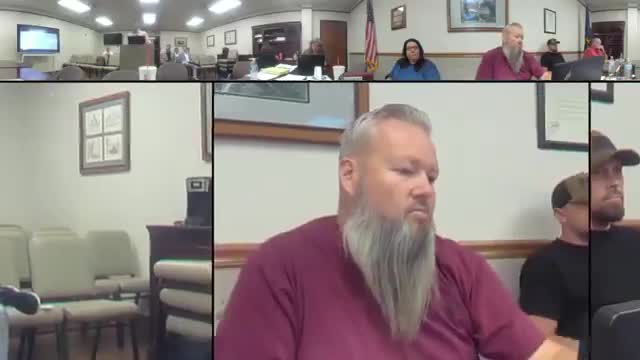
Summary
At a special meeting Aug. 29, 2025, the Scott County Council gave initial approval to ordinances authorizing pursuit of judgment-funding bonds and an associated additional appropriation. The actions start a process that includes public hearings Sept. 9 and could increase property taxes to cover annual debt service if the bonds are sold.
SCOTTSBURG, Ind. — The Scott County Council on Aug. 29 held first readings and took initial votes to begin the process of issuing judgment-funding bonds and appropriating the proceeds to pay a court-ordered settlement and related costs.
The council read the titles of two ordinances — an ordinance authorizing issuance and sale of judgment-funding bonds (2025 OR-48) and an ordinance approving an additional appropriation in connection with issuance of those bonds (2025 OR-49) — and took initial votes to advance both measures to the council’s regular meeting on Sept. 9, when two public hearings and second readings are scheduled.
Bo Zeller, staff member, told the council the filing and public-notice steps have begun and that the meeting’s action constituted the statutorily required first reading. "This bond ordinance is for judgment funding bonds," Zeller said, describing the Indiana statute that allows counties to issue bonds to fund court judgments. Zeller said notices were submitted for publication and public hearings would occur before the council’s Sept. 9 meeting.
Jason Stemler, a consultant working with bond advisers and the county, presented illustrative underwriting numbers and repayment scenarios. Stemler said the ordinance includes a not-to-exceed bond size of $6,000,000 but the advisers’ current illustrative financing would produce net proceeds in the neighborhood of $4.8 million after fees. "On these assumptions, you're looking at a total bond of about $4,825,000," Stemler said, summarizing estimated legal, underwriting and miscellaneous costs.
Stemler also said the issuance would likely be taxable (because proceeds could be used for operating expenses) and used a conservative interest-rate assumption of 6.25 percent for worst-case illustrations. Under that scenario, he showed annual debt-service of about $440,000 and said the county would need to levy an estimated tax increase described in the presentation as "about 4 and a half cents" to generate the payment. Stemler provided illustrative taxpayer impacts from that levy: a homeowner with a $150,000 assessed value would pay roughly $20–$28 a year; a $300,000 assessed home about $70 a year; a 100-acre farm roughly $90–$92 annually. Stemler cautioned those were market-dependent estimates and the eventual rate and sale price could be better or worse.
Council members and staff discussed timing and alternatives. Zeller and advisers said the legal timetable requires the initial-readings and notice steps now if the county is to hold the two public hearings on Sept. 9 and still complete a sale in time to use proceeds in the 2026 budget. Advisers said the sale process typically takes 45–90 days and that rates and marketability could shift if the county waits into late fall. Stemler recommended considering an underwriter to help market taxable bonds without a formal rating, given concerns about county finances that rating analysts would examine.
Several council members and staff expressed concern about near-term cash and long-term consequences. Speakers warned that depleting the county’s rainy-day reserves to bridge shortfalls would remove a cushion for unexpected claims or payouts; advisers and staff urged preserving reserves because the county will face revenue uncertainty from newly enacted state legislation (referred to in discussion as Senate Bill 1) that is expected to change property-tax credits and local tax structures in coming years. Zeller said the county had already posted a public notice (published Aug. 27) and that the Sept. 9 public hearings would include one hearing on the additional appropriation and one on a preliminary determination to issue bonds.
Councilors also discussed alternatives, including raising local income tax in 2027 as a longer-term revenue option and possible cuts to departments. Staff described draft 2026 budget numbers showing large shortfalls in general and special-purpose funds without the bond proceeds; staff and advisers said the bond proceeds would provide one year of operating capacity, principally to cover the sheriff’s budget and obligations tied to the judgment.
The meeting concluded with the council taking the initial votes to advance both ordinances to the Sept. 9 meeting for public hearings and final readings. The initial votes do not effectuate bond issuance or appropriation; final action will depend on the outcome of the public hearings and a second vote.
Votes at a glance
- Scott County Council ordinance 2025 OR-48 (judgment funding bonds): title read and first reading approved (initial vote taken Aug. 29). Final adoption pending public hearings and second reading on Sept. 9.
- Scott County Council ordinance 2025 OR-49 (additional appropriation related to judgment funding bonds): title read and first reading approved (initial vote taken Aug. 29). Final adoption pending public hearings and second reading on Sept. 9.
Next steps
The council will hold two public hearings at its Sept. 9 meeting — one on the additional appropriation and one on a preliminary determination to issue bonds — and will take second votes that would finalize the ordinances if approved. If the ordinances ultimately pass, the county’s advisers would proceed with marketing and sale; staff warned the county faces trade-offs between selling earlier to avoid possible year-end rate increases and selling later to chase potentially lower interest rates.