Get Full Government Meeting Transcripts, Videos, & Alerts Forever!
Get email alerts on the Millage topic
No spam. Unsubscribe anytime.
Tamarac keeps operating millage at 7 mills; commissioners cite public-safety costs and structural risks
Summary
The Tamarac City Commission voted 5-0 to adopt a 7.0 operating millage for fiscal year 2026 after staff said that the rate is needed to cover rising police and fire costs and to avoid a future structural imbalance.
The City Commission of Tamarac voted 5-0 Wednesday to set the fiscal year 2026 operating millage at 7.0 mills, a rate staff said is 0.4094 mills (6.21%) higher than the rollback rate required under the Truth in Millage (TRIM) process.
Financial Services Director Christine Cajust and Budget Manager Jeff Streeter told the commission the tentative 7.0 mill rate would generate about $2,542,000 in added revenue and is roughly equal to the projected increase in police and fire costs for the coming year. Streeter said the rate “exceeds the rollback rate of 6.5906 mills by 0.4094 mills or 6.21%.”
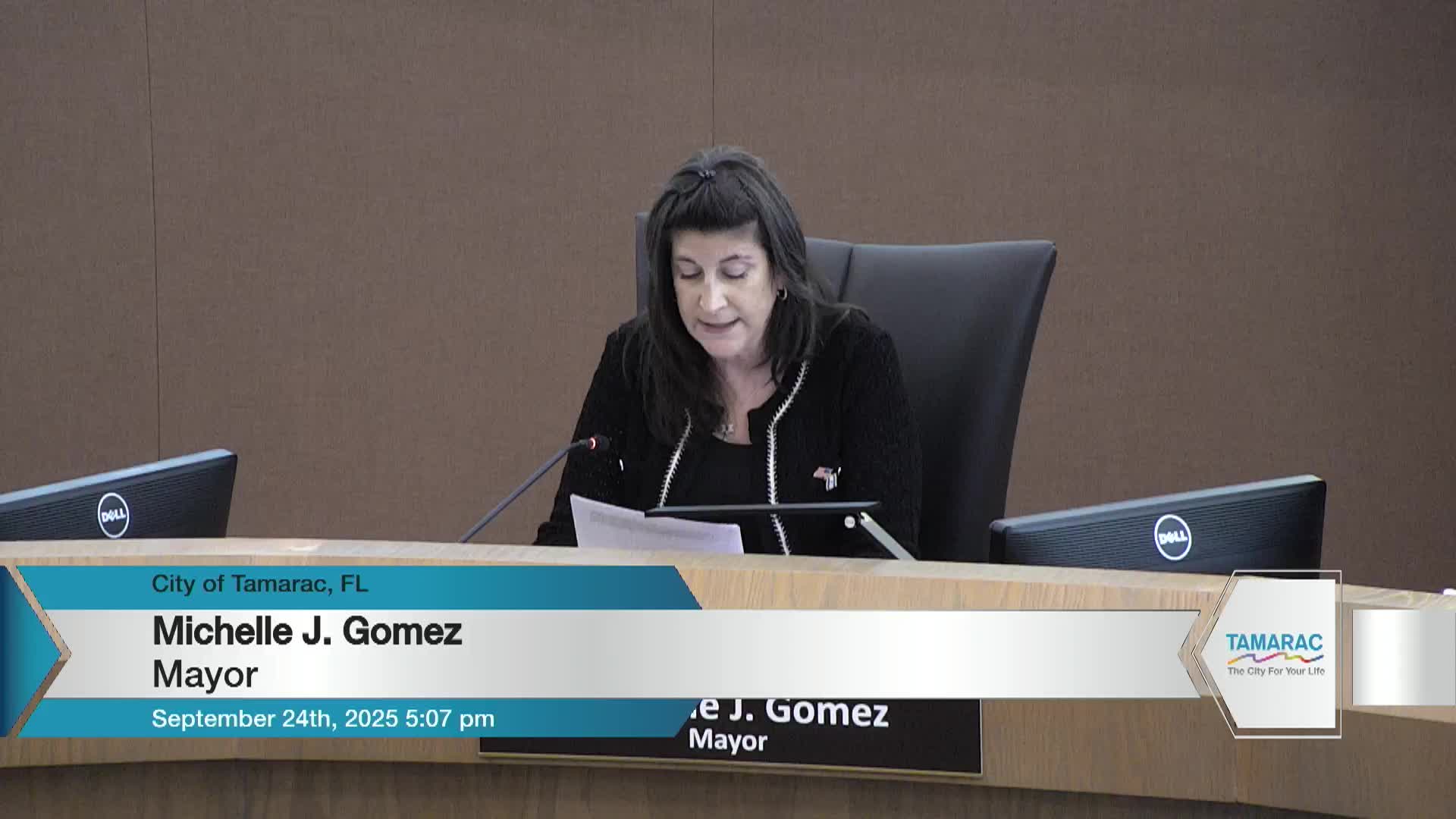
The commission adopted temporary ordinance 2599 after a public hearing and a motion by Commissioner Wright, seconded by Vice Mayor Daniel. Roll-call votes were Commissioner Patterson — yes; Vice Mayor Daniel — yes; Commissioner Bolton — yes; Commissioner Wright — yes; Mayor Gomez — yes. The ordinance was approved by the required supermajority (four of five members).
Why it mattered: Streeter and other staff emphasized that three factors drive property-tax revenue — growth in taxable value, value added by new construction, and the millage rate itself — and that the first two have weakened this year. Streeter noted Tamarac has about 32,460 tax parcels and that roughly 20,276 are homesteaded and subject to a cap (Save Our Homes) that limited increases to about 2.9% this year. With new construction down sharply, he told the commission the city needs the 7.0 mill rate to avoid a “structural imbalance,” a budgeting condition in which ongoing revenues do not cover ongoing expenses.
Public comments during the hearing urged caution on the rate. Resident Kate Johnson said the city could cut other areas of the budget rather than keep the millage at 7. “When you look at the budget, there are many places to cut that budget,” she said. Mark Gorgon, who identified himself as a Tamarac resident, echoed calls to scrutinize operational increases and singled out items such as travel and benefits for further review.
Staff details and clarifications: Streeter provided an example showing a property with $100,000 taxable value would pay $700 in city property taxes at a 7.0 mill rate. He also said that each tenth of a mill represents approximately $660,038 in property-tax revenue for the city. Christine Cajust said adopting the rollback rate instead of 7.0 would require roughly $2.7 million in budget cuts and potentially staff or program reductions. Priscilla Moxie, assistant director of finance, confirmed some of the fine-grained impact calculations during commissioner questions.
Discussion vs. decision: Commissioners debated whether to reduce the rate given recent property-value declines reported in parts of Broward County. Several members — including Commissioner Bolton and Commissioner Patterson — asked staff to supply historical millage votes and argued for looking at prior reductions. Staff repeatedly framed the choice as a fiscal tradeoff: lowering the millage would reduce revenue this year and lower future rollback baselines, making it harder to cover ongoing costs.
What’s next: With the operating millage set, staff and the commission proceed to finalize the fiscal year 2026 budget, which is tied to the adopted millage. The commission also directed staff to provide historical vote records and other clarifying details requested during the hearing.
Speakers quoted or summarized in this article spoke during the ordinance 2599 public hearing and in commissioner Q&A.