Get Full Government Meeting Transcripts, Videos, & Alerts Forever!
Get email alerts on the Housing Homelessness topic
No spam. Unsubscribe anytime.
New Castle County committee hears plan for Pay‑for‑Success pilot to help families exit homelessness
Summary
The Community Services Committee reviewed Resolution 25177 and a presentation on a Pay‑for‑Success project that would use CPRA outcome funding, philanthropic up‑front capital and direct monthly cash assistance to serve 120 families in cohorts, with mandatory case management delivered through the Hope Center and a YWCA subcontract for casework.
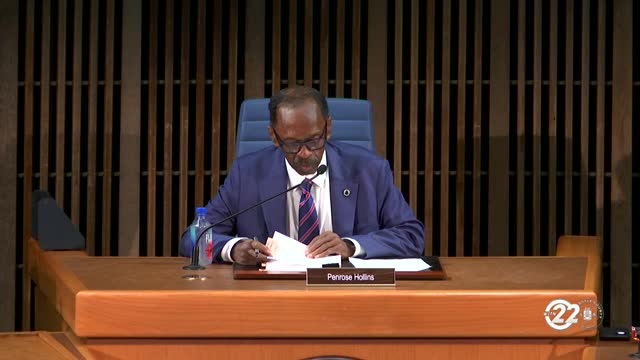
New Castle County’s Community Services Committee on Sept. 23 heard a presentation on Resolution 25177, which would authorize the county executive to execute a partnership agreement with Delaware Family Hope LLC for a Pay‑for‑Success project aimed at ending family homelessness.
The project, led by county staff in partnership with Social Finance and the Hope Center, uses an outcomes‑based federal award under a CPRA program administered by the U.S. Department of the Treasury. Mike Bowser, Greens Director, said the county was one of seven agencies nationally in this funding wave and that the award could total up to $9,600,000 if outcome payments are earned. "CPRA is a federal program it's through the, the US department of treasury," Bowser said during his presentation.
The pilot would enroll 120 families in two cohorts of 60. Participating families would be offered up to a 90‑day stay at the Hope Center, intensive case management and financial counseling, and then 24 months of direct monthly cash assistance to the head of household. Bowser described the rental subsidy as "90% a fair market value rent based on family size" for the two years of payments. The program design ties federal outcome payments to permanent housing retention and avoidance of shelter stays, as measured by an independent evaluator.
Why it matters: the structure shifts most upfront cost to philanthropic and private funders and repays those upfront funders from federal outcome payments if the intervention shows statistically significant results. Bowser said the county has raised $2,250,000 to date and is in discussions for another $2,500,000 to $6,500,000; staff estimated approximately $5,000,000 would be needed to begin serving the first cohort. "We believe, to begin servicing the first cohort of 60 families, we will need approximately $5,000,000 to be able to reimburse all service delivery costs," Bowser said.
Program delivery and partners: the county will act as grantee and intervention provider via the Hope Center. The YWCA was selected through public bid to provide case management; the county also contracted for financial counseling vendors. Bowser said the county will use Section 8 technology to automate monthly payments to families. The partnership agreement and a separate evaluator agreement are required by the Treasury before outcome payments can be requested.
Council questions and staff responses: council members pressed staff on safeguards, fiscal exposure, housing placement and benefit treatment. Councilman Jay Street raised concerns that recipients might divert funds and suggested safeguards; he said, "Now you're gonna turn around. You're gonna give me all this extra money to do whatever ... I'm gonna go racetrack." Sam Christian of Social Finance replied that payments are contingent on continued monthly meetings with a case manager and that the intervention is a three‑part model (cash + case management + financial counseling) designed to stabilize participants and provide long‑term follow up: "the main requirement to stay in this program once you start getting funds is that you continue to meet with your case manager for each month throughout those 2 years," Christian said.
On tax and benefit interactions, staff said they are negotiating exclusions and will counsel families before enrollment. "We've been working with every level of government to work on exclusions ... The program is totally optional and, anything like that, there will be a pros and cons discussion upfront," Bowser said. Council members asked staff to confirm whether the county would face budgetary obligations if federal outcome payments do not materialize. Bowser and others said service delivery costs will be paid from philanthropic upfront funds and then reimbursed; the $9.6 million Treasury award would be accepted by ordinance after outcome payments are received and would be brought back to council for appropriation.
Housing navigation and operational limits: staff said the contract includes a housing navigator tasked with landlord outreach because housing placement will be a key challenge. Nicole Waters, Community Development and Housing Manager, emphasized that monthly cash in the household can make families more competitive for units that require higher income verification than traditional voucher programs. "The funds provided by this program will be considered income and gives them the opportunity to successfully compete for housing," Waters said, adding that the program will require ongoing case management and budgeting support.
Outstanding items and next steps: the committee heard detailed questions about contract language and budget controls; some council members requested clearer numeric limits and return‑to‑council triggers for material fiscal changes. Bowser said staff will return to council for the ordinance to accept the $9,600,000 award when outcome payments are realized and that the county would not proceed to serve cohorts until sufficient upfront philanthropic funding is secured. The resolution remained before the committee at the end of the meeting; no final committee vote on Resolution 25177 was recorded in the transcript.
The social finance team on the call included Sam Christian and Lucas Fried, who reiterated the emphasis on case management and long‑term evaluation to measure whether the intervention produces repayment‑triggering outcomes for government cost savings.