Get Full Government Meeting Transcripts, Videos, & Alerts Forever!
Get email alerts on the Housing topic
No spam. Unsubscribe anytime.
Bloomington deliberation session hears affordability, 'missing middle' and ADU concerns
Summary
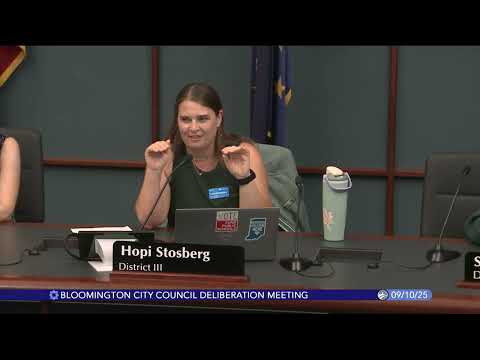
The Bloomington Common Council held a deliberation session Sept. 10 to gather residents' personal experiences with housing; council leaders said the meeting was intended to collect lived experience rather than debate specific policy.
The Bloomington Common Council held a deliberation session Sept. 10 to gather residents' personal experiences with housing; council leaders said the meeting was intended to collect lived experience rather than debate specific policy. “The purpose of the session this evening is not to debate specific types of housing or housing policies, but to get a better understanding of what needs are and are not being met with our current housing market,” President Stasberg said.
Participants met in seven small groups, each co‑facilitated by a city staff member and a council member, and several facilitators reported back. Jamie, a group co‑facilitator, said, “most people in our group felt that the housing was meeting their needs,” though renters in the same group described rents as “a little bit high.”
The nut graf: Across the room several recurring themes emerged — affordability, limited options for the so‑called “missing middle” (housing priced and sized between student rentals and high‑end single‑family homes), mixed views on accessory dwelling units (ADUs), and concern that short‑term rentals reduce long‑term housing stock.
Reporting from the groups: several groups said homeowners were generally satisfied with their current housing, while renters more often reported affordability pressures and limited nearby amenities. Councilmember Flaherty, summarizing a larger group, said many residents praised investments in neighborhood infrastructure such as the Seventeenth Street multi‑use path but noted that arterials can limit neighborhood connectivity and access to grocery stores and parks.
Multiple groups described demand for “missing middle” options — smaller, walkable units in the roughly $300,000 price range that could serve first‑time buyers or older residents wishing to downsize. A representative from group 6 reported that “[there is] a lot of different people who are looking for around the $300,000 range.” Several participants said such options are scarce in neighborhoods that are also walkable and close to amenities.
ADUs drew mixed reactions. Facilitators reported roughly split interest: some homeowners said they would consider building or renting an ADU if lot size and resale rules permitted it; others said they had no interest. One facilitator relayed that in some groups participants discussed ways to require owner occupancy so ADUs function as year‑round housing rather than short‑term rentals.
Short‑term rentals were described as controversial. Multiple group reports said participants worried short‑term rentals were “skewing our market and are problematic,” while others viewed them as meeting specific needs. Several groups suggested the city should collect better data and consider permit or registration systems; no specific regulatory action was proposed in the meeting.
Participants suggested a wide range of policy ideas and local tools: land trusts, land banks, limits on investor ownership, parking permitting near campus, form‑based zoning to shape scale and design, loosening regulations to allow density in targeted locations, streamlining the planning process to reduce project delay, and stronger regional cooperation among the city, Monroe County and Indiana University. Jeff, a resident who spoke during the public comment period, urged collaboration: “My plea is for the city, the county, and the university to work together on some kind of plan together on housing.”
Other community ideas included cooperative ownership models and shared‑equity approaches. Anna, a participant, recommended “putting together condo associations or shared living, cooperative living situations that are not rentals. So building equity collectively.”
City staff asked facilitators to submit group notes and said the Planning Department is running related outreach; staff will consolidate the input and present a summary at a follow‑up session. The council set Nov. 12 as part two of the deliberation process, during which the city plans to share summaries of outreach and “potential…proposal or potential…change proposals,” according to the facilitator’s closing remarks.
Organizers also offered online and paper reflection forms; staff said survey responses are public record but that names provided are disassociated from comments for privacy.
The session produced no formal motions or votes. Instead, it yielded a record of resident experiences and a range of suggestions for possible policy tools the Planning Department and council can consider as it develops housing proposals for later meetings.