Get Full Government Meeting Transcripts, Videos, & Alerts Forever!
Get email alerts on the Sustainability topic
No spam. Unsubscribe anytime.
Bloomington Commission on Sustainability outlines 2024 grants, tree‑planting and priorities for 2025
Summary
The Bloomington Commission on Sustainability reported funding $7,000 in grants in 2024, awarding neighborhood and working group grants, advancing canopy tree plantings and pilot recycling and composting projects, and setting housing/urban agriculture and education as 2025 priorities.
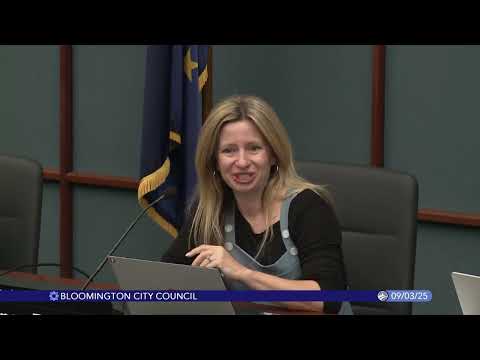
Justin Vassell, chair of the Bloomington Commission on Sustainability (BCOS), presented the commission’s 2024 annual report to the Common Council on Sept. 3, describing grants awarded, program activity and two strategic priorities for 2025.
Vassell said BCOS awarded $7,000 in grants in 2024 from two sources administered with Environmental Services Department (ESD) support: sustainable neighborhood grants and working group grants. Neighborhood awards included a $1,000 follow‑on TerraCycle project in the Covenanter neighborhood to collect hard‑to‑recycle materials and a $1,000 installation of a pre‑made native pollinator garden in Grand View Hills. Working group funding supported a Canopy Bloomington partnership to plant 16 trees in underserved neighborhoods, each with a three‑year maintenance commitment, and a “cob bench” and pollinator garden at Redbud Books on Kirkwood Avenue.
Vassell said ESD provides up to $10,000 annually to each grant category; BCOS does not hold its own treasury. He described other projects in development for 2025, including a Bokashi composting education pilot led by commissioner Matt Austin and potential matching funds from the Monroe County waste‑reduction district.
Vassell summarized operational challenges in 2024 — temporary leadership, quorum issues and meeting continuity — and said the commission responded by holding nine of 12 scheduled meetings, adding work sessions for deeper discussion, passing a formal BCOS resolution in December affirming its advisory role, launching a comprehensive sustainability assessment and an ad hoc climate progress committee.
For 2025 BCOS identified two priorities: (1) housing and urban agriculture — exploring green building, alternative housing and zoning models and food security through urban agriculture; and (2) education, coalition building and outreach — connecting residents to resources, strengthening partnerships and increasing public engagement.
Council members asked about BCOS collaboration with Indiana University (IU) sustainability staff; Vassell said one ex‑officio seat is filled by the IU office of sustainability and noted direct outreach to student and campus organizations. Council members also asked whether the TerraCycle pilot could be replicated; commissioners and Matt Austin said the follow‑on project is intended to produce replicable guidance for other neighborhoods and that larger TerraCycle bins (“pallets”) are available but more costly.
Vassell thanked city staff liaison Sean Mia and sustainability coordinator Jolie Perry and asked the council to continue consulting BCOS on sustainability‑related ordinances and policy.