Get Full Government Meeting Transcripts, Videos, & Alerts Forever!
Get email alerts on the Small Business Relief topic
No spam. Unsubscribe anytime.
Commission backs proposal to create small-business rezoning construction relief fund; supervisors to draft ordinance
Summary
The commission voted to support Board of Supervisors File 250,782, a proposal to create a Small Business Rezoning Construction Relief Fund to help businesses affected by rezoning-related construction, with funding options including general fund, opt-in gross receipts, and philanthropic contributions.
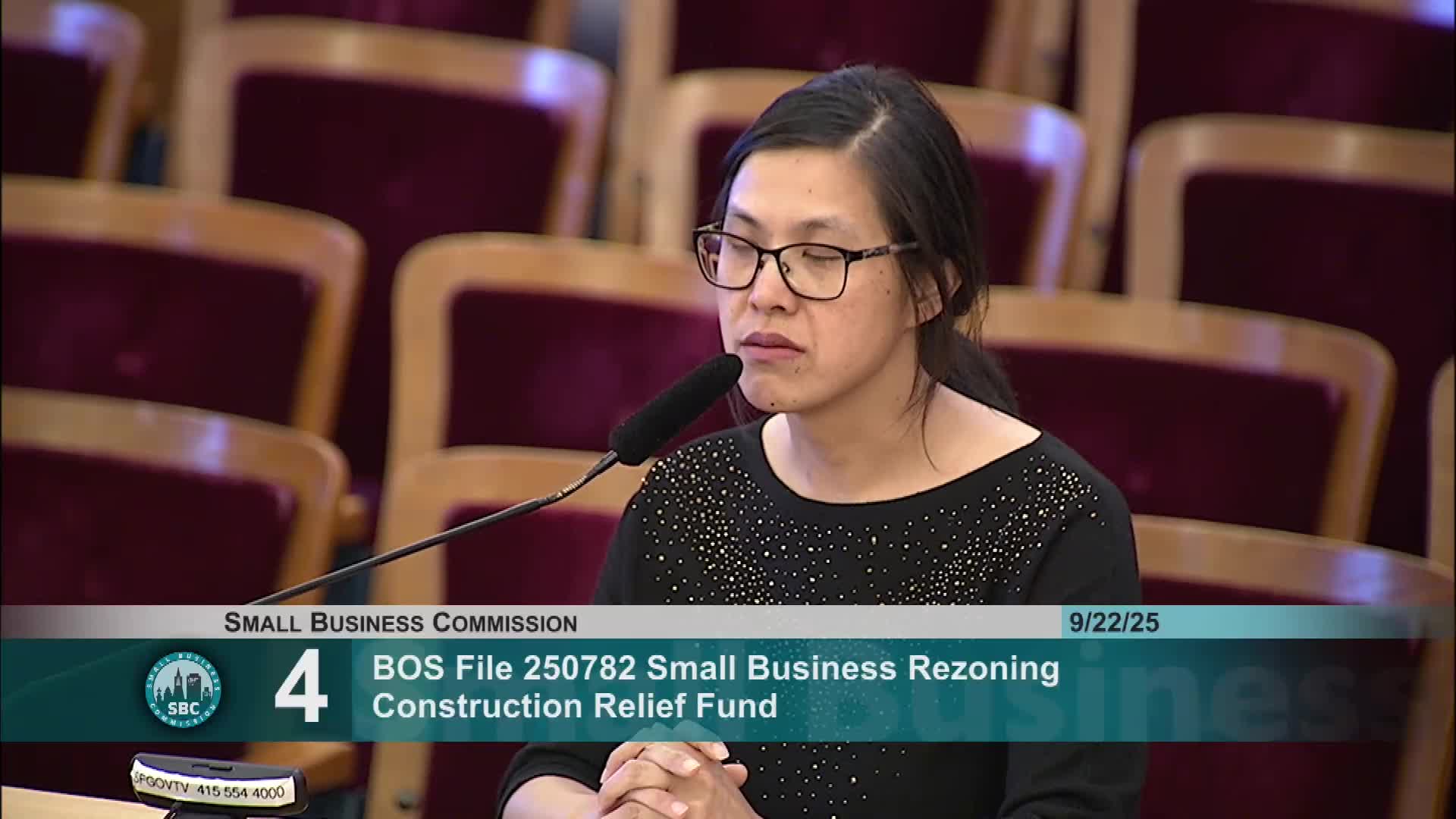
The San Francisco Small Business Commission voted to support Board of Supervisors File 250,782, legislation to establish a Small Business Rezoning Construction Relief Fund intended to provide financial and technical support for businesses affected by construction tied to the city’s rezoning efforts.
Jen Lowe, legislative aide to Supervisor Melgar, presented the measure and said the fund is designed as a mitigation tool for businesses that may be displaced or face reduced foot traffic from construction related to proposed citywide rezoning. Lowe said the fund’s sources could include general fund appropriations, an opt-in mechanism for gross-receipts taxpayers and private fundraising.
Lowe described a flexible program structure that would provide grants or loans for relocation costs, technical assistance and other relief. She said staff and the Board of Supervisors’ Budget Analyst had researched comparable programs in other cities and recommended a program that can adapt to unknowns about how many properties will be developed and how much funding will be needed.
The draft legislation, she said, currently uses the city’s standard small-business definition (100 employees or fewer and $5,000,000 or less in gross annual receipts) but staff are considering amendments to account for industry differences, inflation indexing for revenue thresholds and larger grant sizes for certain sectors such as restaurants.
Several community representatives and trade groups spoke in favor during public comment. Laurie Thomas, executive director of the Golden Gate Restaurant Association, told commissioners the association supports the mayor’s rezoning proposal “with this as a requirement” and urged a broad eligibility definition and higher revenue thresholds. Simon Bertrand of SF New Deal also voiced support.
Commissioner Cynthia Dickerson moved to support Board File 250,782; Commissioner Renae Cornett seconded the motion. The commission recorded five affirmative votes and no oppositions and the motion passed. Commissioners and public commenters urged that staff and supervisors seek varied funding sources and prioritize relief for businesses that are locally rooted and have fewer alternative locations.
Lowe said the program would include a two-year look-back period so businesses that were displaced shortly before the program’s adoption could apply, and that staff envisioned Office of Small Business and Office of Economic and Workforce Development administering the program with flexibility on grant size and eligibility rules. Commissioners discussed possibilities for prioritizing single-location businesses and for tailoring thresholds for restaurants or other sectors with high relocation costs.
The commission’s support is advisory; the Board of Supervisors will draft and consider ordinance language and funding sources. Lowe said supervisors and the mayor’s office have indicated openness to general fund or other sources but that final appropriations and program mechanics would be decided through the board’s legislative and budget processes.