Get Full Government Meeting Transcripts, Videos, & Alerts Forever!
Get email alerts on the Street Vending Theft Enforcement topic
No spam. Unsubscribe anytime.
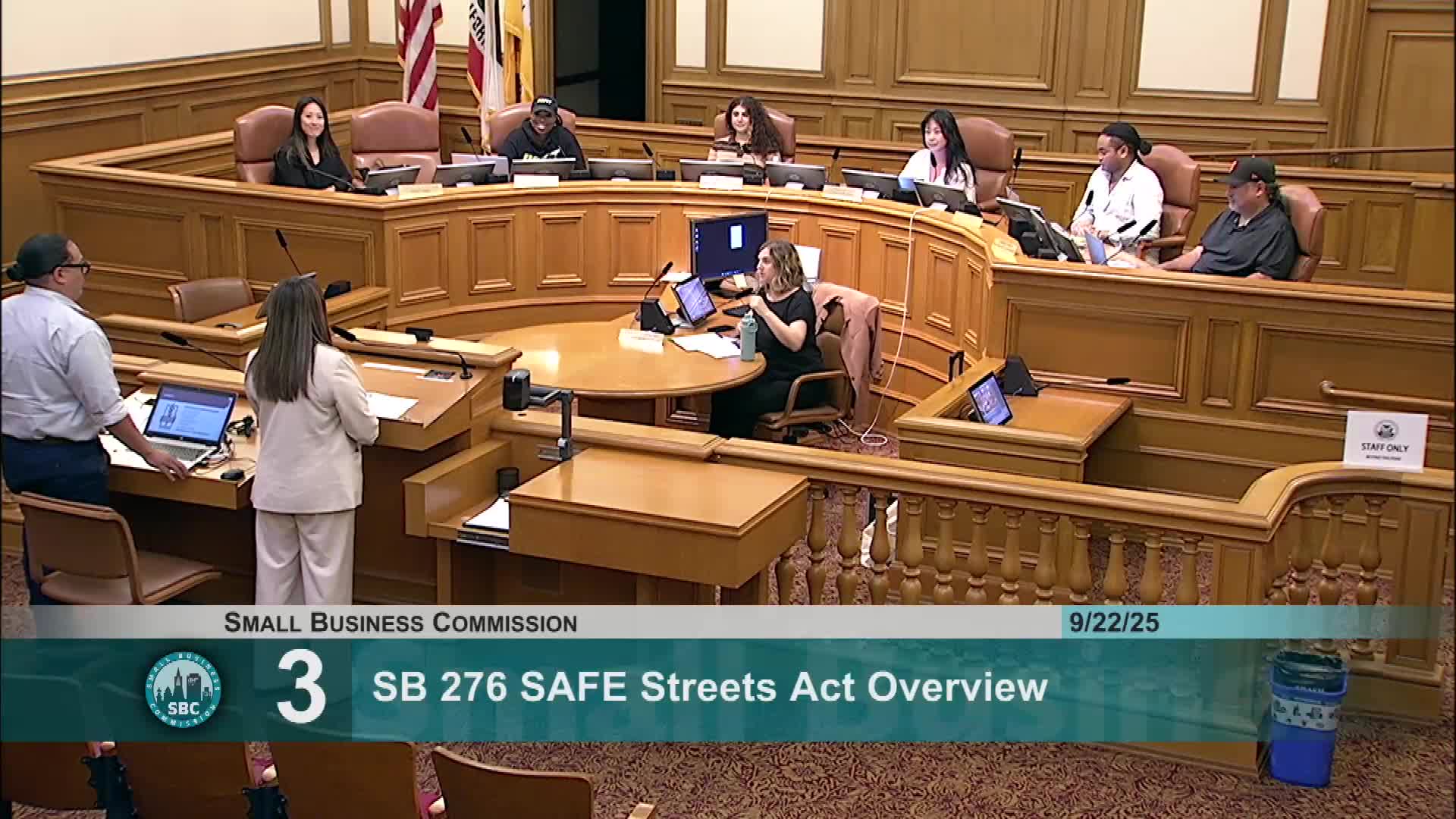
City staff brief commissioners on Senate Bill 276 (Safe Streets Act) targeting sale of stolen goods on sidewalks
Summary
Office of Economic and Workforce Development staff outlined Senate Bill 276, which would allow local authorities to identify commonly stolen items and enable police intervention against unpermitted street sales of those goods; the measure is pending the governor's signature.
City staff briefed the Small Business Commission on Senate Bill 276, the Safe Streets Act, a state measure intended to give San Francisco an additional tool to address the street sale of commonly stolen goods.
Diana Ponce de Leon, director in the Office of Economic and Workforce Development, and Rafael Moreno, senior program manager in the same office, explained that SB 276 would permit the city to adopt an annual local list of commonly stolen items and, under certain conditions, allow targeted police intervention against unpermitted sellers on sidewalks.
Ponce de Leon said the measure grew out of neighborhood concerns about fencing operations and retail theft and that the city had worked “very closely” with Senator Scott Wiener and with affected communities while crafting local responses. Rafael Moreno said the bill “allows for the city and county to come up with a list of commonly stolen items” and that the local list would be submitted annually to the Board of Supervisors.
Moreno stressed exclusions and safeguards included in the state bill: it would not apply to vendors with valid permits who could provide a preferred receipt, nor to prepared food sold on-site or prepackaged food items. He said permit fees would be capped for vendors and that the law would not require fingerprinting or immigration-status checks for vendor applications.
Staff described a multi-step local process if the bill is signed: a community outreach period roughly 60 days before adopting a local ordinance, a 30-day public information campaign, and coordination among the Police Department, Public Works and other city departments to collect data and implement the local ordinance. Moreno said the state bill itself includes an expiration date (Jan. 1, 2031) and that the city would submit an annual legislative packet if it adopts a local list.
Commissioners asked about enforcement scope, data collection and measures of success. Vice President Zazunas confirmed the bill applies to sidewalk sales and not to brick-and-mortar businesses; staff reiterated that brick-and-mortar enforcement is not part of SB 276. Commissioners and staff discussed mechanisms for measuring outcomes, including counting citations and misdemeanor filings, surveying storefront merchants and tracking permit issuance. Moreno listed required reporting items from the state bill: agency administering the permit, the city’s list of commonly targeted merchants, the total number of permits issued, methods used to verify lawful possession of merchandise, number of infractions and misdemeanors issued and demographic data on persons cited.
Commissioners and staff also described programmatic work to reduce demand for stolen goods, such as vendor orientation courses, workforce referrals and incubator programs. Ponce de Leon said outreach and vendor education have led some vendors into permit pathways and workforce programs, and that the bill is only “one piece of a bigger picture” of interventions the city is pursuing.
No formal action was taken by the commission; staff requested feedback and said they would return with updates as the governor’s action and the local drafting process progress.