Get Full Government Meeting Transcripts, Videos, & Alerts Forever!
Get email alerts on the Short Term Rentals topic
No spam. Unsubscribe anytime.
San Antonio board reviews cluster of short‑term‑rental appeals amid tax‑reporting confusion
Summary
At a Board of Adjustment meeting, several owners appealed revocations of short‑term rental permits tied to unpaid hotel occupancy taxes. City staff described reporting and notification gaps tied to an online portal; the board upheld some revocations and reversed one after hearing applicants and neighbors.
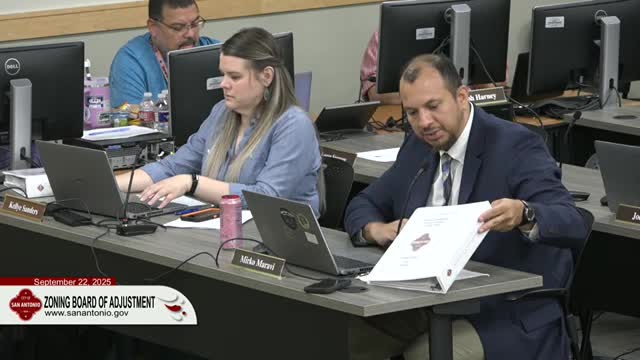
San Antonio’s Board of Adjustment on Tuesday considered a series of appeals from short‑term‑rental operators whose permits were revoked after the city recorded missing hotel‑occupancy tax reports.
The appeals and related discussion focused less on neighborhood impacts than on how the city and operators reported occupancy taxes. Finance department staff told the board audits showed missing reports from August 2024 through February 2025 in multiple cases. Staff and several applicants described confusion in the city’s online portal (referred to in testimony as “Avenue”) and a separate county reporting path; the portal’s form requires operators to select whether a property is inside or outside city limits, and city staff said choosing the wrong radio button could result in revenue being reported to the county but not to the city.
Why it matters: The board’s handling of multiple, similar appeals exposed gaps that commissioners said could be corrected administratively — for example, clearer notice and a simpler payment/notification workflow — while also testing how strictly the board should apply section 16‑1110 of the Unified Development Code, the provision staff cited that allows revocation when taxes are not reported within 90 days.
Board and staff presentations
Finance staff told the board that, for several properties, city records showed zero city reporting for months in late 2024 and early 2025 while county reports showed income. A staff presenter said: “When a user selects the wrong radio button, the revenue can route to the county account instead of the city,” and that the city’s enforcement workflow typically begins when accounts show 90 days of nonpayment, after which multiple notices are sent before administrative revocation is pursued.
Applicants and neighbors gave varied accounts. Roberto Gurán, the applicant for 7630 Cascade Oak, told the board he and his wife faced financial strain after he lost a job in November 2023, and said he had trouble navigating the city’s portal and did not realize a payment‑plan option was available. “If I had received a physical letter, I would have taken steps to correct this,” Gurán said. Neighbors, including Kyle Baker, described repeated on‑site problems at that address — parking blocking sidewalks and trash — and asked for better enforcement of property standards.
Alex Cruz and Louis Sharp, who appeared for 145 East Agarita Avenue, told the board they did not receive clear electronic notices and that some mailed notices went to an old mailing address; Cruz said he believed some emails looked like scams and that he did not open them. City staff confirmed notices were sent to the addresses on file and said permit accounts may list multiple contact emails, which can complicate delivery.
Board action and immediate outcomes
The board split its decisions across cases of similar facts.
- 10 31 South Gevers Street: The board considered a special‑exception request to allow an additional type‑2 short‑term rental on a façade. A motion to grant the façade exception failed on a roll call; Commissioner Ozuna voted yes while nine commissioners voted no; the motion failed 1–9 and the exception was denied.
- 7 630 Cascade Oak (applicant Roberto Gurán): Staff recommended denial of the appeal of the administrative revocation, citing missing hotel‑occupancy tax reports and multiple notices. After testimony from the applicant and neighbors, a motion to reverse the revocation failed on roll call 0–11; the board left the revocation in place.
- 145 East Agarita Avenue (applicant Alex Cruz / Louis Sharp): The board considered an appeal from a revocation based on nonpayment. Commissioners noted the applicant’s claim that notices looked like spam and that emails may have gone to an old address. A motion to grant the appeal failed 0–11; the revocation was upheld.
- 12115 Stony Falls (applicants Alejandro and Jessica Benavides): The board heard about prior inspections and posted notices. After testimony that the property had addressed issues and neighbors spoke in favor, the board voted 11–0 to grant the appeal and reinstate the short‑term‑rental permit.
What commissioners emphasized
Commissioners repeatedly asked staff for clearer documentation of the notice process: when notices are generated, which email addresses are used, whether physical mail was returned, and whether the portal logs show bounced messages. Commissioner Mena and others said a summary table of notices and communications would be helpful in appeals that turn on whether the operator had actual notice and time to correct.
Several commissioners said that while operator errors can justify enforcement, the city should minimize preventable administrative failures. Commissioner Bonilla and others suggested more customer‑facing guidance and a clearer payment‑plan workflow. Commissioner Bregman and Commissioner Brechtmann told applicants who had their appeals denied that they should meet with staff to confirm account details and options for repayment or reinstatement.
What the record shows (and does not)
City staff repeatedly cited the Unified Development Code provision — section 16‑1110 — that authorizes revocation of permits for failure to pay or report hotel‑occupancy taxes within 90 days. Staff also presented evidence of notices and audit comparisons showing county receipts where city receipts were missing. Applicants presented receipts or payment attempts in some cases and said they had been in contact with the portal vendor or the city. The board’s votes turned on those facts as presented; in several cases commissioners concluded either that the operator failed to meet the ordinance’s notice or reporting obligations or that the record did not show an administrative error by staff.
Next steps and recommendations from the hearing
Commissioners directed staff informally to provide clearer notice histories (dates and addresses/emails used), to consider guidance for operators about the city vs. county reporting button, and to offer one‑on‑one help for operators who say they did not receive timely notice. Several commissioners urged staff to tighten the city’s audit and outreach before moving to revocation when errors appear to be technical or customer‑service problems.
For applicants who lost appeals, staff advised meeting with the finance department about payment plans and the process to seek reinstatement.
Ending note: The hearing showed the board balancing enforcement of tax and permit rules with practical problems operators described in using the city’s online systems. The board left several revocations in place, granted one appeal and instructed staff to clarify notice and reporting procedures to reduce future disputes.