Get Full Government Meeting Transcripts, Videos, & Alerts Forever!
Get email alerts on the Civic Process topic
No spam. Unsubscribe anytime.
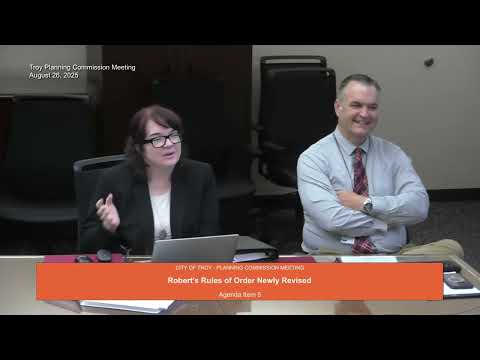
Troy City planning commissioners review Robert’s Rules refresher at Aug. 26 meeting
Summary
City clerk Aileen Dixon led a refresher on Robert's Rules of Order at the Planning Commission’s Aug. 26 meeting, covering quorum, motions, amendments, decorum, and procedures for public hearings and postponements.
Aileen Dixon, Troy City clerk, gave a roughly hourlong refresher on Robert’s Rules of Order to the Troy City Planning Commission during the commission’s Aug. 26 meeting, describing how parliamentary procedure applies to local boards and how commissioners should handle motions, amendments and public hearings.
Dixon told the nine-member commission that basic principles — equality of members, decorum, majority rule and orderly procedure — should guide routine meetings, and reviewed how common parliamentary motions work in a local-government context. She said a quorum for the nine-member body is five and that no deliberation or votes should occur without a quorum. She also stressed that members are entitled to informed voting and equal opportunity to speak before votes.
“Every motion would follow the order of a move, a second, a discussion, and then the vote,” Dixon said, emphasizing that chairs should repeat the motion before a vote so all members understand what they are deciding.
Dixon walked commissioners through subsidiary motions — postponement, tabling, and amendment — and explained that amendments can be by insertion, striking or substitution, and that the main motion is voted on last as amended. She described “calling the question” (a motion to end debate) and “point of order” (a challenge when procedure or decorum is breached) as tools that can be used in contentious discussions.
Commissioners asked scenario-based questions about public hearings when a quorum is not present, when applicants ask to postpone a hearing, how to handle late submittals and whether the chair may make a motion in a small board. Dixon replied that, from a parliamentary perspective, public hearings should not proceed without a quorum and that moving a motion just to get discussion started is a common real-world practice on small boards.
On the question of discussing an item and then postponing it at the requester’s insistence, Dixon said that if a public hearing remains open, the public will have been heard and the hearing can be continued to the next meeting; commissioners can discuss items only after a motion is made and seconded if they intend to take formal action.
Commissioners and staff flagged several practical points for future internal guidance, including how much of a motion needs to be read aloud, how to handle minutes approval when a commissioner was absent from a prior meeting, and the advisability of administrative policies for public-hearing continuations. Several commissioners thanked Dixon for the presentation.
The training closed with commissioners noting the value of the refresher for everyday meeting practice and for consistent enforcement of procedural rules.