Get Full Government Meeting Transcripts, Videos, & Alerts Forever!
Get email alerts on the Economic Development topic
No spam. Unsubscribe anytime.
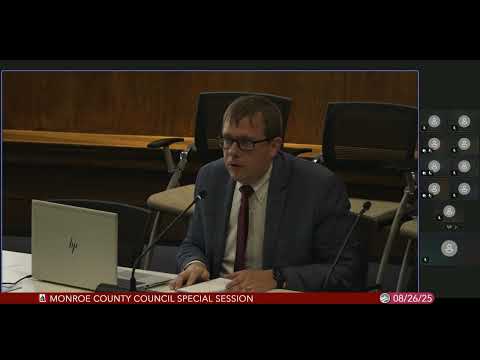
Monroe County Council unanimously approves tax abatement, MOU for Centra US LLC redevelopment
Summary
Monroe County Council approved Resolution 2025-35 to grant a multi‑year tax abatement and associated memorandum of understanding (MOU) for Centra US LLC to redevelop the former GE site on Curry Pike; the vote was unanimous after discussion about a fee provision in the MOU and a failed attempt to amend it.
Monroe County Council voted unanimously on Aug. 26 to approve Resolution 2025‑35, granting a tax abatement and authorizing a memorandum of understanding (MOU) with Centra US LLC for redevelopment and production-line expansion at the former GE site on Curry Pike.
The MOU pairs an augmented abatement schedule with specific investment and hiring benchmarks: Centra has committed to install an initial production line in the renovated facility by 2029 and to create roughly 100 jobs for that line, with an average salary target of about $70,000; additional lines and hires are tied to further abatement extensions. The council also discussed a provision in the MOU that directs a fee from the abatement to the Bloomington Economic Development Corporation (BEDC) if the BEDC remains active.
Why it matters: the project would put a large vacant facility back into use in a Monroe County tax-increment financing (TIF) district, add life-sciences manufacturing capacity locally, and is presented by company and development officials as creating high‑wage jobs and further regional economic activity.
County staff member Jeff Cockrell summarized the MOU framework to the council and described changes from prior abatements, including a narrower definition of “substantial compliance” and a clawback if Centra does not follow through on multi‑line commitments. Cockrell told the council the augmented schedule under discussion would provide “100% abatement for the first three years and then a 90% abatement for the next three years,” with further 90% years contingent on additional production lines and corresponding employment targets.
Pat Adams, identified as site head and general manager of Centra’s Bloomington facility, described the company’s plans and capacity constraints. Adams said Centra expects the first line to involve about $241,000,000 in renovation and installation and commit roughly 100 jobs for that line. Michael Eichoff, a principal at Grant Thornton advising Centra, and other company representatives joined Adams at the meeting to answer council questions.
Council discussion focused on two subjects: the MOU’s performance triggers and the section that directs an abatement-related fee to a local economic development nonprofit. Councilor David Henry asked for public clarification on the fee language, saying, “The word shall has my attention,” and sought to understand whether the fee would be automatically passed through to a nonprofit without annual council review. Cockrell responded that the fee mechanism follows state code language permitting counties, with company agreement, to charge a fee to be forwarded to a nonprofit that supports economic development, and that the MOU specifies the BEDC as the recipient only “in the event that the BEDC is still in existence, still not for profit, and still doing the economic development of the community.”
Henry then moved to amend the MOU to strike the fee provision (section 2); the motion did not receive a second and therefore failed. Council members expressed support for the overall project across the political body. Councilor Hawk, whose district includes the site, said constituents “are really looking forward to seeing jobs created there.” Councilor Peter Iverson and others noted the site’s potential to strengthen Monroe County’s life‑sciences cluster and the regional ties with research institutions.
Jen Pearl, president of the Bloomington Economic Development Corporation, spoke during public comment in favor of the project and provided economic multipliers cited by BEDC: she said pharmaceutical manufacturing typically produces additional indirect and induced jobs and spending regionally and highlighted that the proposed average wage of about $70,000 is above Monroe County’s median household income. Pearl also characterized the redevelopment of the former GE site as a long‑term community benefit.
Council members raised other implementation concerns during the discussion. Several asked about timeline and triggers for additional lines and hires, housing availability for new employees, and traffic and shift‑change impacts for neighbors. Company representatives said they are planning multiple entrances and staging to reduce roadway backups and described commitments to workforce upskilling. Council members asked that those operational details be further developed in site plans and subsequent permitting.
The council took a roll‑call vote on Resolution 2025‑35. The record shows the seven members present voted yes and the motion passed unanimously; the resolution and MOU will next go to the county commissioners because the property is in a TIF district and the commissioners must approve a statement of benefits for tax payments within a TIF district.
The meeting adjourned after the vote; the MOU takes effect in accordance with the resolution but still requires separate signatures on the MOU document as noted during the session.