Get Full Government Meeting Transcripts, Videos, & Alerts Forever!
Get email alerts on the Emerging Contaminants Grants topic
No spam. Unsubscribe anytime.
MassDEP outlines rolling ECSDC grant and new engineering-design program for small water systems
Summary
Abby Jacobs of the Massachusetts Department of Environmental Protection described two grant opportunities — the ECSDC program and a new Engineering and Design Plans Grant — both open with rolling admissions and targeted to small or disadvantaged community water systems addressing emerging contaminants including PFAS and manganese.
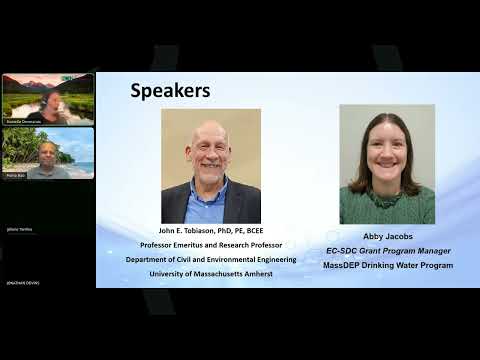
Abby Jacobs, grants manager for the Emerging Contaminants in Small or Disadvantaged Communities (ECSDC) program at the Massachusetts Department of Environmental Protection, described available grant funding and eligibility during an RCAP Solutions webinar on Sept. 16.
Jacobs said the ECSDC grant funds planning, design and construction of long-term solutions for emerging contaminants, naming PFAS and manganese as examples. She said eligible entities include community public water systems (publicly or privately owned), nonprofit transient and nontransient noncommunity systems and systems located in a Clean Water Trust disadvantaged community or serving populations under 10,000. Small systems that are not in a designated disadvantaged community must demonstrate limited capacity to take on debt to qualify.
"This grant is not competitive, and it's still open with rolling admissions," Jacobs said, urging interested systems to submit a needs-assessment survey to express interest.
Jacobs also reviewed a newly launched Engineering and Design Plans Grant that pays engineering firms directly for design work to address emerging contaminants. The program supports community public water systems in disadvantaged communities and can provide up to $75,000 toward engineering/design costs and is supported by funds that can be applied to projects up to roughly $500,000. Jacobs said priority and eligibility rules differ slightly between the two grant tracks and noted for-profit systems and certain transient noncommunity systems have limited eligibility for some awards.
Why it matters: Small and disadvantaged systems commonly lack in-house engineering capacity and capital; these two programs are structured to lower planning and design barriers and to connect systems with preapproved engineering firms and technical assistance providers.
Other program features Jacobs described: - Eligible activities: nonroutine and pilot testing, planning and design, interconnections, new or test wells, pilot treatment work and consolidation projects. - Application details: needs-assessment survey available on the program website to indicate interest; both programs operate on rolling admissions and applicants are encouraged to apply early. - Engineering grant specifics: pays engineering firms directly for design work; eligibility restricted to small systems in disadvantaged communities for the newly launched engineering grant track.
UMass and RCAP support: Jacobs and webinar hosts noted UMass and RCAP Solutions provide technical-assistance providers and bench/pilot resources to support implementation. Webinar slides listed contact names for TA providers (Eric, Christina and Adam) and indicated additional lab resources purchased through an EPA grant to support PFAS measurements and other testing.
The webinar concluded with instructions on certificate requirements for continuing-education credit and a reminder to complete the program needs-assessment form. Jacobs and the webinar hosts said interested systems should contact MassDEP or listed TA providers for next steps.