Lifetime Citizen Portal Access — AI Briefings, Alerts & Unlimited Follows
House subcommittee divides over national voucher policy; H.R.3345 entered into record without objection
Loading...
Summary
Members of the House Oversight subcommittee debated national school choice and voucher policies during a hearing that featured witnesses for apprenticeships, career pathways and school choice. Committee Republicans argued vouchers and choice expand opportunity; Democrats warned of diverted funds and oversight gaps. Rep. Higgins entered H.R.3345 (a
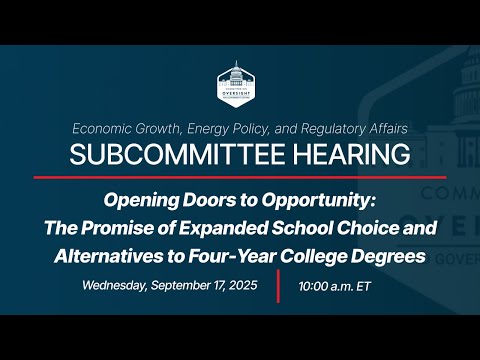
The House Oversight and Reform Committee’s Subcommittee on Economic Growth, Energy Policy, and Regulatory Affairs heard competing views on national school choice and voucher policies during a hearing that included education and workforce witnesses and members from both parties.
The dispute centered on whether federal policy should expand taxpayer-funded vouchers and tax-credit scholarship programs or strengthen and fully fund public schools. Chairman Burleson and Republican witnesses praised recent federal action to expand school choice; Democrats including Ranking Member Frost and Rep. Ansari argued vouchers divert scarce public resources and weaken accountability.
Republican proponents said choice gives families alternatives when traditional public options do not meet student needs. Shaka Mitchell, senior fellow at the American Federation for Children, said school choice ‘‘isn’t about abandoning public education. It’s about expanding options, fostering innovation, and holding every school accountable for results.’’ Mitchell told the subcommittee that ‘‘over 1,300,000 students are enrolled in one of 74 publicly funded choice programs across the country,’’ and cited Ohio research he said showed higher college enrollment and bachelor’s attainment for participants in that state’s program.
Witnesses and members also linked school choice to workforce readiness. Rachel Gretzler, visiting fellow at the Economic Policy Innovation Center and research fellow at the Heritage Foundation, said ‘‘we have become too fixated on 4‑year college degrees’’ and argued federal subsidies encourage students to take degrees with low returns.
Democrats disputed the claims that vouchers improve outcomes and highlighted risks to public schools. Rep. Ansari said Arizona’s voucher program ‘‘has been a catastrophic failure’’ and asserted ‘‘about 70% [of voucher funds] are being used by families coming from the wealthiest ZIP codes’’ while oversight has been weak. Ansari told the panel she had seen ‘‘voucher dollars on luxury items, pianos, ski trips, and even video game consoles’’ during oversight hearings on that state program.
Orange County, Fla., school board member Stephanie Vannos described public school programs aimed at offering choices inside the system, including magnet programs, dual enrollment and career and technical education. Vannos said those options serve ‘‘students with disabilities, students from all socioeconomic backgrounds, and English language learners’’ and warned that diverting public funds would harm teacher retention and extracurriculars. She told members that ‘‘teacher pay in Florida ranks 50th’’ and that the state’s voucher expansion has coincided with what she called chronic underfunding of public schools.
Committee members exchanged sharp questioning. Rep. Boebert praised choice and criticized higher education costs as a ‘‘scam’’ for some students, while Rep. Higgins defended proposals to reduce federal involvement in education. During the hearing Rep. Higgins asked unanimous consent to enter H.R.3345 — a bill he said would abolish the Department of Education and transition services to states — into the record; the request was entered ‘‘without objection.’’
Both sides urged attention to accountability and to students who are not well served by current arrangements. Democrats emphasized oversight, funding shortfalls, and impacts on students with disabilities; Republicans emphasized parental freedom and alternative pathways. The hearing record includes extensive written testimony and follow‑up materials that members said would be submitted for the congressional record.
The subcommittee adjourned after members were given five legislative days to submit additional materials and questions for the witnesses.