Get Full Government Meeting Transcripts, Videos, & Alerts Forever!
Get email alerts on the Parking topic
No spam. Unsubscribe anytime.
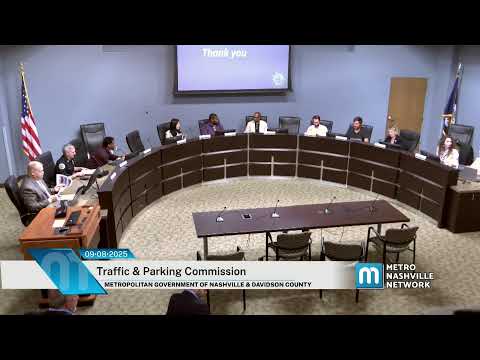
Traffic & Parking Commission delays Music Row paid-parking expansion after public objections
Summary
The Metro Traffic & Parking Commission deferred a proposal to convert roughly 209 curbside spaces on Music Row to paid "economy" rates after public comment and requests for more community outreach; NDOT said existing paid spaces in the district would also convert to the lower economy rate if approved.
The Metro Nashville Traffic & Parking Commission on an item brought from its consent agenda deferred action on a proposal to add paid parking across parts of Music Row and to convert existing spaces there to an "economy" rate.
The proposal from Nashville Department of Transportation staff and their contractor, Emmanuel Matias of Endat, would add parking meters at multiple blocks on or adjacent to Music Row and set an economy-zone rate of $1 per hour with a 10-hour maximum. After public comment from nearby residents, representatives of the music community and college staff, and extended commissioner questions about outreach and impacts, the commission voted to defer items 5.20.1–5.20.7 to the next meeting (the commission moved the October meeting to Oct. 20).
The plan, as presented by Emmanuel Matias, would both add new paid spaces and convert some currently paid non-economy spaces to the lower economy rate. "The economy zone . . . are a dollar per hour with a 10 hour max," Matias told the commission, describing the proposed rate structure.
Why it matters: Music Row contains a mix of small businesses, studios, colleges and residences. Several speakers told the commission they either had not been notified or believe the change would harm long-standing local uses. Dave Pomeroy, president of the Nashville Musicians Association, said the area is not primarily retail and that many musicians and staff need long-duration curb access. "No one contacted us," Pomeroy said. "This would cause huge inconvenience to the creative community in what's left of Music Row."
What commissioners heard: Residents described street-level parking reliance, students and faculty described limited lot capacity, and local music organizations said they were not reached before the proposal appeared in staff materials. Commissioner Hollis asked for utilization data and clearer evidence that new paid parking was needed; staff responded that utilization data for currently free curb spaces was not available in their dashboard but that existing paid-space utilization data would be brought to a future meeting.
Staff described outreach steps that had occurred: internal analysis, flyers to addresses in the proposed area and contact with the area council member. Commissioners and members of the public said that outreach had not reached many affected parties. Commissioners asked NDOT to produce a checklist of engagement steps and utilization/revenue dashboard data before the item returns.
Following discussion, the commission voted to defer all seven Music Row items off the consent agenda to the commission's next meeting to allow further community engagement and for staff to return with additional information and clearer notice plans.
Votes at the meeting related to the item: the commission approved removing items 5.20.1–5.20.7 from the consent agenda for separate consideration, then voted to defer those items to the next meeting. The consent agenda item 5.1 (authorization for a new multiway stop at Woodland Avenue and South Sixth Street) was approved as moved earlier in the meeting.
The commission asked NDOT to return with: utilization and revenue dashboards for existing paid zones; documentation of prior outreach and the flyer distribution; clarity on how council-member input is obtained and recorded; and suggested approaches for resident accommodations such as validations or resident permit options (NDOT staff said technology for resident stickers/validations is still under discussion).
The commission set a 30-day expectation for additional outreach before installation if the items are reintroduced, and NDOT said there is generally a short grace/enforcement period (two weeks of warnings) after signage and software go live.
The item was deferred to the commission's next meeting, which staff noted has been rescheduled for Oct. 20.