Get Full Government Meeting Transcripts, Videos, & Alerts Forever!
Get email alerts on the Behavioral Health topic
No spam. Unsubscribe anytime.
Sedro-Woolley council hears regional plan to spend opioid-settlement funds on STAR Center, recovery and bridge housing
Summary
Sedro‑Woolley received a briefing Tuesday on a regional proposal to use opioid‑settlement money to fund a mix of one‑time and two‑year recovery services, including start‑up capital for the STAR Center and short‑term “bridge” housing.
Sedro‑Woolley received a briefing Tuesday on a regional proposal to use opioid‑settlement money to fund a mix of one‑time and two‑year recovery services, including start‑up capital for the STAR Center and short‑term “bridge” housing.
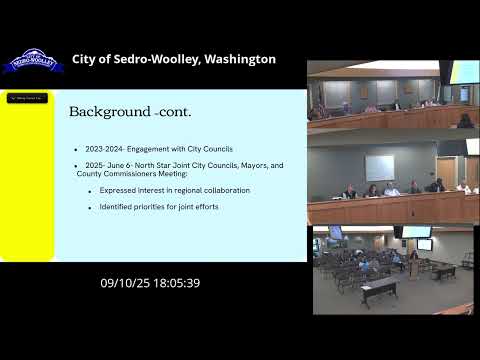
“Council members we are here because we would like to seek your direction in a proposed regional collaboration utilizing opioid settlement funds,” Monica Negrilia, director of strategic initiatives for the North Star initiative, told the Sedro‑Woolley City Council. George Kostovich, who worked with county staff on the proposal, reviewed the funding math and expected outcomes.
Negrilia and Kostovich said the region had collected about $2.6 million from multiple settlements as of June 30, 2025. Under the draft proposal they presented, the funds would be split roughly 80/20 between regional projects and amounts held for each participating jurisdiction. The plan prioritizes three areas: one‑time startup capital for the STAR Center, two‑year pilot funding for short‑term bridge housing, and two‑year funding for expanded recovery housing capacity.
Why it matters: the presenters argued that pooling funds across city and county governments would let the region fund projects—particularly the STAR Center startup—that single jurisdictions could not afford alone. The STAR Center is described in the presentation as a 17,000‑square‑foot facility with 48 beds and about 75 employees; presenters said the annual operating budget is roughly $12 million and the project still needs about $1.5 million in startup capital. The proposed regional split in the briefing had the county covering about $1.0 million and the cities combined contributing about $500,000 toward that $1.5 million startup gap.
Council discussion focused on partnership models, sustainability and local discretion. Councilman Cook described himself as “a strong proponent of the STAR Center” and asked whether the proposed housing investments should be delivered by existing nonprofit providers rather than creating new programs; Negrilia answered that the plan anticipates issuing requests for proposals and partnering with established providers. Councilwoman Kester said she “personally disagree[d] with North Star” and preferred the city direct funds to the STAR Center rather than routing them through an interlocal. Councilman Henderson asked who owns the STAR Center (the county) and how operations would be funded; Kostovich said the presenters expect the provider, Pioneer Human Services, to bill insurance and that the main need is start‑up capital to cover the early months before billing ramps up.
Clarifying details presented or requested: the packet and slides included the $2.6 million regional total (with an asterisk noting settlements and payment schedules continue through later years); Sedro‑Woolley’s share as of June 30 was shown as about $105,000; proposed two‑year amounts for the pilot programs shown in the briefing were approximately $150,000 for bridge housing and $650,000 for recovery housing (total amounts for the county/cities combined under the illustrative 80/20 split); STAR Center startup gap shown as $1.5 million; STAR Center annual operating budget shown as $12 million; STAR Center ribbon‑cutting tentatively scheduled for Dec. 16 and a joint city/county meeting to discuss an interlocal agreement was scheduled for Sept. 30.
Next steps and action: no formal appropriation was made at Tuesday’s meeting. Councilman Cook moved to approve Sedro‑Woolley’s $104,075 share for the three projects; the motion did not receive a second and no vote on final funding occurred. Council members requested additional information—an operating and sustainability model for the STAR Center, clearer contracting models for recovery and bridge housing, and reports back after the other cities complete their discussions. The presenters agreed to return with more detailed budgets and to follow up on contracting and procurement options.
Ending: the council did not authorize spending at the meeting. North Star staff left the council with two calendar items: a Sept. 30 joint meeting to discuss a proposed interlocal agreement, and a tentative STAR Center ribbon cutting on Dec. 16. Council members said they wanted more fiscal detail and to hear how the other cities in Skagit County respond before making a final decision.