Get Full Government Meeting Transcripts, Videos, & Alerts Forever!
Get email alerts on the Solicitation Ordinance topic
No spam. Unsubscribe anytime.
Highlands workshop advances stronger solicitation ordinance after merchants describe harassment and fraud
Summary
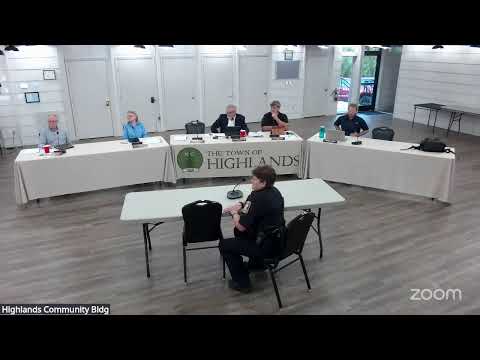
At a Highlands workshop, commissioners agreed by general consensus to send a draft ordinance tightening solicitation and peddling rules to the next council meeting after merchants and residents described repeated harassment, alleged fraud and safety concerns on Main Street.
Town of Highlands commissioners at a workshop agreed by general consensus to bring a draft ordinance tightening rules on solicitation and street peddling to the next formal meeting for a vote, after more than an hour of public comment from merchants and residents who said itinerant vendors and door-to-door solicitors are harassing pedestrians, disrupting businesses and sometimes obtaining large payments through high‑pressure sales.
The draft ordinance was presented by Nick, the town attorney, who said the proposal consolidates existing categories—peddler, solicitor and transient vendor—into a single definition of “solicit,” adds a definition of “aggressive manner,” and gives the town enforcement options against either an individual or a business entity. "We cannot stop somebody from shouting, you know, 'Hey. Come into my store,'" Nick said, adding that the ordinance is aimed at conduct that targets people located on public property even when the solicitor stands on adjacent private property.
The issue drew repeated testimony from downtown merchants. Joanna Fine, executive director of the Highlands Chamber of Commerce, said the chamber receives frequent complaints. "We get at least a phone call or an email every week from visitors and residents that are accosted by these people," she said. Business owner Beata described a customer who she said lost $13,000 after being pressured into a purchase; "She understands that 13,000 is gone," Beata said.
Police described enforcement limitations. Officer McCall told commissioners many calls arrive after the fact and that officers sometimes cannot pursue fraud charges because victims have signed receipts. "Most of the calls that we get... a couple of days later... we're not able to do anything about it," McCall said. The officer said video evidence could be used for charging if a violation is visible on camera.
Under the draft, the town could cite solicitors who continue to press someone who has said "no" or otherwise indicated refusal, and could pursue penalties against the individual or an associated corporate entity when available. Nick and staff clarified that the town cannot generally regulate activity that occurs wholly on private property, but can regulate solicitations directed at people on public sidewalks or streets. Commissioners and merchants also discussed landlord/tenant lease boundaries; if tenants do not lease the outside area immediately in front of their doorway, landlords could restrict use of that space to prevent soliciting onto the public sidewalk.
Participants asked about penalty levels. Town staff said North Carolina law limits local civil penalties, and the town attorney noted the statutory per‑violation civil cap of $500 under state law; the draft also contains language to criminalize certain violations as misdemeanors. Several speakers urged stronger deterrents and supplemental measures such as plain‑clothes patrols and additional cameras to capture violations for charging.
After extended public comment — which included allegations of harassment, allegations of deceptive product claims, and concerns that aggressive soliciting is deterring visitors and hurting downtown businesses — the commission signaled general consensus to place the drafted ordinance on the agenda for the next meeting for consideration and a potential vote. Commissioners also approved workshop minutes during the session.
The discussion included references to other municipalities that have limited solicitation in downtown areas, including Aspen, Sedona and Banner Elk. Police and town staff said they have referred documents about potential fraud and credit‑card complaints to the North Carolina attorney general but have not yet received a substantive response on that separate fraud investigation.
The town attorney and staff recommended returning the ordinance in its revised form at the next regular meeting; commissioners requested that staff also report on possible enforcement tools (cameras, plain‑clothes patrols and lease clarifications) before or at that meeting.