Get Full Government Meeting Transcripts, Videos, & Alerts Forever!
Get email alerts on the Living Shoreline topic
No spam. Unsubscribe anytime.
Owner seeks living shoreline and beach nourishment for Dead And Bones Cove; board approves
Summary
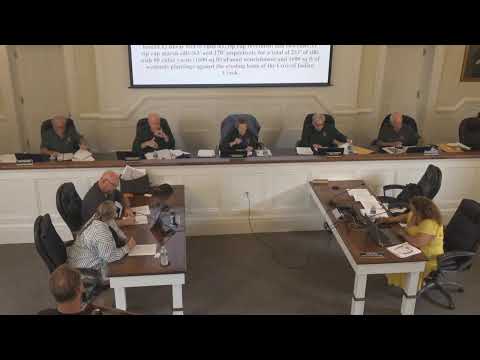
The Lancaster County Wetlands Board approved Tom Sharra’s application, presented by agent Kelsey English of Ransom’s Nursery and Maintenance, to install a living shoreline including a 142-foot rip-rap sill, beach nourishment and wetland plantings along Dead And Bones Cove.
The Lancaster County Wetlands Board approved an application from Tom Sharra, represented by agent Kelsey English of Ransom’s Nursery and Maintenance, to install a living shoreline and beach nourishment along Dead And Bones Cove.
Kelsey English described the proposal as “a 142 feet of rip rap sill” with “about 1,200 square feet of bank grading” and a sand nourishment area intended to provide recreational access for small craft and pets without disturbing wetland vegetation. English said the sand area is the element that prevents the project from qualifying for the board’s group 2 general permit exemption.
Olivia (staff member) told the board the county had no further comment and reiterated that without the sand nourishment the application would qualify as a group 2 permit. After no public opposition, a board member moved to approve the project as submitted and another member seconded; the chair called the question and the motion carried.
The application listed a mixture of structural and soft approaches: a stone sill and rip-rap, bank grading where the bank is undercut, sand nourishment at a recreational access point, and wetland plantings along the shoreline. The ad and presentation identified the site as Dead And Bones Cove, off Virginia State Highway 222 (Williams Road) on Toms Morris Drive, tax map 278B-4-41, VMRC application number 25-1882.
Board action was limited to the elements within its jurisdiction; the staff record notes the sand nourishment keeps the project out of a general-permit category and therefore before the board for explicit approval.
The board’s written record will contain permit conditions and technical details required for construction and planting to ensure the sand and plantings do not harm jurisdictional wetlands.