Get Full Government Meeting Transcripts, Videos, & Alerts Forever!
Get email alerts on the Municipal Budget topic
No spam. Unsubscribe anytime.
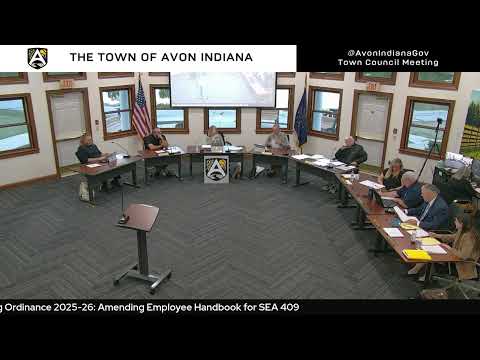
Avon reviews sustainability analysis and introduces proposed 2026 budget
Summary
Town financial advisor walked the Avon Town Council through a multi‑year sustainability analysis and staff introduced draft 2026 budgets for the general fund and major special funds, flagging risks from state tax changes and recommending revenue options including a wheel tax and an excess‑levy appeal.
Greg (financial advisor) reviewed a multi‑year sustainability analysis and the staff presented the town’s proposed 2026 budget levels, urging caution about state law changes that could reduce local revenue.
Greg told the Avon Town Council the analysis models revenues and expenses fund‑by‑fund and focuses on where the town will “land” in 2028. He highlighted two state changes that are central to the town’s outlook: the circuit‑breaker credit and the recent legislative actions he referred to as SB 1 (already enacted) and a likely SB 2 (expected to follow). Greg said the town faces about $291,000 in additional lost revenue tied to a $300 tax credit the state will provide to homesteads in 2026 and cautioned that other revenue streams (notably local income tax distributions and interest income) are uncertain.
Why it matters: the sustainability analysis sets boundaries for the 2026 budget and establishes what level of ongoing spending the town can support into 2028. Greg and staff emphasized that decisions this year (for example, how much to appropriate in 2026) will tighten or loosen the town’s options when the TIF district revenues decline and state growth quotas change.
Key budget items and assumptions - General fund: staff recommended a proposed general fund budget of $10,200,000 (presented as the policy target for 2026). Greg said the recommendation assumes the town will pursue an excess‑levy appeal to capture newly allowed levy growth and that the town would qualify for the three‑year growth factor the state recently provided. - Park fund: staff said the park fund target for 2026 is $1,000,000 (the 18‑month budgeting approach was noted); 2024 actuals were about $813,000. - Food & beverage: food‑and‑beverage revenues were presented at $2,400,000 and are being used to support park operations and bond coverage tied to park projects. - TIF and other capital funds: staff described a strategy to reduce 2025 TIF appropriations and shift some projects to 2026 to better match cash flow and avoid encumbrances; council and staff discussed the need to plan for TIF districts that will expire (notably a major district in March 2028). - Stormwater and infrastructure: the stormwater utility showed a cash balance above $1,000,000 and staff confirmed new subdivisions are automatically captured once assessed through the county; a collections policy and lien process were described to address unpaid accounts.
Risks and revenue options Greg and staff flagged multiple near‑term risks: declining interest income, growth‑quotient uncertainty under SB 1/SB 2, larger circuit‑breaker impacts, and the scheduled reduction of some TIF revenue through 2028. To offset those risks they recommended several revenue actions that the council is already considering: (1) pursuing an excess‑levy appeal available in the immediate term, (2) enacting a municipal wheel tax and surtax to secure road‑funding matches, and (3) careful use of fund balances and targeted transfers (for example, a one‑time $600,000 support to a TIF project this year).
Staff noted insurance and personnel cost pressures: liability/property insurance renewal placeholders were set at a 20% increase (about $100,000) because of growth and increased vehicle exposure; PERF employer rates for sworn police were noted to increase (from 20.3% to 23.3% in the presentation) and police recruitment and longevity were budgeted as part of the proposed personnel increases.
Council process and next steps Ryan (staff) explained the schedule: the presentation served as introduction of budget levels. The public hearing was set for September 11 and final adoption is scheduled for October (the ordinance/adoption vote will be on the October agenda). Staff asked council members to send feedback before the September work session so adjustments can be made prior to the public hearing.
Ending The council heard the sustainability report and accepted the proposed 2026 fund levels for public review. Staff emphasized that final decisions this year (including whether to pursue an excess‑levy appeal or enact a wheel tax) will materially affect the town’s fiscal position into 2028. Greg and staff said they will return with additional detail and formal ordinances for council action in September and October.