State Water Board opens CEQA scoping for Potter Valley Project; public comments due Nov. 3
Summary
The California State Water Resources Control Board on Oct. 25 held a public scoping meeting to gather input for an Environmental Impact Report tied to PG&E's surrender and proposed decommissioning of the Potter Valley Project; the board will accept written comments through 4 p.m. on Nov. 3, 2025.
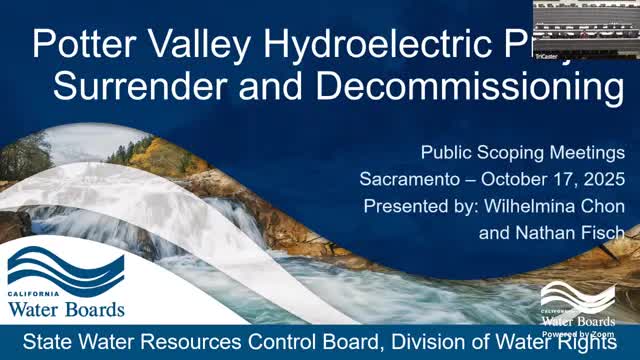
The California State Water Resources Control Board on Oct. 25 held one of four public scoping meetings to solicit input on a State-led Environmental Impact Report (EIR) connected to Pacific Gas and Electric Co.'s surrender and proposed decommissioning of the Potter Valley Project, and to guide a Section 401 water quality certification the board expects PG&E to request.
The board said it will serve as the CEQA lead agency, prepare an EIR to support any conditions in a future 401 certification, and accept written comments until 4 p.m. on Nov. 3, 2025. The agency said a draft EIR will be released for a minimum 45-day public comment period when ready.
Why it matters: The Potter Valley Project includes Scott and Cape Horn dams, Lake Pillsbury and diversion facilities that transfer water from the Eel River to the East Branch Russian River. Public commenters at the scoping meeting urged the board to use the 401 certification process to require restoration-focused conditions, to analyze sediment and downstream water-quality impacts to the estuary and coastal fisheries, and to center tribal cultural resources and participation in planning and mitigation.
Board staff overview and next steps Nathan Fish, senior environmental scientist at the State Water Resources Control Board, opened the meeting and introduced staff. Wilhelmina Chan, environmental scientist in the Division of Water Rights and the project manager for Potter Valley, described the board's role under Section 401 of the federal Clean Water Act: a water quality certification must ensure projects comply with state water-quality objectives and regional basin plans, and any conditions in a issued certification become mandatory parts of a Federal Energy Regulatory Commission (FERC) license or surrender order.
Chan said the board will prepare an EIR to inform certification conditions and evaluate PG&E's proposed project and a range of alternatives. She said PG&E submitted a final surrender application to FERC in July 2025 and intends to apply for a State Water Board 401 certification. The board noted PG&E proposed removal of Scott and Cape Horn dams, restoration of former reservoir areas, removal/transfer/ restoration of recreational facilities, and leaving diversion infrastructure in place for possible future use by another party. Staff said PG&E's surrender package includes 41 plans and measures; the board did not review each plan at the meeting but referenced the Notice of Preparation published Sept. 22, 2025.
Public comments: restoration, sediment, tribal cultural resources and fisheries Public commenters emphasized restoration, the risks and opportunities of dam removal, and the need for robust analysis and enforceable mitigation in the EIR and 401 certification.
Emily Wood, co-director of ROAR (Revitalizing Opportunities for the Alderpointe Region), urged rapid removal and framed the river in cultural terms: "The Eel ... deserves to be treated as a beloved living relative, not as a broken utility," she said, and asked the board to "use current reduced diversions as a baseline and move swiftly toward dam removal."
Glenn Spain, general legal counsel for the Pacific Coast Federation of Fishermen's Associations and Institute for Fisheries Resources, pressed the board to set a geographic baseline that extends to the estuary and coastal fisheries and to include full economic and ecological benefits of restoration in the analysis. He said historical adult returns from the Eel River once reached roughly 800,000 and cited recent count figures he described as about 9,500, urged use of pre-dam sediment transport as a baseline for sediment studies, and recommended examining the Klamath River removal and the associated sediment mitigation plan as precedent.
Abigail Black, representing Save California Salmon, asked the board to treat the 401 certification as "California's most direct tool to ensure this project truly restores the watershed," and asked that any new diversions be analyzed in a separate process. She urged the EIR to analyze sediment release, downstream water quality, cumulative effects of dam removal plus ongoing diversions, and to prioritize tribal leadership and enforceable mitigation.
Sarah Bates, a commercial salmon fisher out of San Francisco, described the Eel River stock's role in California ocean fisheries, said dam removal is the starting point for habitat restoration and spawning recruitment, and urged mitigation planning based on lessons from Klamath removals.
Nicole Whipple, a Round Valley Indian Tribes member, emphasized tribal cultural resources submerged by the reservoirs, requested thorough water-quality sampling for contaminants including mercury and cyanobacteria, and urged the board to recognize tribal beneficial uses and the tribes' long-standing connection to the river.
Regina Chikazola of Save California Salmon urged a robust restoration and drawdown plan, recommended in‑stream flow recommendations to inform later water-right decisions, and suggested better outreach and notice to remote watershed communities to improve tribal and local participation.
What the board said it will and will not decide at this stage Chan and other staff emphasized that the scoping meeting is to identify issues, alternatives and mitigation measures for the EIR; the board did not adopt policy decisions or grant a certification at the meeting. Staff reiterated that the North Coast Regional Water Quality Control Board's basin plan and a regional "restoration policy" allow authorization of restoration projects that may cause temporary exceedances of water-quality objectives if long-term benefits to beneficial uses and water quality are demonstrated; the board said any certification must include conditions to ensure compliance with applicable state requirements.
Outstanding technical and procedural questions raised at the meeting included which baseline(s) to use for sediment and flow analyses (commenters suggested current reduced diversions and pre-dam natural erosion), the appropriate geographic scope (to the estuary and coastal fisheries), how to manage sediment releases from reservoir drawdown, the need for enforceable mitigation and monitoring, tribal consultation and protection of submerged cultural resources, and coordination with any separate NERF (New Eel Russian Facility) proposal whose CEQA lead will be the Eel-Russian Project Authority.
Next steps The State Water Resources Control Board will accept written comments on the scope of the EIR and potential mitigation measures through 4 p.m. on Nov. 3, 2025, and will post the meeting transcript, presentation materials and the Notice of Preparation on the Potter Valley project webpage. When ready, the board will publish a draft EIR with at least a 45-day public comment period and then prepare a final EIR before determining certification conditions.
No formal votes or board decisions were taken at the scoping meeting; the public record and staff analysis will inform the board's subsequent regulatory and CEQA work.