Get Full Government Meeting Transcripts, Videos, & Alerts Forever!
Get email alerts on the Public Safety Transparency topic
No spam. Unsubscribe anytime.
Manassas police roll out public crime‑mapping and city launches community complaint task force pilot
Summary
The Manassas Police Department demonstrated a new public crime‑mapping and alert tool tied to its upgraded CAD/RMS system; the council also received a briefing on a multi‑department 'community complaint task force' pilot aimed at improving 30‑day resolution of property, blight and code enforcement complaints.
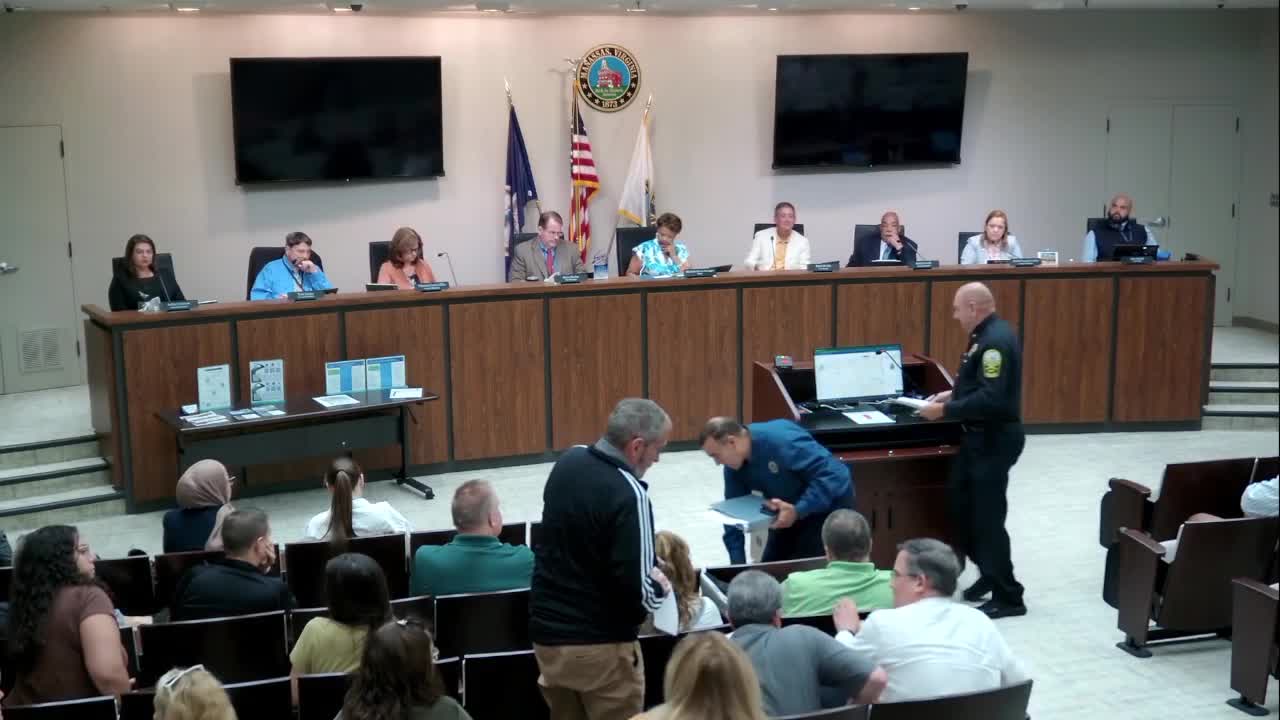
The Manassas Police Department demonstrated a new publicly accessible crime‑mapping and alert portal Sept. 8 that uses the department’s upgraded CAD/RMS (computer aided dispatch / records management) system to display calls for service, police‑reported incidents and heat maps by date range, neighborhood team and call type. Captain Andy Brooks led the demonstration and showed features that allow users to set address‑based alerts, export tables and download incident data to spreadsheets. The department said the online feed will be available from the city website (departments → police) and that data is uploaded monthly to the regional COG crime dashboard for trend analysis.
Chief Keane noted that the system was paid from red‑light enforcement funds and that the CAD replacement and mapping functionality cost about $1.5 million; the chief said none of that was taken from the general fund. The portal includes daily, weekly and monthly alert options and a 24‑hour lag on incident ingestion (captains said the site shows incidents within about 24 hours of reporting).
Separately, the city manager and staff introduced a pilot “community complaint task force” designed to accelerate resolution of recurring quality‑of‑life complaints (overgrown lots, blighted properties, litter/debris, property maintenance). The model calls for cross‑departmental intake when a complaint is filed — for example, a police officer who observes a violation during a separate call can submit the item to the task force — and an expectation that staff will attempt to resolve eligible complaints within 30 days or return them to the full task force for escalation. The pilot will track referrals and outcomes and report back to council at a future retreat with data on resolution rates.
Council members asked that staff consider additional outreach during the pilot and noted other programs (load control, utility customer programs) that complement city efforts to reduce nuisance calls. City staff said the new task‑force model is intended as a pilot and may be refined based on results.