Manassas staff outline proposed battery energy storage system; neighbors, fire officials press for stricter setbacks and emergency plans
Loading...
Summary
City staff and fire officials presented details of a proposed 7 MW lithium‑iron‑phosphate battery energy storage system (BESS) at an existing Church Street utility site, prompting residents to press for larger setbacks, engineered containment and formal evacuation plans. No council vote was taken; staff says a public town hall is scheduled and any
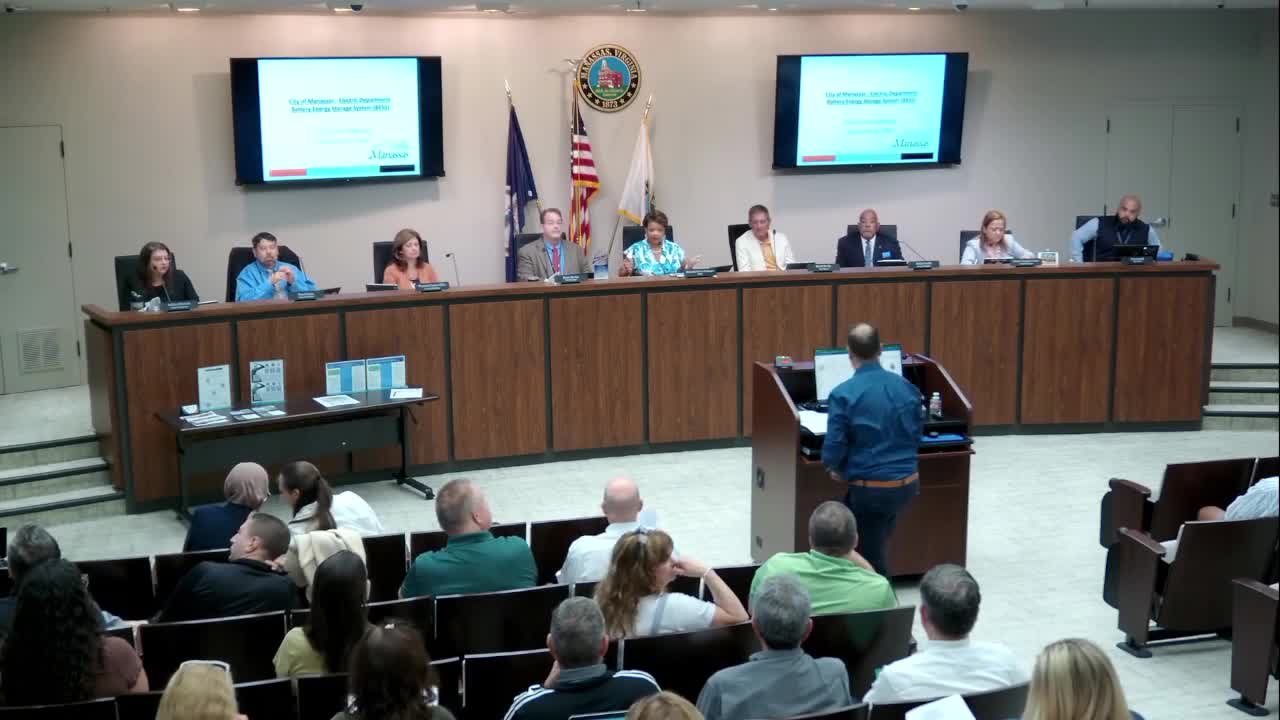
City staff and the fire chief presented a technical briefing Sept. 8 on a proposed 7‑megawatt battery energy storage system (BESS) to be sited at the city’s Church Street utility property near Quarry Road, saying the installation is intended for “peak load demand shaving” rather than market trading or backup power.
The presentation by Tarek Ali (utilities/public works) and Fire Chief Mills described the system as a 7 MW nameplate capable of discharging over a two‑hour period (14 megawatt‑hours total) manufactured to Tesla specifications and using lithium‑iron‑phosphate chemistry. Ali said the city plans to operate the system itself under a 15‑year contract with the vendor and that the agreement limits the installation to 150 charge/discharge cycles per year, which he said equates to a maximum of about 300 operational hours annually.
City staff said the BESS would be used to reduce the city’s demand charges — a major portion of its wholesale bill — and to reduce the city’s use of on‑site diesel generators during peak events. Ali told council the city has about 17,000 electric customers and that demand charges contributed a large portion of the city’s June 2025 Dominion bill, which totaled roughly $3.236 million for that month. He said prior peak‑shaving efforts can reduce demand costs by hundreds of thousands of dollars in high months.
Chief Mills and city staff addressed safety systems and emergency response. Mills described UL testing standards (UL 9540 / 9540A), NFPA 855 and International Fire Code requirements and said BESS units using lithium‑iron‑phosphate cells have a lower probability of thermal runaway than older chemistries. He also said the site will include redundant monitoring, internal fire detection and automatic shutdown, an extinguishing system inside enclosures, a Knox Box for first‑responder access and a site‑specific emergency response plan to be developed with the vendor and the fire department. Mills recommended engineered containment for runoff (a vault or curb that can capture potentially contaminated water) and neutralization procedures for any acidic runoff.
Residents who live immediately adjacent to the Church Street parcel said during public comment that the site sits within or next to a designated historic district, that nearby houses are older and not airtight, and that an event could place thousands of people — including schoolchildren at several nearby schools and residents of an assisted living facility — at risk. Several speakers cited incidents in other states and urged larger setbacks (speakers and public commenters referenced a 100‑foot NFPA recommendation and asked for setbacks of 100 meters where feasible), blast or containment walls and an evacuation plan with clearly published triggers.
Utilities staff said the Church Street site was selected because it already contains generation assets and distribution capacity that allow the city to inject the battery output onto the local bus without violating the city’s contract constraints with Dominion. Ali said other city‑owned sites lack the combination of infrastructure and connections needed for a 7 MW system and that moving the equipment farther from utility infrastructure would require relocating underground utilities at the developer’s expense.
Council members and staff emphasized process: the city manager said the company proposing to operate the BESS will need a property lease and a franchise agreement and that both approvals will require advertised public hearings before council; staff estimated those hearings would most likely occur in October or November. The mayor and several council members encouraged neighbors to attend a city‑staff town hall scheduled for the following Monday and said staff will continue outreach to directly affected property owners.
No formal vote on site approval or a lease took place on Sept. 8. The presentation and the public statements make clear the project remains “proposed” and that additional engineering, public safety, permitting and public‑hearing steps will follow before any lease or franchise is approved.