Get Full Government Meeting Transcripts, Videos, & Alerts Forever!
Get email alerts on the Criminal Justice Court Services topic
No spam. Unsubscribe anytime.
Alachua County accepts outside review of court services, orders stakeholder meetings before implementation
Summary
The county commission received a consultantreport recommending a multi-phase reorganization of Court Services and approved staff to pursue a phased implementation plan with further stakeholder engagement and legal review before finalizing any transfers of duties.
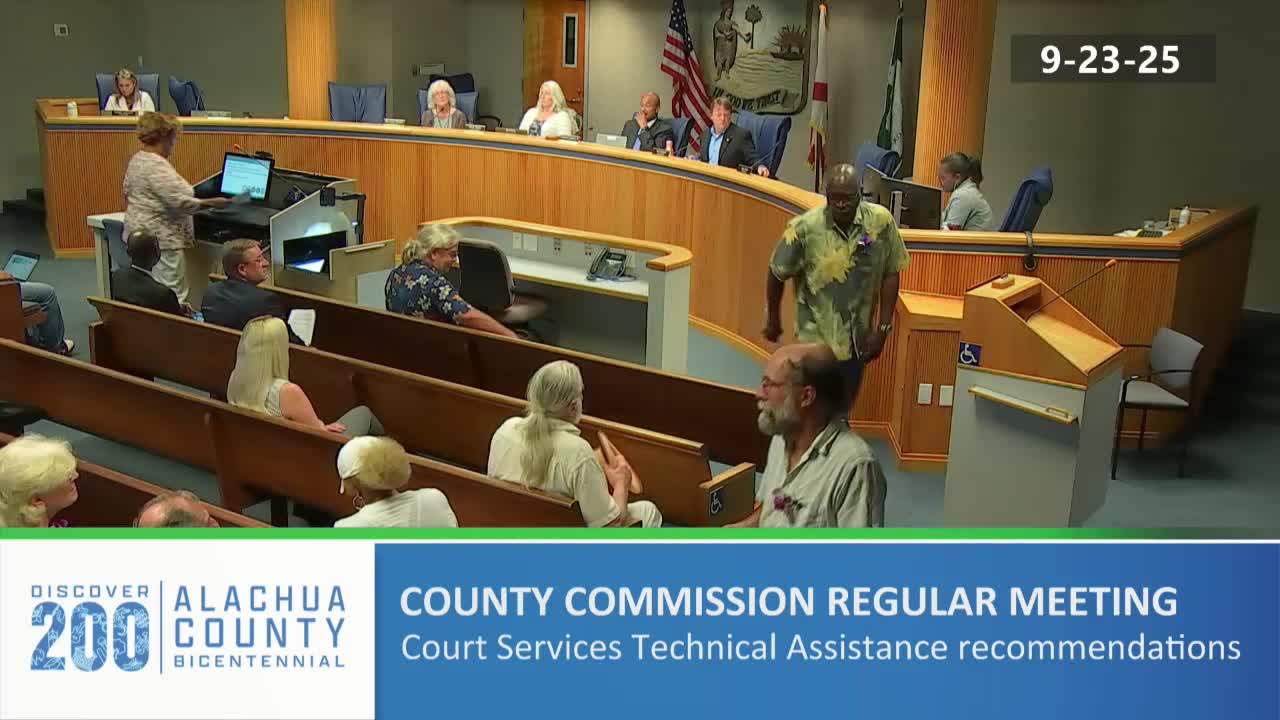
The Alachua County Commission on Sept. 23 accepted a consultantreport that recommends reorganizing the countyCourt Services department and ordered staff to hold targeted stakeholder meetings and return later with an implementation plan.
The Board received the 36-page review from the Center for Effective Public Policy (CEPP), which proposed a three-phase, up-to-24-month approach to restructure pretrial, probation and community service functions to reduce overlap and align duties with best practices. CEPP said the countyshould consider moving certain probation and treatment-court responsibilities to court administration as part of a phased realignment.
County staff leader Heather Akpon, assistant county manager for justice and workforce strategies, told the commission the review followed a year of internal assessment and outside study. CEPP consultants Kelvin Banks and Tara Blair told commissioners they had interviewed justice stakeholders, observed first-appearance courts and jail operations, and analyzed workload and statute references to form their recommendations.
Why it matters: The report aims to reduce duplicated work and mission creepthat staff and consultants said has strained department capacity. The consultants identified opportunities to separate pretrial screening from post-conviction supervision, consolidate electronic monitoring and GPS cases in a single probation-focused unit, move some administrative functions to county IT, and outsource routine drug testing to a vendor. They estimated a phased reorganization could take 18to24 months and would require additional funding for positions transferred to court administration.
Board action: After extended public and commissioner discussion, the commission voted to receive the report, authorize staff to begin the stakeholder and implementation planning process, and return with a recommended implementation plan and any budget implications. The commission specifically directed staff to: - Meet with judicial and justice partners, including the state attorney, public defender, court administration and the Department of Corrections, to discuss proposed transfers of duties and funding implications; - Request legal review where the report flags statutory limits (for example, statutory supervision of felony cases); - Prepare a phased implementation and procurement plan before hiring external implementation support; and - Report back to the board with recommended changes or agreements before full operational transfers occur.
Board members stressed two constraints: (1) this vote accepted the consultantreport and authorized planning, but did not finalize transfers or require immediate operational changes; and (2) many recommendations require agreement from state or judicial partners and additional budget authority if functions move to court administration.
Public input and concerns: Dozens of commenters and advocacy groups spoke during public comment. Some reentry and community advocates, including Emily Westerholm of Release Reentry, supported the recommendations to reduce unnecessary use of jail for low-risk violations and recommended more diversion and treatment options. Several individuals with recent supervised-probation experience asked the commission to ensure changes reduce over-supervision and promote successful reentry.
Legal and statutory issues: CEPPnoted statutory and accreditation questions that require county-county-attorney review; the report includes references to Florida criminal-justice statutes used in the analysis. County attorneys and CEPP exchanged clarifying questions while the report was being drafted.
What happens next: Staff said a formal implementation plan, budget estimates and stakeholder agreements will be prepared and brought back to the commission for additional direction. The board emphasized that acceptance of the report is not an authorization to immediately shift duties without further approvals and that county legal counsel and justice partners must be involved before transfers occur.
Ending: Commissioners praised the depth of the consultant work and emphasized the need to carry the participatory process through: they asked staff to return after structured engagement with judicial and community stakeholders, with a clear budget and timeline for any changes that require new county funding.