Get Full Government Meeting Transcripts, Videos, & Alerts Forever!
Get email alerts on the Crisis Response topic
No spam. Unsubscribe anytime.
Portland presenters outline crisis‑response continuum, urge use of crisis line and coordinated response
Summary
Portland Police Behavioral Health Unit, Portland Street Response and Multnomah County Project Respond described roles and a shared model for in‑person crisis care; presenters emphasized that callers can dial 911 or the Multnomah County behavioral health crisis line (503‑988‑4888), and explained when higher‑acuity involuntary holds apply.
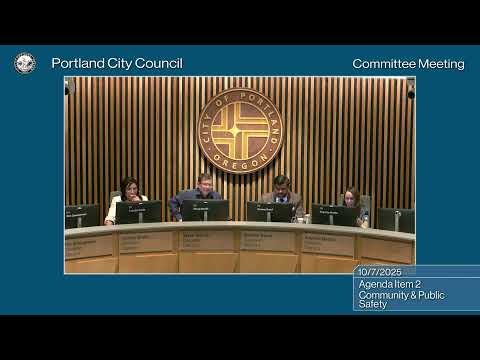
At its Oct. 7 meeting the Community and Public Safety Committee heard a joint briefing on Portland’s crisis‑response model from the Portland Police Bureau’s Behavioral Health Unit (BHU), Portland Street Response, Project Respond (Cascadia) and Multnomah County’s crisis call center.
Speakers described a shared “continuum” of crisis response and four possible outcomes for in‑person crisis calls: on‑scene resolution and disengagement with follow‑up, voluntary transport to care, involuntary transport (for example a police officer hold or a director’s custody hold), and transport to jail when appropriate. The presenters said on‑scene resolution is the preferred outcome when it can be achieved safely.
Jennifer Butcher, acting lieutenant in PPB’s Behavioral Health Unit, explained that Portland Street Response is staffed to address low‑acuity crises and is an unarmed, mobile response team pairing crisis professionals and EMTs. April Roa, interim program manager for Portland Street Response, and Lisa Stewart, program manager for Project Respond (Cascadia), said Project Respond is mandated by the state to provide mobile crisis services across Multnomah County 24/7 and is staffed with master’s‑ and bachelor’s‑level clinicians plus peer providers; Project Respond staff can also author director’s custody holds when a person poses a risk to themselves or others.
Presenters emphasized how the three programs coordinate. Call takers at the Bureau of Emergency Communications (BOEC or 911) and the Multnomah County Behavioral Health Call Center triage incoming calls and route them to the most appropriate responder. Cheryl Lemley, Multnomah County program manager for crisis services, said the county embedded a crisis responder at BOEC about a year ago to prioritize 911 transfers; she said the embedded responder handles transfers first and triages whether mobile response should be Project Respond, Portland Street Response or a 911 emergency dispatch.
Speakers provided usage and operational details: the county crisis line number is (503) 988‑4888; Multnomah County receives roughly 80,000 crisis‑line calls per year and resolves about 85% of calls by phone without dispatching a mobile team. BOEC currently transfers an estimated 60–70 calls a week to the crisis line via the embedded responder, according to presenters.
The committee also discussed training and on‑scene staffing. Presenters described Portland Police Bureau’s Enhanced Crisis Intervention Team (ECIT) program: officers receive roughly 50 hours of CIT training in basic and advanced academy coursework and an additional 40‑hour advanced course is available for those who opt into ECIT; the presenters said about 83 ECIT officers are currently operationally deployable and another roughly 163 officers and sergeants hold certification but are not routinely assigned to respond.
Committee members asked whether Project Respond handles certain complex calls and about the mechanics of how officers request assistance. Presenters said officers in the field can page or text for Project Respond and that, in practice, teams frequently consult and shift responsibility as acuity changes on scene. Multnomah County and PPB presenters also urged public awareness of the crisis phone line but reiterated that callers will receive an appropriate response whether they call 911 or the crisis line: “No wrong door,” Lemley said.
No formal votes or policy changes were made during the presentation; presenters said work continues to expand coordination, public outreach and data auditing.
Ending: Presenters asked the committee to publicize the county crisis line and said they will continue to refine real‑time collaboration among police, unarmed responders and county clinicians to reduce unnecessary emergency detentions and improve follow‑up care.