Get Full Government Meeting Transcripts, Videos, & Alerts Forever!
Get email alerts on the Syringe Services topic
No spam. Unsubscribe anytime.
Lewiston Council removes 1-for-1 language from draft syringe-service ordinance, tables final approval to Oct. 7
Summary
After more than three hours of public comment and council debate, Lewiston city council voted 4-3 to remove language requiring a 1-for-1 syringe exchange from a proposed ordinance governing syringe service programs and then voted 4-3 to continue further action to the council meeting on Oct. 7.
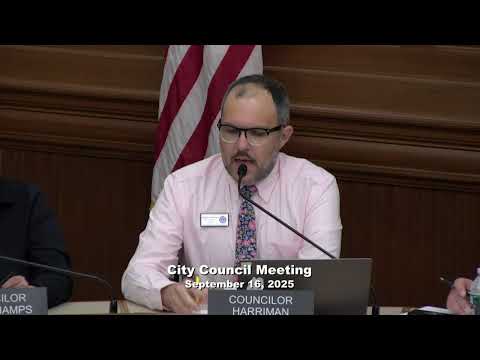
Lewiston City Council members on Tuesday voted to strip references to a required 1-for-1 syringe exchange from a draft ordinance regulating syringe service programs and then postponed final action until the council’s Oct. 7 meeting.
The move capped a months-long process and a night of public testimony in which health providers, recovery advocates and neighbors argued over whether limiting sterile syringe distribution would reduce litter or increase the risk of infectious disease.
Supporters of leaving the 1-for-1 language — which would generally require one sterile syringe be provided for each used syringe returned — said it would increase repeated contact between providers and people who inject drugs, which they argued helps connect clients to services. Opponents, including multiple public-health professionals, said evidence and state guidance favor needs‑based distribution and warned that strict limits would encourage syringe reuse and raise the risk of HIV, hepatitis C and injection-related infections.
Councilor Chittum proposed removing all references to a 1-for-1 exchange from the draft ordinance; the amendment passed by roll-call vote, 4 to 3. Council members later voted 4 to 3 to table further consideration and bring the ordinance back for continued public hearing and action on Oct. 7.
Council debate threaded public-safety concerns with clinical evidence. “Contact is the most important part of this program,” Councilor Sowell said while opposing the amendment; he argued that tighter distribution rules can increase repeat client visits and opportunities for help. Dr. Lisa Miller, a family and addiction medicine physician who spoke during public comment, described a fatal case of infective endocarditis she attributed to shared needles and concluded: “Harm reduction goes way beyond needle exchanges.”
Speakers representing state public-health authorities and local providers urged the council against hard limits. Gordon Smith, director of opioid response for the governor’s office, reminded councilors that state law previously includes a higher distribution cap and urged the city to “stay the course” with needs-based programs. Spurwink, a local harm-reduction and recovery services provider, and other organizations told the council they customize distribution to clients’ needs and that a strict 1-for-1 rule would limit that flexibility.
Council members who supported removal said the change aligns the city’s approach with current public-health recommendations and state guidance. Councilor Chittum said the council should avoid “handcuffing providers who are trying to provide a service to those people most in need of it.”
The public hearing produced scores of speakers, including doctors, recovery advocates and residents. Several asked the city to invest more opioid-settlement funds in sharps-disposal receptacles and regular cleanups to address syringe litter — a concern raised repeatedly by residents who testified that they find syringes in parks and public areas.
Councilors also debated zoning restrictions in the draft ordinance (which would limit where licensed syringe-service programs could operate), mobile distribution, and whether the city should cap the number of licensed providers. Director Conner of city staff told the council the draft ordinance excludes mobile exchanges for now; staff proposed to return with a separate workshop on mobile services.
The council’s action removes the 1-for-1 requirement from the draft but leaves other contested provisions in place for further review. The item remains on the agenda for Oct. 7, when the council will resume deliberations and accept additional public comment.
A spokeswoman for Spurwink thanked residents and councilors for the extensive testimony and said the organization would continue to work with the city on operational and location questions. The city clerk’s office said the public hearing record will be continued and updated language will be circulated before the next meeting.
Lewiston’s vote mirrors a broader debate nationally and in Maine about how to balance harm-reduction best practices against neighborhood concerns over discarded syringes. The council’s decision to remove 1-for-1 language does not itself create a licensed program; any provider must still meet state certification and local licensing steps described in the draft ordinance.