Get Full Government Meeting Transcripts, Videos, & Alerts Forever!
Get email alerts on the Wildfire Fund Affordability topic
No spam. Unsubscribe anytime.
Informational hearing on SB 254 outlines $9 billion wildfire fund proposal and affordability measures; no committee vote
Summary
Sen. Becker and coauthor Assemblymember Petrie Norris held an informational hearing on SB 254, which combines wildfire‑fund reforms, securitized financing for mitigation, transmission financing measures and permitting changes aimed at lowering rates. The hearing was informational; the committee did not vote on the bill.
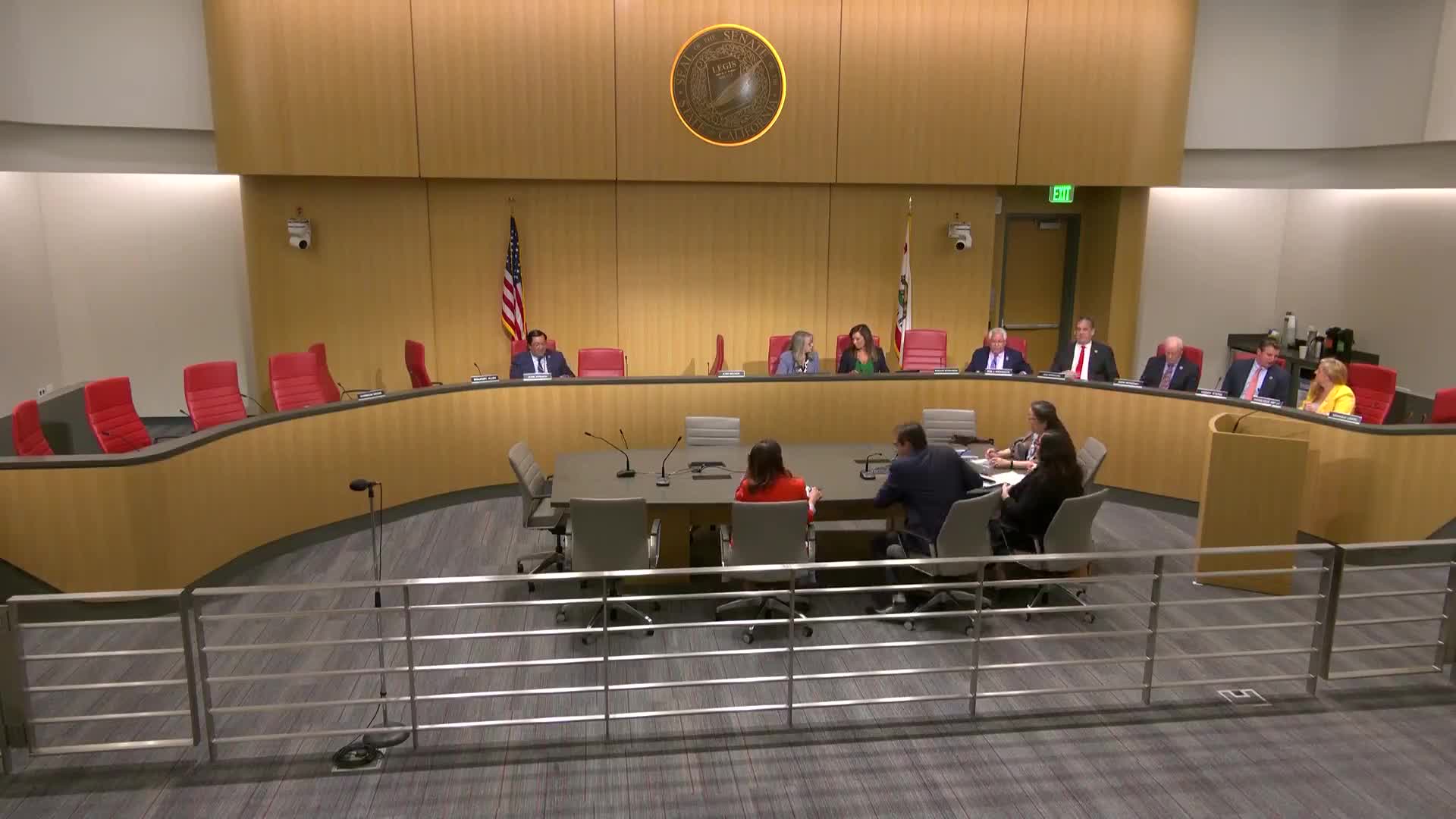
The Senate Committee on Energy, Utilities and Communications held an informational hearing on SB 254, authored by Sen. Becker with Assemblymember Petrie Norris and Sen. Wahab as joint authors. The hearing presented a multi‑part proposal that the authors said is intended to lower electricity bills, stabilize utilities after recent catastrophic wildfires and accelerate clean energy and transmission projects.
Sen. Becker described SB 254 as a combination of several components: reforms to wildfire mitigation spending and oversight; a requirement that utilities finance $6 billion of future wildfire mitigation capital spending through securitized debt to reduce carrying costs; measures to use public financing or ownership to reduce transmission costs; heightened scrutiny of utility profits; permitting reforms to speed clean energy projects; and a proposed successor wildfire fund capitalized with contributions from both ratepayers and utility shareholders.
“...this is a very long bill. So I'm gonna give a a somewhat brief overview of each of the 7 major topics,” Sen. Becker said, later summarizing components that include securitization of $6,000,000,000 in mitigation spending and estimated annual savings of between $300,000,000 and $400,000,000 from that financing approach.
Anne Patterson, senior counselor to the Governor, testified in support and provided background on California’s 2019 wildfire fund, explaining the purpose of the fund to protect ratepayers and wildfire victims and describing the administration’s view that an interim solution is needed while a broader report and evaluation proceed.
Key provisions described in the hearing record include: - A requirement for utilities to finance $6,000,000,000 in future wildfire mitigation capital investments using securitized debt; authors said this approach is estimated to save ratepayers $300 million to $400 million per year. - Measures to reduce the cost of building major transmission projects by leveraging public financing or public ownership; authors claimed savings of up to 50% on some projects and an estimated potential of up to $3,000,000,000 per year in savings if widely deployed. - Creation of a successor wildfire account (a “continuation account”) capitalized with up to $9,000,000,000 in bonds secured by an extension of an existing non‑bypassable charge on electric bills; authors stated the extension would not increase current rates in the near term but would extend an existing assessment. - A plan for shareholder contributions that would match ratepayer contributions and other mechanisms to discourage third‑party purchasing of insurance claims; the hearing also called for a report back to the Legislature with additional long‑term recommendations.
The hearing was informational; the authors said the measure had been amended recently and the text remained under negotiation. Several parties testified in support, including the governor’s office, labor and environmental organizations, municipal utilities and IOUs. Opponents and parties with concerns included the Utility Reform Network (TURN), the Utility Wildfire Survivor Coalition and business groups. Opponents said the measure, as drafted, lacked sufficient safeguards for prior wildfire victims, could give too much control to utilities and investors, and could impose large future costs on ratepayers.
Will Abrams of the Utility Wildfire Survivor Coalition testified in strong opposition, saying victims from prior fires remain unpaid and that SB 254 risks prioritizing new payments over completing prior victim compensation.
Several witnesses described the package as a first step that would require additional legislation or follow‑up, and authors acknowledged the need for further work in future sessions. Because the committee held the session as an informational hearing, no committee vote was taken on SB 254 at this meeting; the authors said the bill would be heard in committee at a later date.