Get Full Government Meeting Transcripts, Videos, & Alerts Forever!
Get email alerts on the Biogeneration Facility topic
No spam. Unsubscribe anytime.
Sacramento sewer district: Biogeneration facility meets IRA construction milestone; tax-credit payout range estimated
Summary
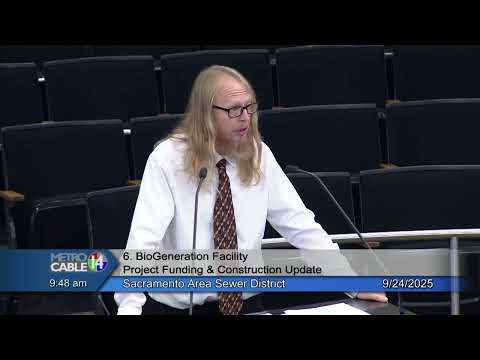
The Sacramento Area Sewer District on Sept. 24 received an update on the Biogeneration Facility project, which staff said has begun construction and met the milestone required to qualify for direct-payment tax credits created by the Inflation Reduction Act of 2022.
The Sacramento Area Sewer District on Sept. 24 received an update on the Biogeneration Facility project, which staff said has begun construction and met the milestone required to qualify for direct-payment tax credits created by the Inflation Reduction Act of 2022.
The project — referred to in staff materials as "Biogen" — is a renewable-energy combined-heat-and-power system that staff told the board will include about 13.4 megawatts of installed capacity delivered by four 2.6-megawatt internal-combustion engines and one 2.8-megawatt fuel cell, with future hydrogen-production capability. Construction is being delivered under a design‑build contract with Ameresco, and most major systems and many components are on site or in local storage, staff said.
Steve Nabozick, the district project lead who presented the update, told the board the district’s tax adviser has provided a favorable position on project eligibility under Internal Revenue Code section 48 and the Inflation Reduction Act (IRA). "We've met the beginning of construction milestone," Nabozick said, adding that meeting prevailing‑wage and apprenticeship requirements and documenting domestic content will be critical to maximizing the credit payout.
Why it matters: staff estimated total capital expenditures at about $150,000,000 and said the eligible cost base for the IRA credit typically falls in the 70–85% range for similar combined-heat-and-power projects. Using that eligible-cost range, and depending on whether prevailing‑wage and domestic‑content tests are met, staff presented an expected tax-credit range of roughly $28,000,000 to $51,000,000. The district is treating prevailing‑wage and domestic‑content compliance as high priorities because the IRA multiplies the credit base when those requirements are met.
Funding details and other incentives: Nabozick also described state Self‑Generation Incentive Program (SGIP) funding that applies to the fuel cell portion of the project. The district’s estimate for SGIP payout to the project was about $4,300,000, broken down in staff slides as $2 per watt for the first megawatt, $1.50 per watt for the second megawatt, and $1 per watt for the remaining 0.8 megawatts of the 2.8‑MW fuel cell. SGIP payments would be split: roughly half at commissioning and the remainder over a five‑year performance period; staff said a third‑party data collector will be required and estimated its cost at about $50,000 over the performance term.
Contract terms and risk allocation: Nabozick said Ameresco’s design‑build contract includes provisions tying contract incentives and penalties to IRA outcomes and compliance obligations. In staff materials he noted Ameresco pays the district $2,000,000 in liquidated damages unless the 40% credit outcome is achieved, in which case the district would pay Ameresco a $2,000,000 IRA bonus. "If they hit their targets, they're going to get $2,000,000; if they don't, they'll be billed $2,000,000," a director summarized during questions; Nabozick confirmed that structure.
Construction update and subsurface conditions: staff reported the pile foundations are complete, fuel‑cell equipment has been received on site, and substantial preparatory work for the fuel‑cell pad has been finished. The project encountered unexpected liquefiable soils during subsurface exploration, which required deep foundations and led to an increased change‑order allowance the board approved earlier in the meeting as part of the consent calendar. Nabozick described completed hot‑water system modifications and piping work required to change how heat flows between the Sacramento Municipal Utility District (SMUD) source and the digesters once Biogen is commissioned.
Domestic content and prevailing wage: Nabozick described domestic‑content rules (staff: structural steel must be 100% domestic; manufactured products show 40% domestic content) and said Ameresco made many early equipment purchases. Staff and the district’s tax adviser (Ernst & Young) are compiling documentation to support domestic‑content claims and to demonstrate compliance with prevailing‑wage and apprenticeship obligations.
Board questions and next steps: directors asked for clarification on the IRA matrix, the range in outcomes tied to domestic content and prevailing wage, whether the contractual structure with Ameresco is standard, and how federal rule changes might affect the district. Nabozick said the district has "met the beginning of construction milestone" and that, based on current tax‑adviser guidance, the district has not been told of changes that would put the project at risk. He said staff will continue to monitor federal rulemaking and that the district has engaged a tax adviser to minimize risk through documentation and contract terms.
No board action requested: staff described this item as an update and asked the board to receive and file the information. Earlier, the board approved consent calendar items 1–3, which staff said included an increase to a change‑order allowance related to the project; that consent motion passed unanimously by the members present.
The district will continue documenting domestic content and prevailing‑wage compliance, complete remaining foundations and pads in the balance‑of‑plant area, and proceed with equipment installation and commissioning activities in the coming months.