Get Full Government Meeting Transcripts, Videos, & Alerts Forever!
Get email alerts on the Housing Trust Fund topic
No spam. Unsubscribe anytime.
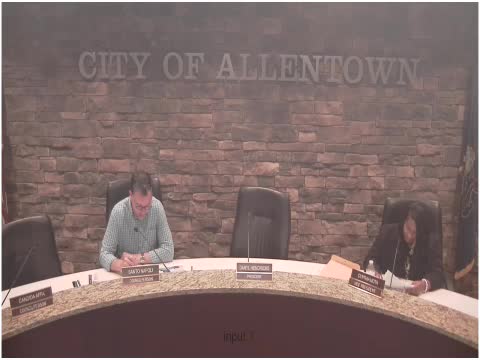
Allentown committee discusses housing trust fund, deed transfer tax and workforce housing goals
Summary
At an Allentown City Community and Economic Development Committee meeting, city housing staff and committee members discussed workforce housing goals, the potential use of deed transfer tax revenue to seed a housing trust fund, first‑time homebuyer efforts and zoning changes to encourage mixed‑use development.
At an Allentown City Community and Economic Development Committee meeting, city housing staff and committee members discussed workforce housing goals, the potential use of deed transfer tax revenue to seed a housing trust fund, first‑time homebuyer efforts and other tools to preserve and expand affordable and workforce housing in the city.
Vicky Kistler, community and economic development staff, summarized elements of the city's housing study (Welcome Home Allentown) and an implementation plan that includes a five‑year target of about 550 affordable units with an estimated five‑year development cost of $6,500,000. Kistler said the city's annual HOME and CDBG federal allocations account for roughly $3,600,000 and that the remaining gap to meet the 5‑year goal is roughly $3,000,000, noting that the gap assumes maximizing federal entitlement dollars for housing.
Committee members discussed using deed transfer tax revenue as a recurring local source. One committee member said a 0.5 percentage‑point increase in the deed transfer tax had previously been proposed and estimated at the time to generate about $2,300,000 a year. Staff noted that any decision on earmarking deed transfer tax revenue would require coordination among the mayor, the finance director and city council.
On workforce unit production, staff and members said the city currently relies on developers to propose projects and lacks a standing dedicated revenue stream to proactively recruit or finance projects. Kistler described obstacles developers report, including the complexity and long timelines for federal Low‑Income Housing Tax Credit financing; she cited an example of a project that took seven years to assemble financing and ultimately did not proceed because the capital stack could not be made to work.
Staff outlined a separate proposal to expand first‑time homeownership via the redevelopment authority. Kistler said the department applied for a $1,500,000 grant to acquire and rehab 10 properties for sale under deed restrictions to low‑ and moderate‑income buyers. She described the financing gap that emerges when the city pays fair market value and rehabs a property but the affordable sale price is lower than the city's invested cost, creating a need for subsidy to close the difference.
Kistler and other staff discussed capacity constraints among local nonprofit developers and community housing organizations (CHDOs). She said fewer nonprofits currently meet HUD CHDO capacity requirements and some nonprofit partners, including Habitat, are at capacity, which affects the city's ability to outsource acquisition and rehab work.
The committee also discussed zoning and other incentives. Staff reported the planning commission advanced zoning and subdivision and land development ordinance replacements and that those items were expected to be considered by council in late September. The new zoning code includes incentives to encourage mixed use and affordable units, such as allowing two additional stories on certain mixed‑use corridors if at least 20% of a project is affordable. Staff said the city is also exploring tax‑abatement structures that reduce taxes on improvements (not base property value) as a potential inducement for difficult projects.
Staff noted ongoing pilot and one‑time programs funded with community reinvestment and other grant dollars, including home repair and eviction‑prevention efforts, and told the committee that those funds are limited and will be exhausted. Kistler said programs are showing progress but emphasized long timelines and operational complexity; she said the department has applied for grants and may need modest staffing adjustments if the city pursues more in‑house acquisition and rehab.
No formal vote or ordinance was adopted at the meeting. Committee members asked staff to continue developing options for a housing trust fund, to provide budgetary estimates for potential incentives tied to the deed transfer tax and to return with more details about the $1.5 million acquisition grant, zoning timing and staffing needs.