Get Full Government Meeting Transcripts, Videos, & Alerts Forever!
Get email alerts on the Economic Development topic
No spam. Unsubscribe anytime.
Tulsa County commissioners weigh Clydesdale tax-increment proposal amid road, financing concerns
Summary
County commissioners spent an extended portion of Monday's meeting discussing a proposed tax-increment district (TID) for the Clydesdale data-center project, focusing on how the county's share of incentives would fund road improvements, indexing of payments and the project's timing.
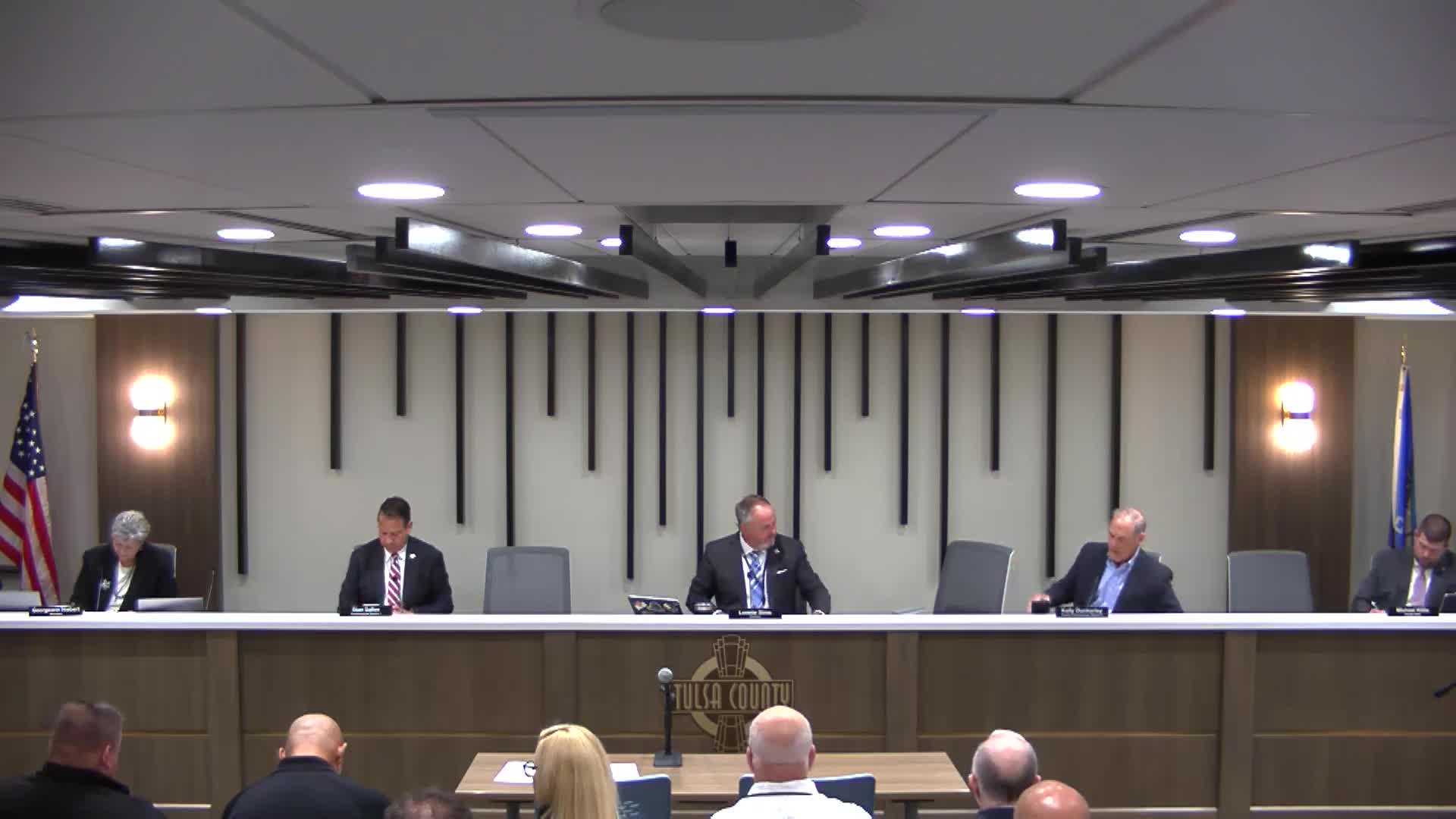
Commissioners of the Tulsa County Board of County Commissioners discussed a proposed tax-increment district for the Clydesdale project on Sept. 22, examining how the county's portion of the incentive package would be structured and whether it would accelerate a long-planned road project.
The discussion began after Commissioner Joseph Dunkerley placed the item on the agenda to allow commissioners and members of the public to exchange concerns and questions. "I placed this on the agenda," Dunkerley said, noting he had spoken with residents and wanted commissioners to "flesh this out a little bit more" before any final action.
Why it matters: Commissioners said the project could leverage private funds to build roadwork the county has deferred for years, but they also warned the county's portion of incentives may be a long-term commitment with uncertain cash flows. That tension—between advancing infrastructure now and protecting future county revenue—drove much of the debate.
Most of the technical discussion focused on a multi-segment road commonly referred to in the meeting as the "80 Sixth Street North" corridor, the east-mile segment between Memorial and Sheridan, and on timing tied to the Clydesdale project.
Alex Mills, county engineer, said the full road project had been split into two segments due to limited Vision Tulsa sales-tax revenue, and the east mile (Memorial to Sheridan) was the higher priority. "The West Mile was not gonna be done within the duration of the Vision Tulsa funding," Mills said, adding that funding certain segments with partner contributions could allow at least one portion of the project to be built within the Vision Tulsa funding window.
Developer and project representatives said the incentive package includes a $500,000-per-year county payment tied to the project's first phase. Lauren Harvey, identified as a developer representative, said the first phase was planned to be completed in 2027, with the first payment due in January 2028 and annual payments thereafter for 25 years. "We're looking at the first phase and this $500,000 a year payment is tied to that first phase ... to be completed in 2027," Harvey said.
Commissioners and staff also discussed when the second project phase might be affordable. Documentation provided by the developer showed the second phase could be affordable in fiscal year 2029-30, but staff said that timing depended on sequencing, availability of TID revenue and right-of-way acquisitions.
Several commissioners said they were still unsure whether the county's portion was a fair trade for taxpayers. "I understand that this is a non-negotiated package at this point, that it's kind of a take it or leave it," Commissioner Dunkerley said. He added that he was "not sure this helps us speedily address" county road needs and worried the county could be waiting eight or more years for work the community expected sooner.
Commissioner Salee, who served on the recommending committee, described committee negotiations and said the package was intended to be regionally competitive. He said the committee had discussed indexing and that some other recent regional packages had 0% indexing; he also noted the committee had proposed 1.5 percent in earlier talks. "We certainly did [discuss CPI indexing]," Salee said. "...this is spot on with all of the other taxing entities or projects."
David Tackett of the Office of Government Efficiency and Transparency provided additional analysis that the commissioners said they had reviewed ahead of the next public hearing. "I appreciate you doing this over the weekend to get us some additional information ahead of next week's meeting," Chairman Sims said to Tackett.
No final action: The commission did not vote on the TID during the Sept. 22 meeting. Commissioners said they had received extensive materials from the developer and county staff and indicated they would continue vetting the package at the scheduled public hearing the following week. Several commissioners said they wanted more time to study cash-flow projections, indexing options and the county's contractual terms.
What remains unclear: Commissioners and staff flagged unanswered or uncertain items, including (1) whether county payments could be bonded to accelerate construction, (2) how CPI or other indexing would affect long-term costs, (3) the practical timing for bidding and constructing the West Mile segment, and (4) whether all four planned facilities would be built. Several speakers noted that project phasing and revenue assumptions could reduce or accelerate the county's ability to bid the roadwork.
Next steps: Commissioners indicated they will continue discussions and review the developer's responses and county cash-flow analyses at the forthcoming public hearing. The commission did not make a formal motion on the TID at the Sept. 22 meeting.