Get Full Government Meeting Transcripts, Videos, & Alerts Forever!
Get email alerts on the Pace Assessments topic
No spam. Unsubscribe anytime.
California Supreme Court hears challenge over whether PACE suits are barred as tax refund claims
Summary
At oral argument the court addressed whether lawsuits against private PACE administrators that seek to strip advantages from bondholders are functionally tax-refund challenges that must first go through statutorily prescribed administrative remedies under California'law.
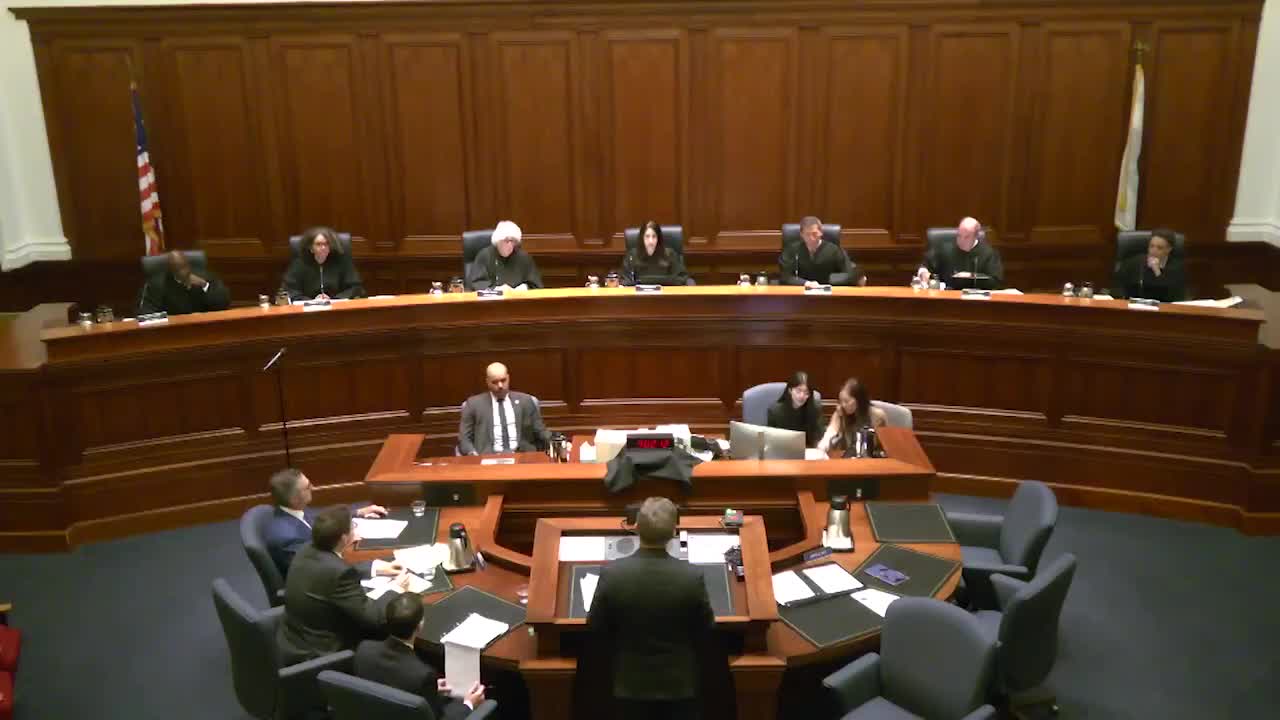
SAN FRANCISCO — At oral argument before the California Supreme Court in San Francisco in September 2025, lawyers for homeowners and for PACE program respondents debated whether claims under the Unfair Competition Law against private PACE administrators are effectively tax-refund actions that must be pursued first through the procedures in the Revenue and Taxation Code.
The case, Morgan v. Ygrene (No. 277628), centers on homeowner plaintiffs who allege that private PACE administrators and their financing affiliates obtained a security interest in home-improvement contracts in violation of state law and then used those contractual rights to obtain liens and bondholder payments handled through local property-tax collection. At argument, counsel for appellants told the justices, "are the plaintiffs here really just seeking a tax refund?" (James Swiderski, counsel for appellants). Respondents'counsel argued that PACE assessments are statutorily collected "at the same time and in the same manner as county taxes" and that challenges to such assessments must follow the tax-refund and exhaustion procedures in the Revenue and Taxation Code (respondent counsel, Abigail).
Why it matters: The court's decision will determine whether consumer-protection lawsuits that attack behavior by private administrators and lenders in PACE programs are barred unless plaintiffs first pursue administrative tax-refund remedies — a ruling that could sharply limit private claims and shape how PACE financing is structured across California.
At argument, appellants' counsel acknowledged limits on remedies that directly interfere with tax collection but urged the court to allow equitable remedies targeted at private defendants. Swiderski argued that a court can "deny a party the benefit of his violation of law" without canceling assessment liens on property, proposing remedies such as converting the secured claim into unsecured debt or ordering disgorgement limited to the private defendants. He said the lien itself would remain and bondholders would continue to be paid while a court-crafted equitable remedy could strip the private parties of an unlawful benefit.
Respondents countered that the relief the complaint requests — including injunctions against collection, cancellation of assessments, and refunds — amounts in net effect to a tax challenge and is therefore barred unless plaintiffs first pay the assessment and request relief administratively under the procedures specified in the Revenue and Taxation Code. Respondent counsel pointed to statutory PACE enabling measures (SB 555 and AB 811 were cited at argument) and invoked Revenue & Taxation Code provisions and case law that treat assessments collected with property taxes as "taxes" for purposes of refund procedures.
Both sides and several justices also discussed related legal authorities raised at argument: Civil Code 1804.1(j) (described in the briefs as a statutory restriction on contractors taking certain security interests), precedent on the net-effect doctrine (cases like Modern Barber Colleges were cited), and municipal-assessment decisions such as the Oakland assessment case and Katz v. City of Seaside. Respondents emphasized the policy reasons behind statutory validation and exhaustion rules: judicial and market confidence in bonded special-assessment financing and the practical difficulty of unwinding validated bond structures.
Counsel for appellants stressed the equities for affected homeowners, particularly older borrowers with small incomes, and asked the court to preserve UCL-based equitable remedies that would not undo validated assessments but would prevent private investors and program administrators from keeping proceeds allegedly obtained in violation of consumer-protection laws. Appellants suggested one possible remedy: an injunction prohibiting immediate foreclosure or permitting conversion of the secured obligation into an unsecured debt owed to the private creditors.
No decision was announced. At the close of argument the court thanked counsel and submitted the matter. The court's forthcoming opinion will resolve whether the pay-first, litigate-later tax framework bars these UCL claims in federal or state court and will shape the availability of equitable relief against private PACE administrators.