Get Full Government Meeting Transcripts, Videos, & Alerts Forever!
Get email alerts on the Public Health Facility Rehab topic
No spam. Unsubscribe anytime.
Guam Legislature rejects sending Manila public health building bill to third reading; debate highlights $27.8M rehab estimate and nursing partnership
Summary
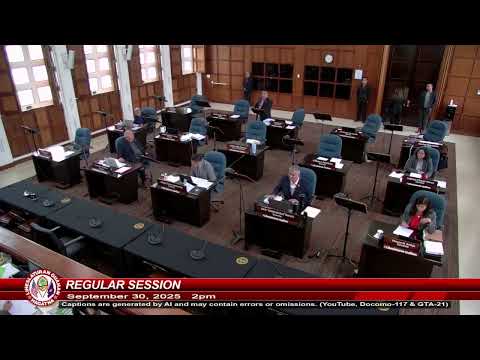
The Guam Legislature rejected a motion to place Bill 12-38 COR — which would reserve the former Manila public health building for DPHSS and authorize use by the Guam Community College nursing program — on the third-reading file, with the roll-call recording 4 yeas, 7 nays and 4 excused.
The Guam Legislature failed to place Bill 12-38 COR on the third-reading file after a roll-call vote that recorded 4 yeas, 7 nays and 4 excused. The measure sought to reserve Lot 2417-1-R7 (the former Manila public health building) for immediate use by the Department of Public Health and Social Services (DPHSS) and to authorize part of the site for the Guam Community College (GCC) nursing program.
Sponsor Senator Therese Turlahi (identified on the floor as the bill’s author) described five years of closure since an electrical fire in November 2019 and cited a Phase 1 assessment contract DPW executed for $1,000,000. That assessment, the sponsor said, concluded the building is in poor condition but “recommends implementation to restore the facility to proper function and operation and to allow for reuse and preservation of existing structures.” The assessment contractor is now preparing plans, specifications and cost estimates; the sponsor reported a current renovation estimate of approximately $27,800,000.
Supporters stressed the health-system impacts of the building’s vacancy, pointing to declines in public-health encounters since the closure and to services that were central to the Manila clinic: immunizations, TB and communicable disease testing, maternal-child health, WIC, SNAP and other programs. One floor statement summarized published encounter numbers included in the bill’s legislative intent: 8,331 encounters pre-pandemic versus 4,281 in 2023, and a sharp fall in child-health visits. Speakers said losing a centrally located clinic disproportionately harmed residents with limited transportation and contributed to preventable gaps in prenatal and pediatric care.
Senators cited the ongoing cost of scattered leases: one speaker noted the government was paying about $2,800,000 per year in rent for public-health office space after the Manila building closed. The bill would return the site to DPHSS ownership and explicitly permit a memorandum of agreement with GCC so nursing students could train alongside public-health services in the rehabilitated facility.
Witnesses and agency representatives—including Guam Community College’s president, who expressed willingness to partner—were referenced in committee testimony and on the floor. The Department of Public Works confirmed Phase 2 planning work was underway under the $1,000,000 contract and that the contractor expected to deliver detailed plans in roughly eight months.
Opponents on the floor objected to moving the bill to third reading at this time; the roll-call produced eight named senators voting nay in various parts of the count and four members marked excused. On the final tally, Bill 12-38 COR did not advance to the third-reading file.
Supporters urged reconsideration and suggested the measure or companion bills could return to the floor once further interagency planning is complete. They framed the bill as a cost-saving, long-term investment: one supporter noted that renovating the Manila facility could pay back the island’s annual rent expenditures within about 10 years and restore centralized public-health capacity vital for preventive care.