Get Full Government Meeting Transcripts, Videos, & Alerts Forever!
Get email alerts on the Water Infrastructure topic
No spam. Unsubscribe anytime.
Planning commission opposes Moab City utility overlay for Spanish Valley water tank after neighborhood objections
Summary
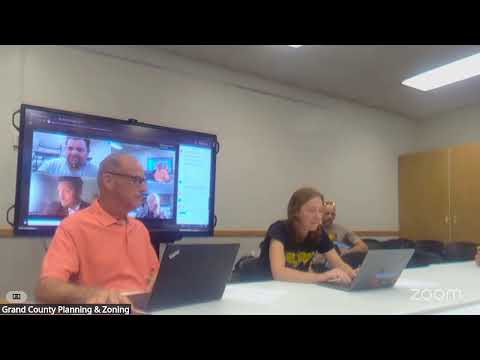
Grand County Planning Commission voted Thursday to forward an unfavorable recommendation to the County Commission on Moab City’s application of a Major Utility Overlay to permit a water storage tank on roughly 3 acres at 2651 South Spanish Valley Drive.
Grand County Planning Commission voted Thursday to send an unfavorable recommendation to the County Commission on Moab City’s request to apply a Major Utility Overlay to roughly 3 acres at 2651 South Spanish Valley Drive to permit construction of a water storage tank.
The commission’s decision came after more than two hours of staff presentations, applicant remarks and public testimony from neighbors and water providers. Staff recommended approval; the commission voted to forward an unfavorable recommendation by voice vote with six in favor of the unfavorable recommendation and one abstention.
The issue matters because the county commission will now consider the overlay despite staff support, and the parcel sits adjacent to residential lots and a 20-acre cemetery parcel that several speakers said is deed‑restricted for cemetery use.
Staff and applicant presentations Chrissy Hawthorne, planning and zoning staff, told the commission the Major Utility Overlay amendment would be applied to a 2–3 acre triangle of city‑owned property so Moab can site a water tank and later address site‑plan details at the site‑plan stage. “This is just to apply the overlay to allow the water tank,” Hawthorne said. She told the commission that public noticing had been completed and that staff received limited written comment but recommended approval.
Corey Schurthl, identified in the record as the community development director representing the applicant’s project team, described the team and said the site had been evaluated as far back as 2015. City engineers said the parcel was chosen in part because a water line runs through it, the city owns the parcel, and the site provides favorable pressure for storage and an emergency interconnect.
Public testimony, concerns and technical responses Neighbors and nearby property owners raised multiple objections at the public hearing. Robert Buckingham, who identified himself as the Grand County Cemetery Maintenance District Cemetery section manager, said the larger tract was originally conveyed by the federal government for cemetery use and that the 3‑acre triangle was cut off from the contiguous cemetery by a later road. Buckingham pressed the city to deed the contiguous cemetery land to the cemetery district to prevent future encroachments.
Several residents described limited notice and confusion about where to find the ordinance language online. Saxon Sharp, who said he holds a Ph.D. in geological sciences, also questioned whether the rezone/overlay was adequately posted online and urged the commission to delay County Commission action so neighbors would have more time to prepare. “Number 1, nobody knows what a major utility overlay is because they can’t read it anywhere,” Sharp said.
Floyd Dean, who lives adjacent to the project, raised geotechnical and public‑safety concerns about sand‑and‑gravel soils at the site, potential erosion, and possible pump noise. He said project documents did not clearly show a pump house and said lighting and access also had not been resolved.
Representatives of water providers and project engineers countered several concerns. Ben Musselman (Grand Water and Sewer) and Kevin Clyde (Grand Water and Sewer Service Area) said the location supports an emergency interconnect and that pumps discussed would be subsurface and used only in emergencies. Musselman said the interconnect would benefit multiple systems during outages. “This location is a good location for an interconnect,” Musselman said.
Motion and commission action After discussion and several attempts to amend or replace the initial motion, Commissioner Megan (last name not specified in the transcript) moved to recommend approval; the motion was seconded. That motion failed, and the commission then moved to send an unfavorable recommendation to the County Commission. The final vote on sending an unfavorable recommendation passed with six in favor and one abstention (recorded in the meeting as Bob O’Brien abstaining). The action is a nonbinding recommendation; the County Commission will open a public hearing on the overlay and may vote later on the ordinance.
Next steps and context The commission’s unfavorable recommendation will be transmitted to the County Commission, which the planning chair said intends to open its public hearing on the overlay at its next meeting and then vote at a subsequent meeting. Staff and the applicant said if the overlay is approved, detailed design, landscaping, noise mitigation, access and any development agreement would be handled at site‑plan and development‑agreement stages. The applicant told the board it had applied for grant funding to cover construction costs and that estimates were revised downward from $2.5 million to $1.5 million; the city said the $1.5 million figure is its current cost estimate and that some grant funding must be spent within the current state funding window.
Commissioners and staff also noted a separate legal consideration: the parcel’s original federal patent language requires Department of Interior approval to change cemetery use in some patents. Commissioners asked staff to confirm whether federal deed restrictions apply and, if so, what approvals would be required before construction.
The item drew more than a dozen in‑person speakers and extended technical back‑and‑forth between staff, city engineers and water providers. The commission’s unfavorable recommendation does not by itself halt the project; it sends the planning body’s view to the County Commission for final legislative action.