Get Full Government Meeting Transcripts, Videos, & Alerts Forever!
Get email alerts on the Housing topic
No spam. Unsubscribe anytime.
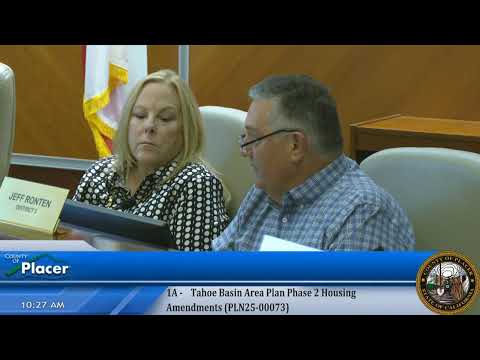
Placer County planning commission recommends board approve TRPA Phase 2 Tahoe Basin housing amendments
Summary
The Placer County Planning Commission voted unanimously to recommend that the Board of Supervisors adopt amendments to the Placer County Tahoe Basin Area Plan implementing regulations to conform with TRPA Phase 2 changes intended to accelerate deed‑restricted workforce housing in town centers and existing multifamily zones.
The Placer County Planning Commission voted unanimously to recommend that the Board of Supervisors adopt amendments to the Placer County Tahoe Basin Area Plan implementing regulations to conform with Phase 2 changes adopted earlier this year by the Tahoe Regional Planning Agency (TRPA).
The amendments would remove local density maximums in town centers and areas zoned for multifamily housing, allow limited additional height for 100 percent deed‑restricted projects in town centers (up to 65 feet if TRPA findings are met), provide more flexible parking standards and allow increased coverage in limited cases where a project can connect to an active, publicly maintained stormwater treatment system.
Why it matters: TRPA and county officials said the changes are aimed at making deed‑restricted workforce housing financially feasible in the Tahoe Basin, where analysts estimate construction costs can reach about $800,000 to $1,000,000 per unit. Commissioners and public speakers said the amendments prioritize redevelopment within town centers such as Kings Beach and Tahoe City and could help employers retain local staff; county and fire officials and residents raised questions about stormwater capacity and evacuation logistics.
Principal Planner Emily Setzer of Placer County told the commission the amendments were adopted by TRPA and now require county action because the Tahoe Basin Area Plan is a joint‑agency document. She said the changes target town centers and existing multifamily zones and would apply only to projects that are 100 percent deed‑restricted as affordable, moderate or "achievable" housing. "These amendments ... would not increase density overall within the Basin," Setzer said, summarizing the environmental addendum for the commission.
Key technical changes described in staff materials and discussion: - Density: The amendments remove the stated maximum density in town centers and multifamily zones so applicants are no longer capped by the former per‑acre limits; projects remain constrained by setbacks, coverage and height standards. - Height: In town centers the baseline maximum is 56 feet; 100 percent deed‑restricted projects can be eligible for up to 65 feet if TRPA findings are met. Additional height must be stepped back one foot for each foot above the existing maximum and projects must meet design and shading findings intended to limit visual and winter‑shade impacts. - Coverage and stormwater: Increased site coverage would be allowed only where runoff can be treated by an active, publicly maintained stormwater treatment system. Staff said currently few such systems are approved by TRPA, so that incentive may be usable only in limited locations. - Parking: The amendments allow flexible, demand‑based parking, and outside town centers set a maximum minimum of 0.75 spaces per unit based on a parking demand analysis; applicants may still choose to build more parking. - ADUs and mixed use: ADUs in town centers or multifamily zones could transfer in up to 1,200 square feet of coverage for the ADU. Mixed‑use projects may qualify if the residential portion is 100 percent deed‑restricted and commercial area does not exceed 50 percent of total floor area. - TRPA bonus units and caps: Setzer noted TRPA maintains a basin‑wide cap on residential units and roughly 900 residential bonus units remain; those bonus units carry restrictions on how they may be used at various affordability levels.
Public commenters representing local businesses, designers and community organizations supported the amendments as a tool to redevelop existing, previously developed parcels for workforce housing. Brad Altman, principal engineer with Evolve Design Works, said his Lake Forest project would redevelop previously covered parcels and provide nine deed‑restricted units for local employees. "These are not short term rentals," Altman said. "These are people that are living and working right here." Rob Olsen, a Tahoe City architect and member of the Tahoe Living Working Group, and Tony Krowolski, president and CEO of the North Tahoe Community Alliance, said local employers face staffing losses because workers cannot find housing nearby.
Commissioners pressed staff on several implementation points. They asked whether projects using these incentives could instead opt to pay an in‑lieu fee (staff answered no: projects using the TRPA amendment incentives must deliver 100 percent deed‑restricted units). Commissioners also sought detail on deed‑restriction monitoring; Setzer said Placer County performs annual deed‑restriction monitoring and TRPA has recently expanded monitoring staff. On stormwater capacity and coverage, staff said Placer County Public Works is working with TRPA but that few active systems currently exist and many projects would not be able to rely on the coverage incentive now.
Wildfire and evacuation concerns were a central theme of the public safety discussion. Lieutenant Ty Connors of the Placer County Sheriff’s Office and Battalion Chief Chris Mertens of Placer County Fire described county evacuation planning and exercises, including contraflow modeling used in drills. Connors said the county and its partners have run tabletop exercises and that contraflow and unified‑command procedures can reduce evacuation times, but both officials emphasized that every incident differs by weather, topography and fire behavior.
The commission made three motions recommending that the Board of Supervisors: (1) adopt a resolution adopting the addendum to the previously certified Tahoe Basin Area Plan EIR (state clearinghouse number 2014072039); (2) adopt a resolution approving the implementing regulation amendments; and (3) adopt an ordinance approving those amendments. Each motion passed on unanimous roll call. The recorded roll calls listed Commissioners Johnson, Watts, Beckler, Runtin, Jewell, Alves and Chair Dahlgren voting yes on the recommendations.
What happens next: The Planning Commission’s recommendation will be forwarded to the Board of Supervisors, which is the decision‑making body for the Tahoe Basin Area Plan amendments. If the board declines to adopt the TRPA approach, county staff said the county would need to develop an alternative set of amendments and demonstrate to TRPA that they are at least as effective in improving the financial feasibility of workforce housing.
For now the action is a recommendation; individual projects that would use the new standards still must complete their own project‑level approvals, including any TRPA findings, design review, environmental analysis and required emergency preparedness or evacuation plans.
Sources: Placer County staff presentation by Emily Setzer; public testimony from Brad Altman (Evolve Design Works), Rob Olsen (architect), Tony Krowolski (North Tahoe Community Alliance); remarks from Lieutenant Ty Connors (Placer County Sheriff) and Battalion Chief Chris Mertens (Placer County Fire).