Get Full Government Meeting Transcripts, Videos, & Alerts Forever!
Get email alerts on the Economic Development topic
No spam. Unsubscribe anytime.
Regional development agency outlines loans, housing and weatherization programs; board sets recruitment timeline and agrees to draft economic priorities
Summary
At its Sept. 24 meeting, the Grand County Economic Opportunity Advisory Board heard a presentation from the Southeastern Regional Development Agency (SIRDA) about its revolving loan fund, CDBG and weatherization programs, discussed housing gap financing, and voted to set application and interview dates for board recruitment and to develop a set of
The Grand County Economic Opportunity Advisory Board on Sept. 24 received a presentation from the Southeastern Regional Development Agency (SIRDA) on regional economic programs, discussed using local revolving loan funds and state Community Development Block Grant resources for housing needs, and voted to set candidate deadlines and to develop principles and priorities for county economic development.
SIRDA executive director Jerry Gamber described the agency as a regional planning and development organization that partners with the U.S. Economic Development Administration and local governments. "We consider you all our bosses, and you let us know how we can best help," Gamber told the board, outlining SIRDA's role providing planning, grant-writing support and other technical assistance to small towns and counties.
Corinne Olsen, SIRDA community development program manager and manager of SIRDA's revolving loan fund (RLF) for the region, said the RLF provides gap financing for businesses and that the program includes a local loan cap. "There is a cap of a $150,000 up for the revolving loan fund, that you can apply for," Olsen said. She said the Grand County–specific pot of RLF money and a wider regional pool both exist; the county's dedicated pot can be drawn on for local applicants. Olsen described the RLF as a flexible lender intended not to compete with banks but to provide financing when private lenders will not, and said the RLF can finance startups, expansions and retention projects.
Olsen and other SIRDA staff also reviewed Community Development Block Grant (CDBG) activity: SIRDA runs or helps communities apply for CDBG funds for infrastructure and single‑family housing rehabilitation projects. SIRDA staff said CDBG funds come from the U.S. Department of Housing and Urban Development (HUD) and are used for projects such as flood repairs, elevator installation and infrastructure for affordable housing developments.
SIRDA staff described the single‑family rehabilitation program and related assistance available to low‑ and moderate‑income homeowners. "It's 80% AMI," said a SIRDA program manager describing income eligibility for CDBG housing rehabilitation, referring to HUD income guidelines. Staff said project funding levels and eligibility can change yearly, and that SIRDA supplements CDBG with other local loan products (including a low‑interest loan fund) when projects need additional financing.
SIRDA also described its weatherization and energy‑efficiency programs, funded through the U.S. Department of Energy and state programs. Staff said weatherization services extend across the SIRDA service region and include home energy audits, insulation and equipment repairs or replacements, and safety checks for fuel-burning appliances. Staff noted partnerships with utilities, including Rocky Mountain Power and Enbridge Gas, to support audits and targeted measures.
Board members raised housing as a recurring local priority. Aaron Weinberg, a board member and housing task force participant, said down‑payment assistance is repeatedly identified as a primary barrier to housing access. SIRDA and Grand County staff said they would research whether existing funding streams, including CDBG and the RLF, could be used to support down‑payment or other housing gap financing. "We'll research that," a SIRDA/GOEO staffer said while noting state policy and HUD rules can set limits.
On board business the advisory board postponed approval of its Aug. 27 minutes because the minutes were not available on the public meeting website. The board then took two formal steps:
- It set a recruitment and meeting timeline for county advisory boards: the board approved advertising openings in early October (with outreach and paid advertising to follow), set an application deadline of Nov. 12, scheduled candidate interviews at the Nov. 19 meeting and set a decision/recommendation meeting for Dec. 17 so appointments can be forwarded to the county commission for consideration.
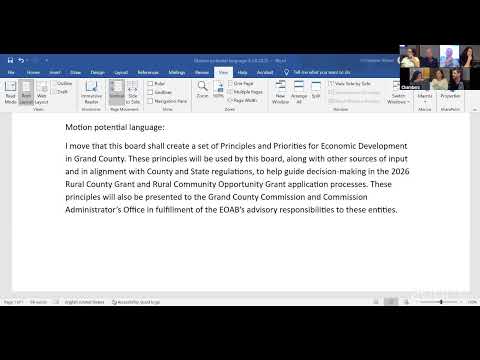
- The board unanimously approved a motion to "explore and create principles and priorities for economic development in Grand County" and to present those findings to the Grand County Commission, the county administrator's office and the county economic development office to support the board's advisory responsibilities. Board members characterized the work as a living document intended to gather input and guide future grant and project recommendations rather than to lock the county into a single strategy.
Board members and SIRDA staff encouraged local partners — chambers of commerce, nonprofits and city staff — to help identify local projects and candidates for assistance. SIRDA staff said applications for RLF and other programs require full business plans, financial projections and collateral descriptions; they said applicants should consult SIRDA early to confirm program fit.
No formal county votes on grant awards or contracts occurred at the meeting. Several SIRDA and county staff members offered to follow up with the housing task force and county staff to research whether down‑payment assistance could be structured using existing funds and programs.
The meeting closed with appreciation to SIRDA staff for the presentation and a reminder that SIRDA and county staff are available for technical assistance to local projects.
Ending — The advisory board's next steps are administrative (advertising openings, accepting applications through Nov. 12, interviewing Nov. 19 and making recommendations on Dec. 17) and substantive (drafting and sharing economic development principles for Grand County). SIRDA staff will follow up with county staff and local committees on housing financing options and RLF eligibility and capacity.