Get Full Government Meeting Transcripts, Videos, & Alerts Forever!
Get email alerts on the Urban Forestry Master Plan topic
No spam. Unsubscribe anytime.
Norman staff present 20-year Urban Forestry Master Plan; recommend new crew and $1M staffing increase
Summary
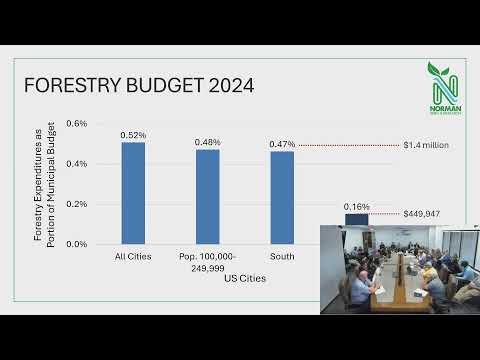
City staff and consultants presented an Urban Forestry Master Plan Sept. 9 that recommends creating a dedicated forestry crew, buying a grapple truck and expanding staffing and budget (from about $450,000 to roughly $1.4 million) to increase proactive tree maintenance, monitor canopy and manage invasive pests.
James Briggs, Park Development Manager for the City of Norman, introduced a presentation to the Norman City Council on Sept. 9, 2025, on the city’s draft Urban Forestry Master Plan produced in partnership with Davey Resource Group. "Hello. Thank you. I'm James Briggs. I'm the, park development manager. I am actually in charge of our city our our entire city forestry crew," Briggs said as he opened the item.
Davey Resource Group consultant Dana Karcher described the plan as a 15- to 20-year guide developed from a 2024–25 review, stakeholder interviews, two community meetings, focus groups and city department coordination. "We look at what the city has, what they want. That's partly through community engagement. How do we get there? What are the steps that are needed to grow the urban forest, grow the canopy?" Karcher said.
The plan draws on the city’s recent Community Wildfire Protection Plan and national comparisons, and includes an inventory of park trees and recommendations on staffing, operations, species selection, canopy measurement and partnerships. Karcher reported a parks inventory of 5,775 trees and said 687 trees were planted and 900 trees were given away during the reporting period; 85 trees were removed. She also cited community survey results indicating 84% of respondents felt there are too few trees in the park system.
Key recommendations presented include establishing a dedicated forestry crew within Parks and Recreation, acquiring a grapple truck to handle large woody debris to reduce contractor costs, producing a forestry standard operating procedures manual and issuing annual reports on forestry activities. The plan suggests a staffing and equipment package that would raise the forestry budget from roughly $450,000 to about $1.4 million to reach staffing levels more comparable to similar Southern cities; the increase presented to council was described as primarily for staffing.
Karcher and staff emphasized proactive maintenance cycles (commonly five to 10 years), care for newly planted trees (especially the first three to five years), prioritizing public trees, and monitoring citywide canopy using a more detailed canopy study. The presentation noted that the city’s canopy is about 30% in developed areas per the wildfire plan, and that park species composition includes a high share of eastern red cedar, lacebark elm, bald cypress, American elm and loblolly pine. Karcher warned that cities should avoid overreliance on a single species and noted, "There's a rule, and it says you should have no more than 10% of one species. So you're very close to approaching that with Eastern redcedar."
The plan calls for monitoring and managing invasive pests; Karcher noted emerald ash borer is present in Oklahoma and advancing regionally. It also recommends partnering with nonprofits and volunteers for invasive-species removal and restoration, piloting a neighborhood tree-liaison volunteer program, and creating a program to designate and support historically significant trees or historic-tree districts (the draft ordinance language would allow neighborhoods to apply for designation).
Council members questioned funding and implementation. Councilor Pico asked about eastern red cedar management, and Karcher indicated the plan addresses invasive-species monitoring and species recommendations. A council member asked whether the proposed roughly $1 million increase (to about $1.4 million total) was for staffing; staff confirmed the increase shown was intended for staff additions, and that equipment such as a grapple truck would be an additional cost. A staff member told the council they would take council direction into the upcoming budget process and return with a proposal.
Council discussion included potential funding approaches: identifying cost savings (for example, reduced contracting for storm debris removal if in-house capacity grows) and the possibility of directing a portion of visitor-tax revenue toward Parks and Recreation. Councilor Peacock asked staff to return with concepts for a “tree retrofit” program to add canopy in large parking lots.
No formal council motion or vote was recorded during the presentation. The item had been reviewed by the Parks Board the prior week, which provided minor comments, and staff flagged that the plan will come back for ordinance and budget actions as appropriate.
For context, presenters said federal funding for urban and community forestry has been reduced at the national level in recent federal budgets and that many cities rely on general fund sources or localized taxes to sustain urban-forest programs.
The council session concluded with staff agreeing to carry budget-direction and implementation questions into the next budget-development cycle and to return to council with specifics.