Get Full Government Meeting Transcripts, Videos, & Alerts Forever!
Get email alerts on the Traffic Enforcement topic
No spam. Unsubscribe anytime.
Supervisors, SFPD and SFMTA review traffic enforcement as speed-camera citations rise
Summary
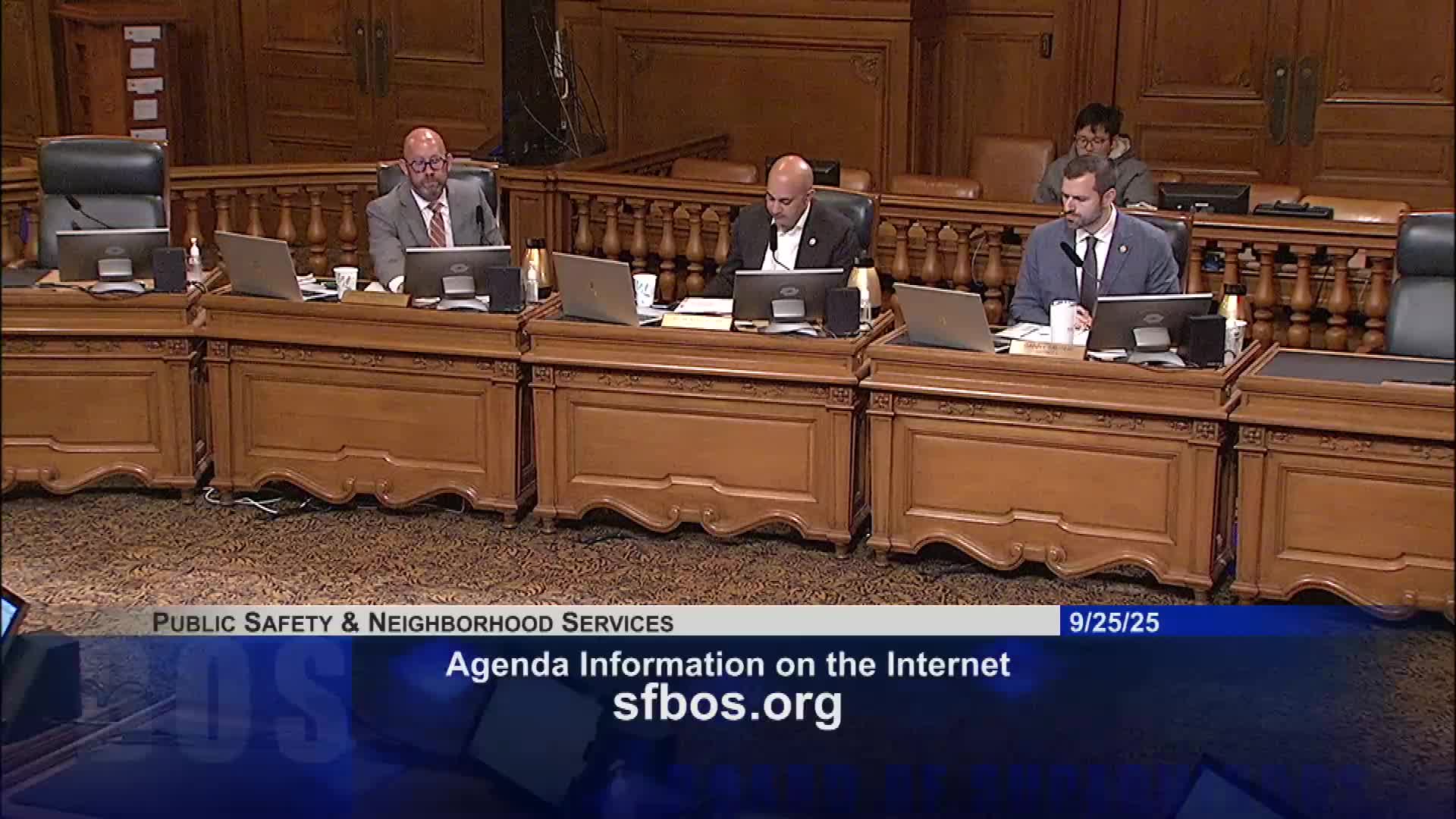
San Francisco supervisors heard updated data and competing proposals for reducing roadway deaths and injuries at a Sept. 25 Public Safety and Neighborhood Services Committee hearing on the state of traffic enforcement and street safety.
San Francisco supervisors heard updated data and competing proposals for reducing roadway deaths and injuries at a Sept. 25 Public Safety and Neighborhood Services Committee hearing on the state of traffic enforcement and street safety.
President Mandelmann, a long-time sponsor of hearings on enforcement, opened the discussion by tracing the steep decline in traffic citations since 2014 and describing residents’ concerns about drivers “behaving really, really badly.” He said, “It means officers once again on our streets enforcing the basic rules of the road, including speeding,” and urged a combination of enforcement and technology to restore visible accountability.
Commander Luke Martin of the San Francisco Police Department’s Special Operations Bureau detailed SFPD data and operations. Martin said departmentwide citation totals fell sharply after 2014, dropped further around the COVID-19 period and have begun rising again in 2023–2025. He told the committee that traffic company staffing is “down to 18” officers and said a fully staffed traffic company in a fully staffed department would be “around 80.” Martin described enforcement tactics including LIDAR speed operations, “wave” operations that repeat targeted deployments at high‑injury locations, and pedestrian-sting operations that yielded more than 1,500 citations and roughly 272 warnings in a recent series.
Shannon Hake, who oversees SFMTA’s street‑safety work, described the state pilot that allowed San Francisco to deploy automated speed enforcement under AB 645. Hake said SFMTA installed 33 speed-camera sites (56 cameras where two were needed for both directions), mailed roughly 360,000 warning notices during the program’s warning period and began issuing citations on Aug. 5; since then, she said, the agency had issued more than 25,000 citations. Hake said weekly violations and the typical speed of violations have fallen week to week this summer and that SFMTA will publish tube-count and speed‑measurement analyses and an injury‑collision report early next year.
SFPD and MTA officials also discussed red-light cameras and costs. Commander Martin said 19 red‑light cameras remain active and that replacing or adding cameras is costly; he estimated the six additional red‑light camera installations discussed by the department would cost roughly $1.8 million. SFMTA’s Hake described the speed‑camera vendor contract as an all‑in monthly fee of about $3,500 per camera that covers equipment, human review, mailing and an online payment portal.
Supervisors pressed the department on staffing, overtime and distribution of enforcement across police districts. Martin said recent academy classes will add roughly 31 officers to the department and that traffic company should receive a steady flow of new officers over the next two years but stressed that gains will be incremental. He said some lower‑call‑volume stations such as Richmond historically generate many citations because officers have more time for proactive traffic work, while busier downtown stations issue fewer proactive citations because officers are tied to calls for service.
Advocates at the hearing stressed infrastructure and behavior‑change approaches. Luke Bornheimer, executive director of Streets Forward, told the committee, “More funding or staffing for SFPD will not solve this crisis, nor will more armed traffic enforcement,” and urged expanded protected bike lanes, transit priority and other Vision Zero infrastructure. Walk San Francisco and other commenters likewise urged combining enforcement with street redesign to reduce speeds and collisions.
Committee members asked the department for additional data and analysis, including: breakdowns of overtime used specifically for traffic enforcement, pre/post comparisons of citations and speeds at camera locations, and whether camera locations should be shifted after the first 18 months of operation. SFMTA said the state pilot allows site changes after 18 months but that the agency is continuing to gather data and has not yet proposed moves.
Votes at a glance: The committee voted twice on procedural items connected to the meeting. The board excused Chair Dorsey from the Sept. 25 meeting (3–0) and continued the agenda item on traffic enforcement to the call of the chair (3–0), with Chair Dorsey excused both times. No new ordinance, resolution or departmental rule was adopted at the hearing.
The committee agreed to continue reviewing enforcement, staffing and camera data; SFPD and SFMTA officials said they will provide additional breakdowns and follow‑up reports. President Mandelmann said he expects the committee to reconvene on the topic within about six months to review updated numbers and implementation progress.
Ending: The committee did not adopt new legislation. The hearing produced a record of recent enforcement trends, early results from the state speed‑camera pilot and a list of follow‑up requests from supervisors — including overtime tracking, camera impact analyses and staffing projections — that the committee asked staff and agencies to return with at a future continued hearing.